North of the Gran Vía, the old city climbs into two neighbourhoods of narrow streets and small squares. Malasaña is named after a young woman killed in the uprising of 2 May 1808, and it centres on the square where that uprising made its last stand. Conde Duque, to the west, grew up around a huge baroque barracks. Both were working districts for centuries and were at the heart of the cultural scene of the 1980s known as the Movida.
This walk starts at the baroque doorway of the city history museum, crosses to the Plaza del Dos de Mayo, then goes west to the quiet square of the Comendadoras, the barracks of Conde Duque and the palace of the Dukes of Alba. It ends at the Plaza de España and the Templo de Debod, an Egyptian temple on the ridge where the sun goes down over the Casa de Campo. The route is a little over two kilometres, gently up and down, and takes about two hours with stops.
Tribunal metro, on lines 1 and 10, is a minute from the start.
Museo de Historia de Madrid
Look up at the extravagant carved stone doorway framed by the red brick front.
This building was the Royal Hospice of San Fernando, a home for the poor, built in the 1720s. Its doorway, by Pedro de Ribera, is one of the most exuberant pieces of baroque in Madrid, a tower of carved stone with curtains, scrolls and a statue of Saint Ferdinand in a niche. Ribera was the city's architect in the early eighteenth century and you will meet his work again at the barracks of Conde Duque.
The building is now the city's history museum, with maps, paintings and models of Madrid through the centuries, including a large model of the city in the 1830s. Opening hours change. Notice how the doorway is far richer than the plain brick building behind it: in a street of shops, the portal was the advertisement.
Walk on · West along Calle de la Palma or Calle de San Andrés to the square, 5 minutes.
Plaza del Dos de Mayo
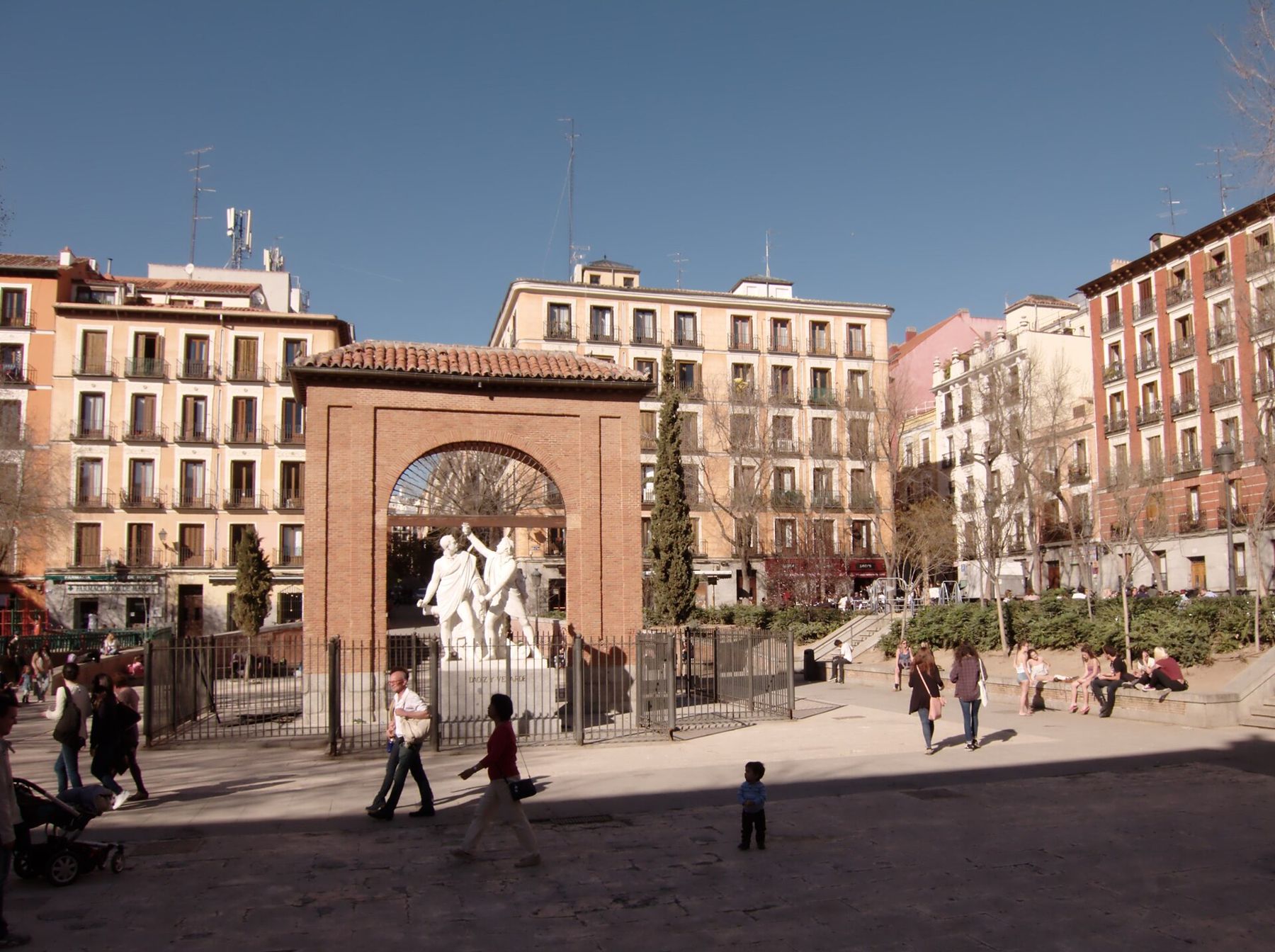
Look at the brick arch and the two officers carved in white stone beneath it.
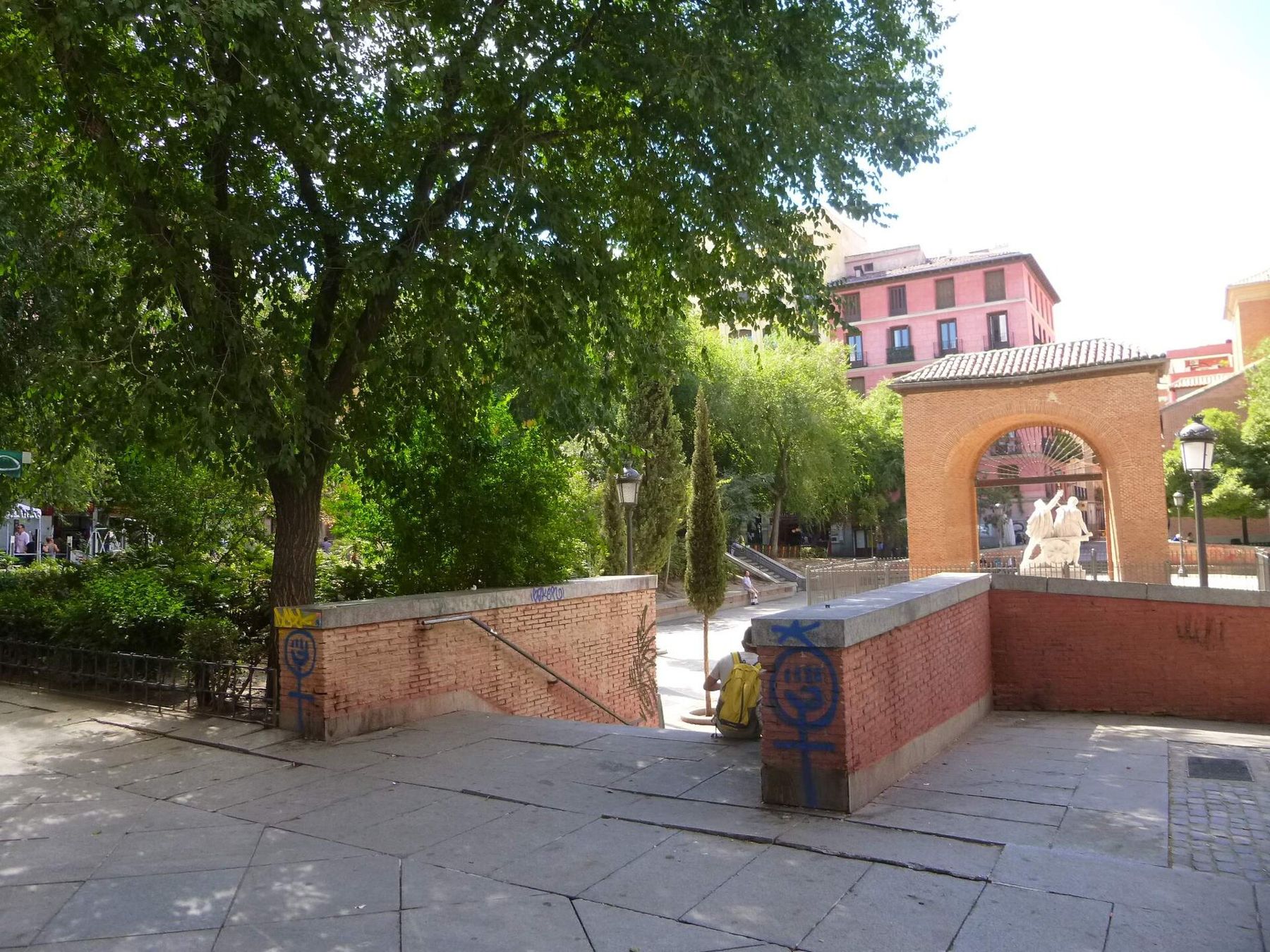
On 2 May 1808 the people of Madrid rose against the French troops occupying the city. The uprising was crushed within hours, and its last stand took place here, at the Monteleón artillery park. Two artillery officers, Luis Daoíz and Pedro Velarde, opened the gates, armed the crowd and held out until they were killed. The arch in the square is the old entrance of the Monteleón palace that housed the park; the statue of the two officers, by Antonio Solá, was made in the early nineteenth century and later moved here.
Manuela Malasaña, a young seamstress, was killed by French soldiers on the same day; accounts of how vary. The neighbourhood is named after her. The next day the French executed many prisoners, a reprisal Goya painted in The Third of May. Today the square has a children's playground, benches and trees.
Walk on · West along Calle de San Andrés and across Calle de San Bernardo, 8 minutes.
Plaza de las Comendadoras
Look at the convent church filling one side of the square.
This small, quiet square is named after the convent of the Comendadoras de Santiago, nuns of the military Order of Santiago, which occupies one side. The church was built in the late seventeenth century, and the nuns still live in the convent.
The square itself, with its trees and benches, is a good place to sit after the busier streets of Malasaña. It is one of the places where the Conde Duque neighbourhood shows its character: small, residential and calm. The order's emblem, a red cross ending in a sword blade, is easy to spot in paintings in the Prado: Velázquez wears it on his chest in Las Meninas.  Change here for the Lisbon lineGraça and the viewpoints
Walk on · South a few steps to the long baroque front on Calle del Conde Duque, 2 minutes.
Cuartel del Conde Duque
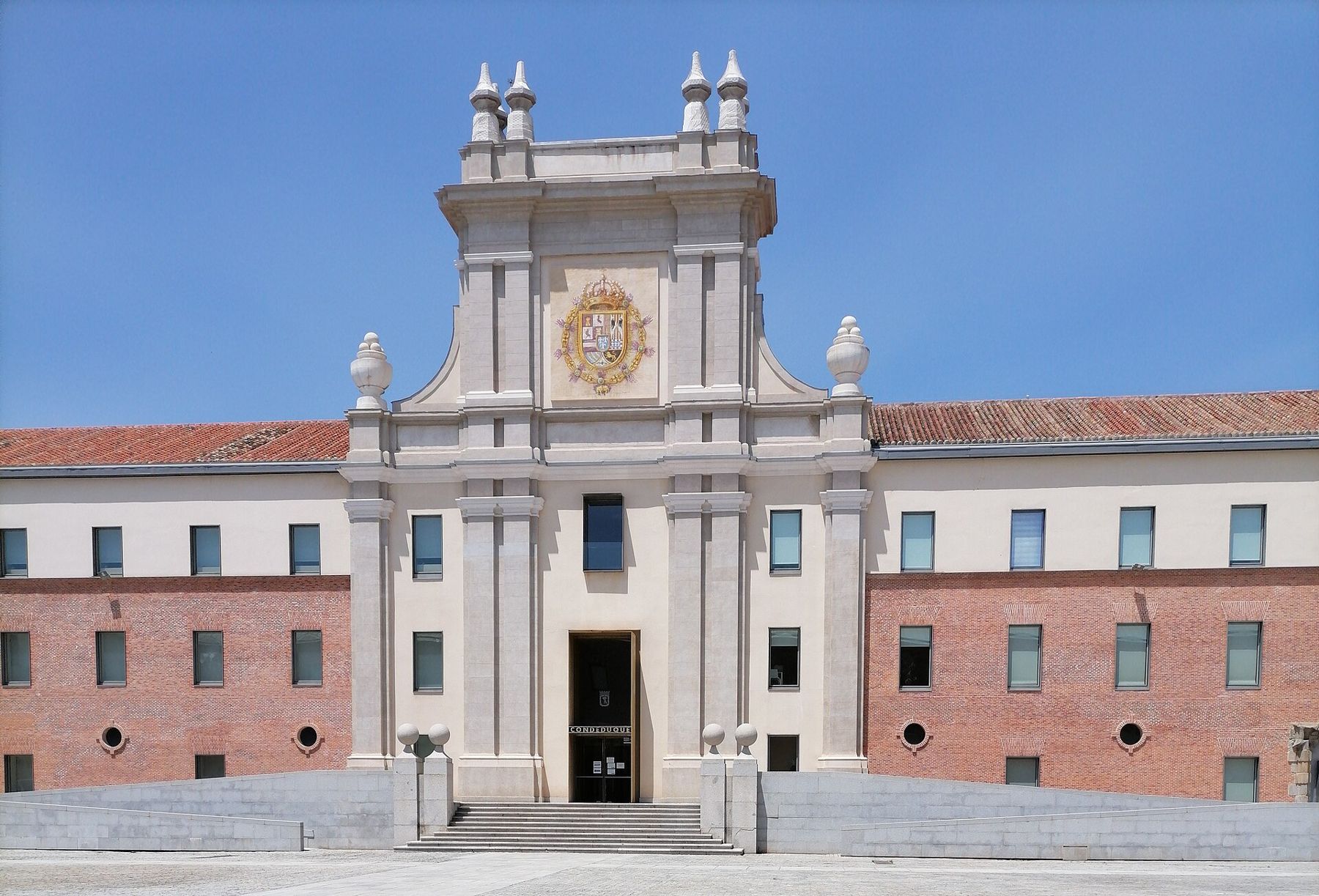
Look at the carved baroque portal set into the very long brick façade.
The barracks were built in the early eighteenth century for the royal bodyguard, to designs by Pedro de Ribera, and they are enormous: the front runs for more than two hundred metres. The name comes from the Count-Duke of Olivares, the minister of Philip IV, whose house stood nearby. A fire in the nineteenth century destroyed the upper floor, and the building declined until the city restored it in the 1980s as a cultural centre.
Today it houses libraries, the city archive, a contemporary art collection and spaces for concerts and exhibitions. Walk through the portal into one of the large courtyards, which are used for open-air events in summer. Compare the portal with the one at the history museum: both are Ribera's, and both put all the decoration at the entrance. Opening times for the courtyards and exhibitions change.
Walk on · South along Calle del Conde Duque, then right onto Calle de la Princesa, 5 minutes.
Palacio de Liria
Look through the railings at the neoclassical palace set back behind its garden.
The Palacio de Liria is the Madrid residence of the House of Alba, one of the oldest noble families in Spain. It was built in the second half of the eighteenth century, with Ventura Rodríguez involved in its design. In the Civil War it was hit by incendiary bombs in 1936 and gutted by fire, though most of the art collection was saved. It was rebuilt over the following decades.
The family still lives here. Inside is one of the most important private art collections in Spain, with works by Goya, Titian and Rubens, and part of the palace is open for guided visits, with times and prices that change. From the street you see the main front through the railings and the gardens around it. It is a reminder that this part of Madrid, now so ordinary, once had large aristocratic houses in big gardens.
Walk on · South along Calle de la Princesa to the large square with the monument, 6 minutes.
Plaza de España
Look at Don Quixote and Sancho Panza riding below the seated Cervantes.
The monument to Cervantes was built between the 1920s and the 1950s. The seated writer looks down from the stone tower; in front of him ride his characters, Don Quixote on his thin horse Rocinante and Sancho Panza on his donkey. The square was remodelled in the early 2020s, with more trees, paths and a direct pedestrian link towards the palace and the gardens.
Two tall towers stand at its northern edge, the Edificio España and the Torre de Madrid, both built in the 1950s and among the tallest buildings in Europe at the time. Walk to the south end of the square and the Royal Palace comes into view. The Madrid de los Austrias walk ends in the Sabatini gardens just beyond.
Walk on · West across Calle de Ferraz and up into the park to the temple, 5 minutes.
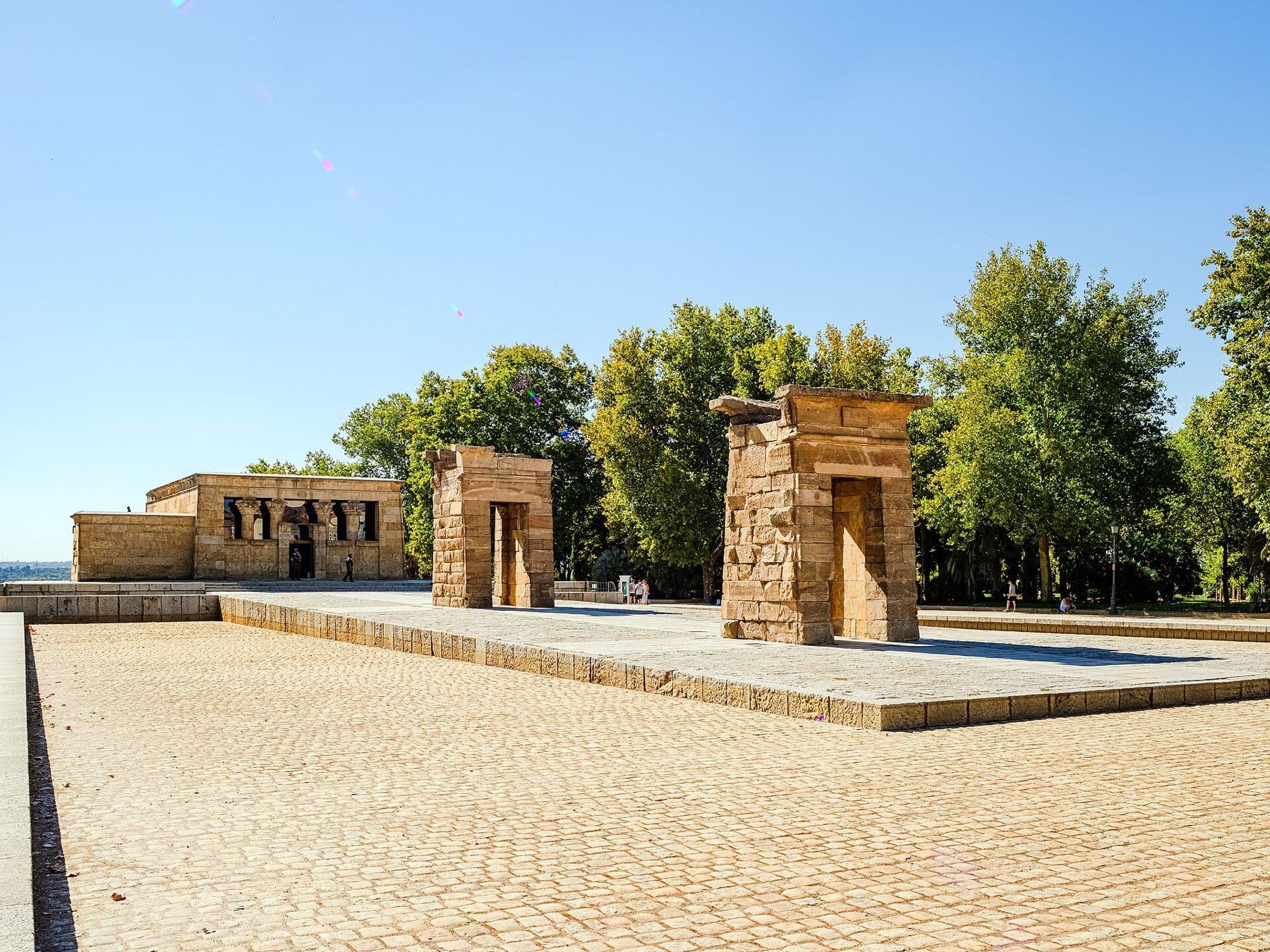
Templo de Debod
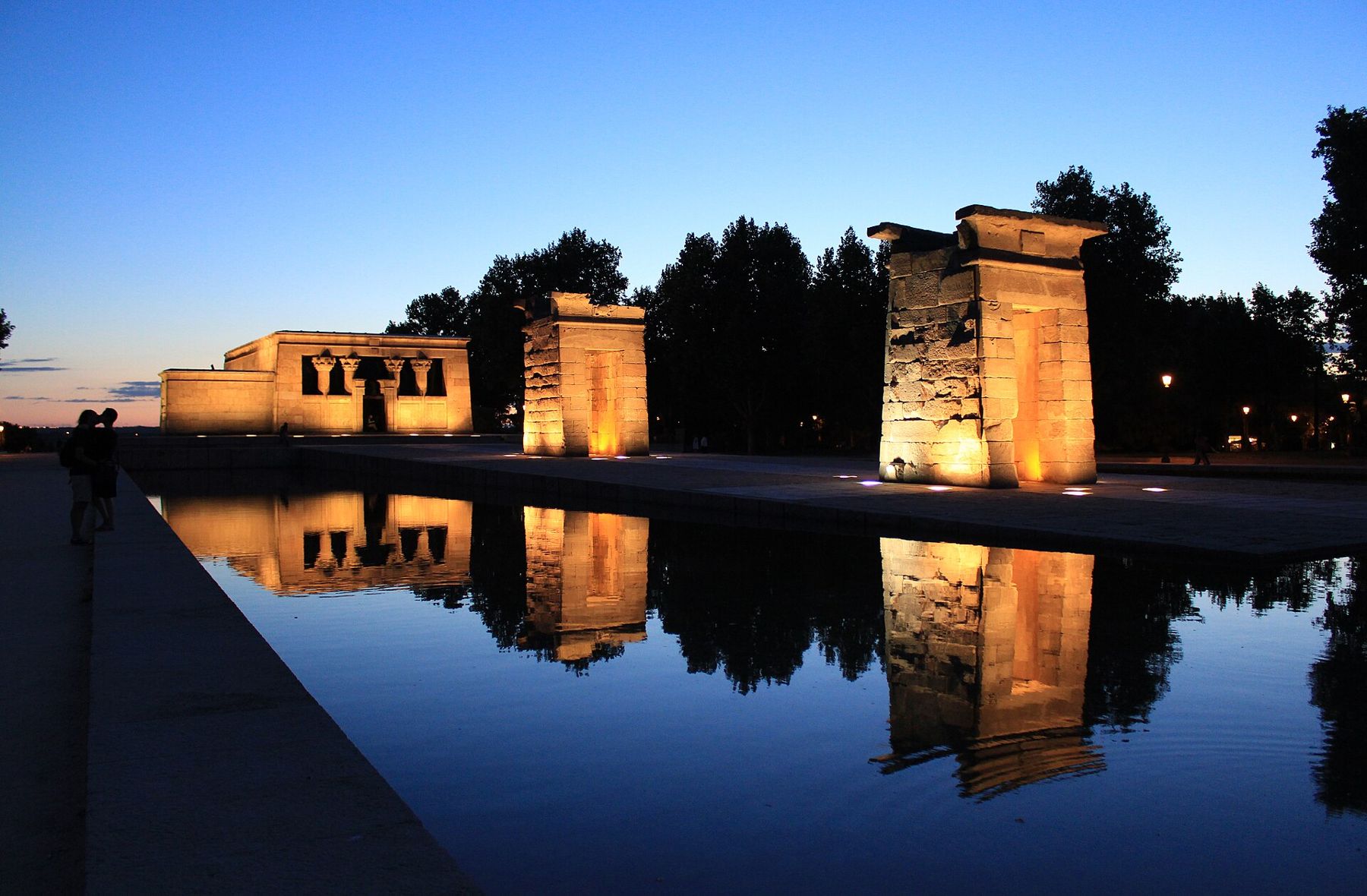
Look at the two stone gateways lined up in front of the temple across the pool.
This is a real Egyptian temple, built in the second century BC near Aswan in Nubia and dedicated to Amun and Isis. When the Aswan High Dam threatened to flood the temples of Nubia, Spain was among the countries that helped to save Abu Simbel, and in 1968 Egypt gave Madrid this temple in thanks. It was dismantled, shipped and rebuilt here, and opened in 1972. Its gateways stand in a pool, recalling the Nile.
The hilltop has its own history. It was the site of the Cuartel de la Montaña, a barracks stormed by Republican forces at the start of the Civil War in July 1936. Earlier, in 1808, the French executed prisoners on the hills of Príncipe Pío nearby. The terrace on the west side looks over the Casa de Campo and is crowded at sunset, when the sky goes red behind the trees.
Finishing at the temple
The walk ends on the hill of the Parque del Oeste. Plaza de España metro, on lines 3 and 10, and Ventura Rodríguez, on line 3, are both a few minutes away. To head on to the river, the gardens below lead down to Príncipe Pío station and the start of the Madrid Río walk.
Light, shade and safety
Time the walk to reach the temple about half an hour before sunset; the time changes a lot through the year, from late afternoon in winter to well into the evening in summer. Malasaña's streets are narrow and shaded, but the park around the temple is open, and in summer the afternoon heat lingers. Carry water; there are drinking fountains in the park. After dark the park paths are less busy, so walk with others or stay on the lit paths back towards the square.
Next
The next morning, try the Madrid Río walk along the river below, or the Habsburg streets around the palace.