In the early seventeenth century, the golden age of Spanish literature, a handful of streets between Puerta del Sol and the Paseo del Prado held the greatest writers of the day. Cervantes, Lope de Vega, Quevedo, Góngora and Calderón all lived or worked here, close to the yard theatres where plays were staged. They knew each other, and some of them loathed each other. The quarter is still called the Barrio de las Letras, the quarter of letters.
This short walk starts in the Plaza de Santa Ana, on the site of one of those theatres, follows the quotations set in brass in the pavement of Calle de las Huertas, and passes the places where Cervantes died, where Lope de Vega lived and where Cervantes is buried. It ends at the Spanish parliament. The route is about a kilometre and a half, gently downhill, and takes an hour or more at a reading pace.
Sol, on lines 1, 2 and 3, and Sevilla, on line 2, are both about five minutes from the start; Antón Martín, on line 1, is close by on the south side.
Plaza de Santa Ana
Look at the theatre front on the east side, with playwrights' names along the top.
The square was opened in 1810, when Joseph Bonaparte, installed as king by his brother Napoleon, had a convent of Carmelite nuns demolished; he cleared so many buildings for squares that Madrid nicknamed him the king of squares. The Teatro Español, on the east side, stands on the site of the Corral del Príncipe, a theatre yard opened in 1583 where the plays of Lope de Vega and Calderón were performed.
Two statues face each other. Pedro Calderón de la Barca, the great playwright of the seventeenth century, sits on a tall pedestal. Federico García Lorca, the poet and playwright killed at the start of the Civil War in 1936, stands at ground level, holding a small bird. Notice how different the two are in scale and style: they were made more than a century apart.
Walk on · From the square's south-east corner, east down Calle de las Huertas, 3 minutes.
Calle de las Huertas
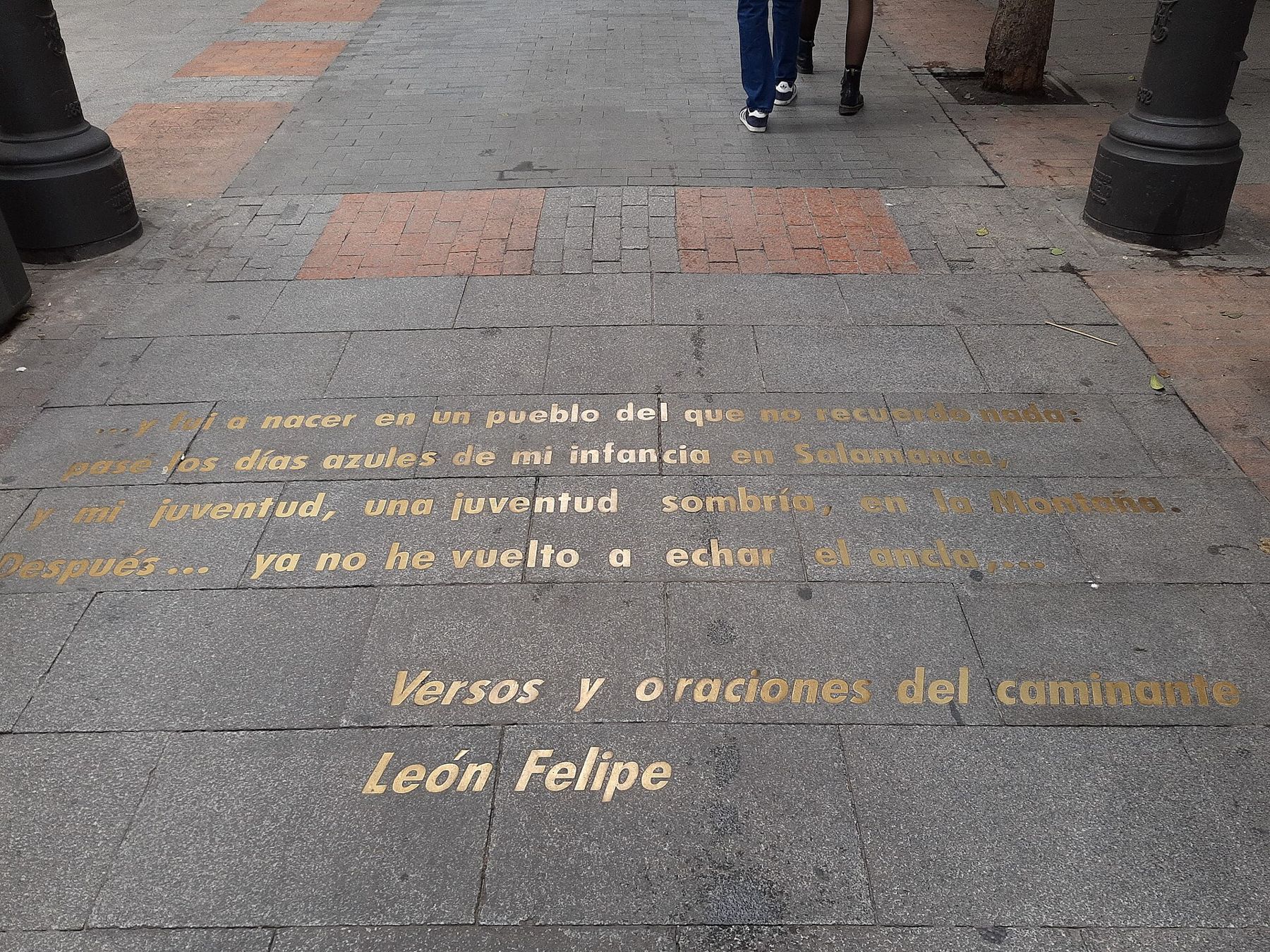
Look down at the golden letters set into the paving stones.
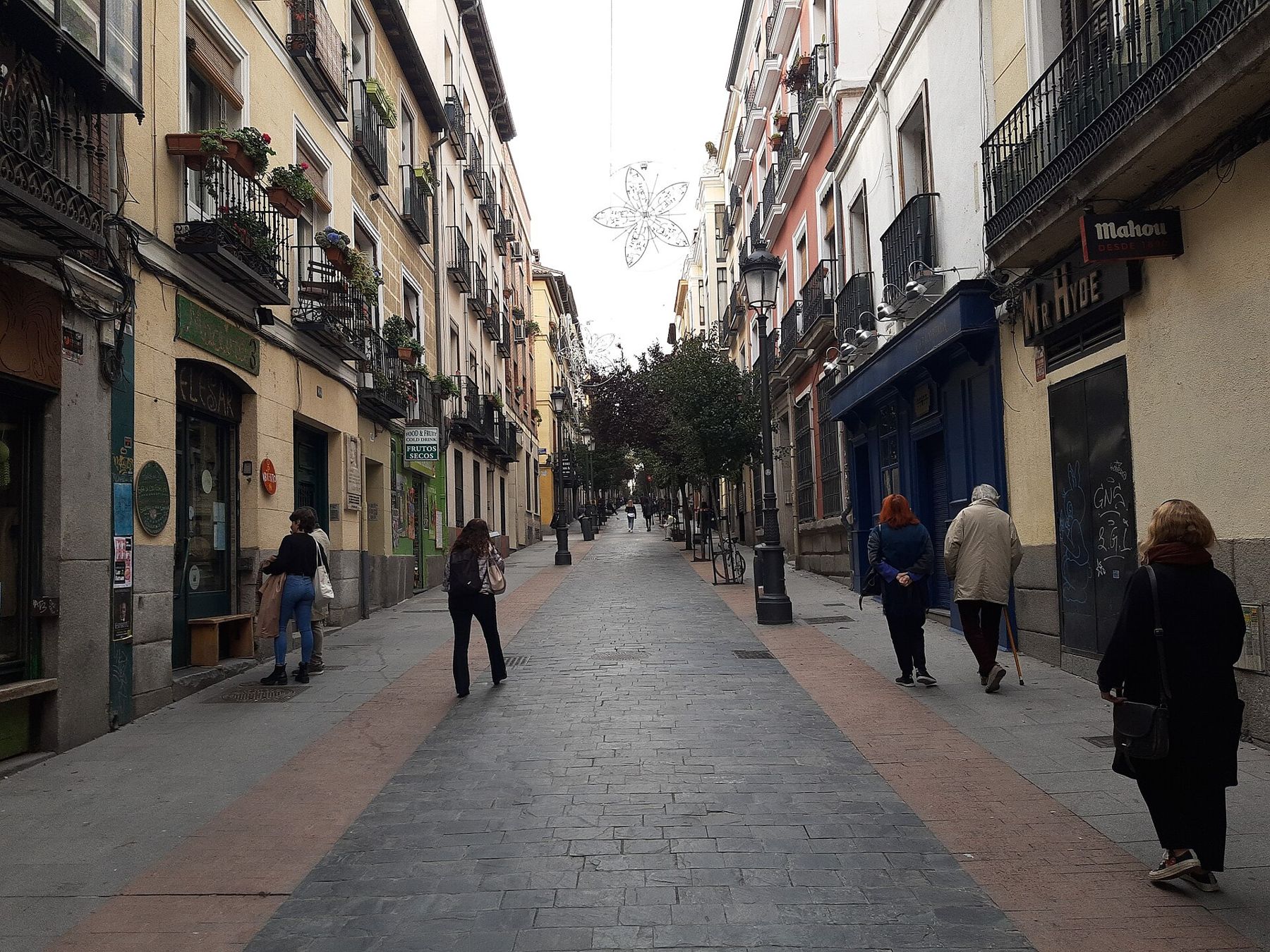
The street takes its name from the orchards, huertas, that once lay along it on the way to the Prado meadows. Today it is pedestrianised, and set into the paving are quotations from the writers who lived in the quarter, in brass letters, each with the name of the author and the work. You will find Cervantes, Lope de Vega, Quevedo, Góngora and later writers, including the poet León Felipe.
The quotations run down the street in the direction you are walking, so it is worth reading them in order. Watch for them on both sides, and for street signs and plaques in tiles on the walls, some showing the old names of streets. In the evening this street fills with people; in the morning you can read the pavement in peace.
Walk on · Downhill along Calle de las Huertas to the corner with Calle del León, 3 minutes.
Real Academia de la Historia
Look at the sober stone and brick front on the corner of Huertas and León.
This building, designed in the late eighteenth century by Juan de Villanueva, the architect of the Prado, was built for the monks of El Escorial to print liturgical books, and since the nineteenth century has been the home of the Royal Academy of History, founded in 1738. The Academy keeps a large library and archive and publishes the national dictionary of Spanish biography.
It marks the heart of the old literary quarter. In the time of Cervantes and Lope, the street corners here were full of booksellers, printers, actors and writers, and the theatres were close by. Notice the plaques on the buildings around this crossing: several mark the houses of writers and artists from the eighteenth and nineteenth centuries as well as the golden age.  Change here for the Lisbon lineBelém, along the water
Walk on · A few steps south along Calle del León to the corner with Calle de Cervantes, 1 minute.
Site of Cervantes's house
Look for the stone plaque on the corner building recording Cervantes's death.
Miguel de Cervantes died here on 22 April 1616, in a house on this corner, a few months after publishing the second part of Don Quixote. He had lived in many places in Madrid, and this was his last address. The house itself was demolished in the nineteenth century, despite protests, and the building that replaced it carries a plaque recording where he died.
The street was later renamed Calle de Cervantes. Notice the irony of the neighbourhood: Cervantes is commemorated on the corner of a street named after him, but is buried in a convent on the street named after Lope de Vega, while Lope's house stands on Calle de Cervantes. The two were rivals, and Lope's plays were far more popular in their lifetimes.
Walk on · East along Calle de Cervantes to number 11, on your left, 2 minutes.
Casa Museo Lope de Vega
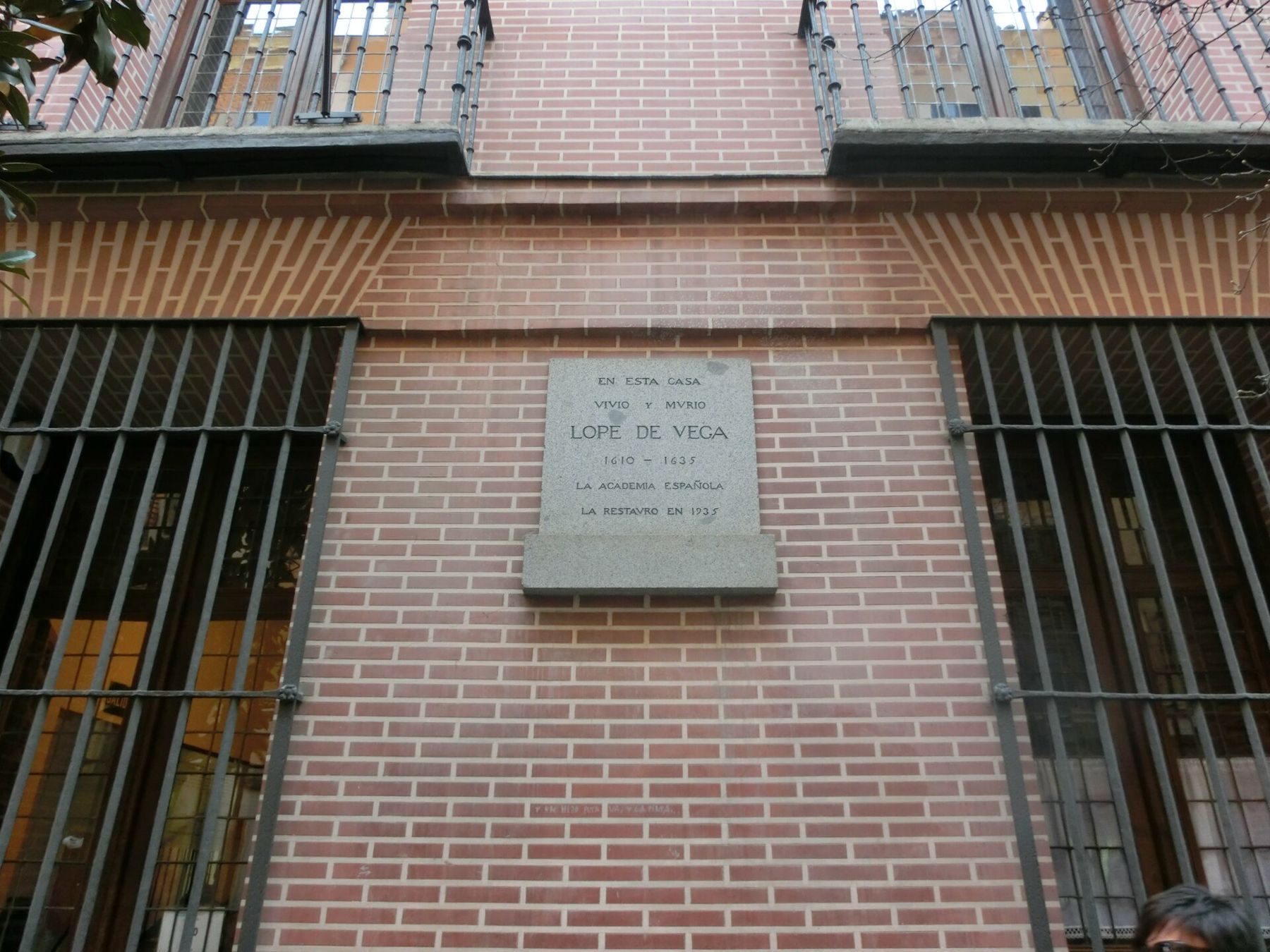
Look at the brick front with barred windows and the plaque above the door.
Lope de Vega, the most prolific playwright of the Spanish golden age, bought this house in 1610 and lived here until his death in 1635. He wrote hundreds of plays, and much of his late work was done in these rooms. The plaque says he lived and died here, and that the Royal Spanish Academy restored the house in 1935.
The house is now a museum furnished with objects of the period, with a small garden at the back where Lope grew flowers and fruit trees. Visits are guided and the hours and booking rules change, so check ahead. Look down at the pavement in front of the door: another brass inscription records that Lope lived and died here, and calls him the phoenix of wits, the name his contemporaries gave him.
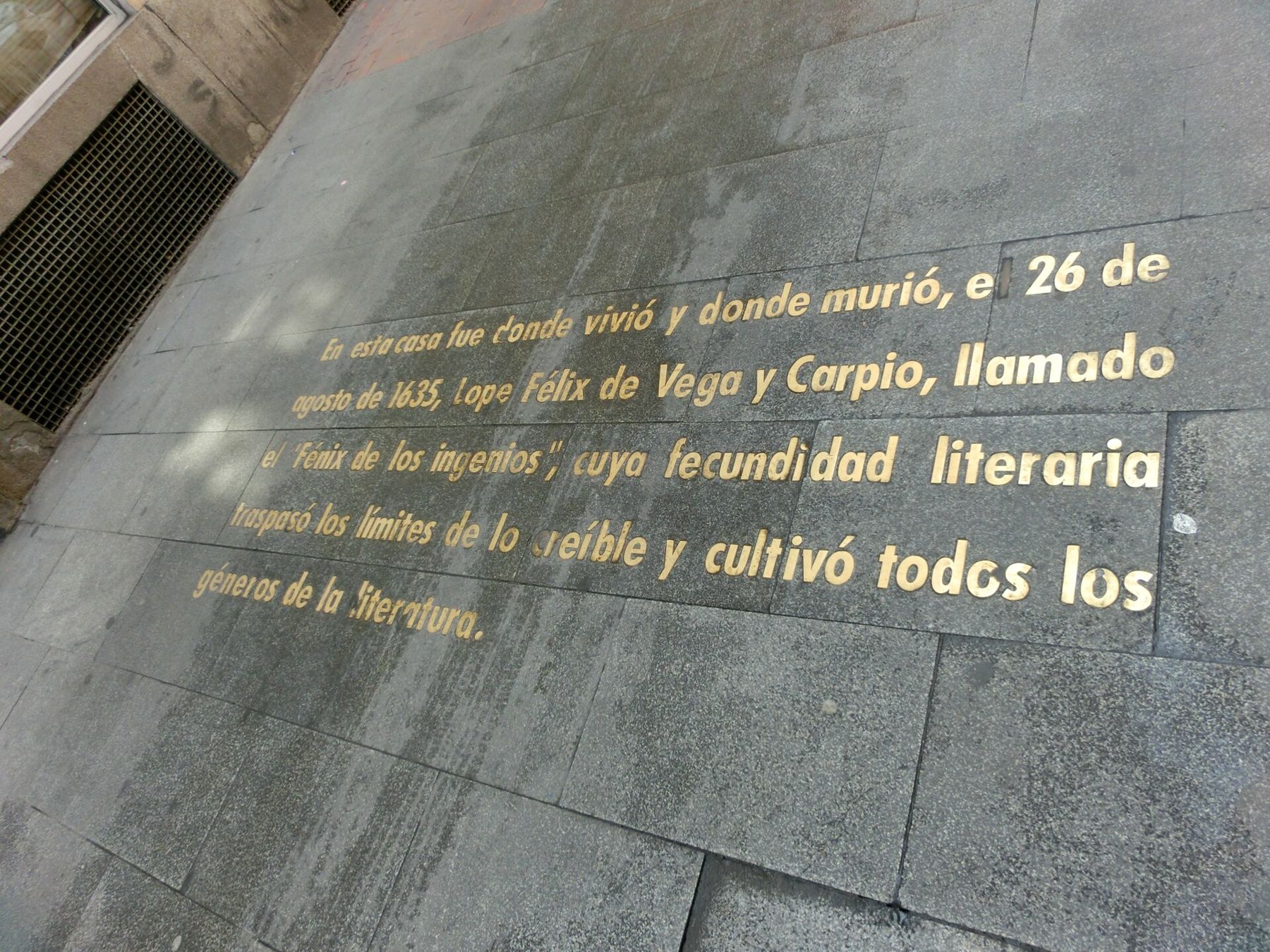
Walk on · Round the block south to Calle de Lope de Vega and the long convent wall, 3 minutes.
Convento de las Trinitarias Descalzas
Look at the plain brick convent wall and the plaque recording Cervantes's burial.
This convent of enclosed Trinitarian nuns was founded in 1612 and is still in use. Cervantes asked to be buried here, and the Trinitarians had a particular claim on him: in 1580 Trinitarian friars paid the ransom that freed him from five years of captivity in Algiers. His grave was lost when the church was rebuilt later in the seventeenth century. In 2015 a search of the crypt found bones that researchers believe include his, and they were reburied in a new tomb.
Lope de Vega had his own link to the convent: his daughter Marcela took her vows here and became a poet herself. The church opens for services, but the convent is closed to visitors. Every year around the anniversary of Cervantes's death, a mass is said for him here. Stand on the far side of the street to see the convent's front in full.
Walk on · North through the side streets to the parliament on Carrera de San Jerónimo, 6 minutes.
Plaza de las Cortes
Look at the two bronze lions guarding the steps of the parliament building.
The Congreso de los Diputados, the lower house of the Spanish parliament, was completed in 1850. The bronze lions were cast from cannons captured in Spain's war in Morocco in 1859 and 1860, and are popularly named Daoíz and Velarde after the two artillery officers of the 1808 uprising. Inside, the chamber ceiling still shows bullet holes from the attempted coup of 23 February 1981, when armed civil guards held the deputies hostage overnight before it failed.
In the small square in front of the parliament stands a bronze statue of Cervantes, put up in 1835, one of the first public statues to a writer in Madrid. It is a good place to finish: the novelist faces the parliament, and the quarter of letters lies behind you. The Paseo del Prado is just beyond, at the start of the walk from the Prado to the Retiro.
Finishing at the Congress
The walk ends in the Plaza de las Cortes. Sevilla metro, on line 2, is a few minutes north, and the Paseo del Prado and the Neptune fountain are two minutes downhill to the east. The parliament building has a security perimeter: do not climb on the lions or the steps.
Shade, water and noise
The streets of the quarter are narrow and mostly shaded, which makes this a good walk for a hot day. The open squares are in full sun at midday. There are public drinking fountains in some of the squares, but few public toilets on the route. In the evening and on weekends the quarter is very busy and noisy, so for reading the pavement go early.
Next
Continue east to the Prado and the Retiro, or head back west past Sol to the Plaza Mayor and the palace on the Madrid de los Austrias walk.