In the eighteenth century Charles III turned a stretch of meadow on the eastern edge of Madrid into a promenade lined with trees and fountains, and placed beside it the buildings of a scientific capital: a natural history museum, a botanical garden and an observatory. The natural history museum became the Prado, one of the world's great art museums, and the promenade became the Paseo del Prado. Together with the Retiro park behind it, the area was listed as a World Heritage Site in 2021 as the Landscape of Light.
This walk takes in the outside of the Prado, the fountains of Neptune, Apollo and Cibeles along the promenade, and the Puerta de Alcalá, then enters the Retiro to the great lake and the iron and glass Palacio de Cristal. It is about two and a half kilometres, mostly level with a gentle climb to the gate, and takes about two hours without going into the museum.
Banco de España metro, on line 2, is about ten minutes north of the start; Atocha, on line 1, is about ten minutes south.
Museo del Prado, Puerta de Velázquez
Look at the seated bronze Velázquez, brush and palette in hand, before the long colonnade.
The building was designed by Juan de Villanueva in 1785 as a museum of natural sciences for Charles III. War with Napoleon interrupted it, and it opened in 1819 as a royal museum of paintings and sculpture. Its core is the collection of the Spanish kings, which is why it is so strong in Velázquez, Goya, Titian and Rubens.
The statue of Velázquez stands in front of the main west front, with its central colonnade. At the north end, a statue of Goya faces the hotel-lined square; at the south end, Murillo faces the Botanical Garden. Behind the museum, the brick and glass extension by Rafael Moneo, opened in 2007, wraps around the restored cloister of the church of San Jerónimo el Real, the royal church where Alfonso XIII married in 1906. Entry and opening times change; even from outside, notice how long the building is, built to hold a whole cabinet of the natural world.
Walk on · North along the Paseo del Prado's central path to the fountain, 4 minutes.
Fuente de Neptuno
Look at the sea god with his serpent, riding a shell chariot drawn by sea horses.
Neptune is one of three fountains that Ventura Rodríguez designed for the promenade in the 1780s, as part of Charles III's scheme. The figure was carved by Juan Pascual de Mena from white marble. Sea horses draw his shell chariot, and he holds a serpent.
The fountain stands in a roundabout now called Plaza de Cánovas del Castillo, and it has a second life as the place where supporters of Atlético de Madrid celebrate their team's victories, just as Real Madrid fans gather at Cibeles a little further north. Three of the city's great museums lie within a few minutes of here, which is why the area is known as the art triangle. Look south to see the Prado's front and north to see the dome of the next square up the promenade.
Walk on · North along the tree-lined central promenade to the next fountain, 3 minutes.
Fuente de Apolo (Salón del Prado)
Look at the figures of the four seasons around the base below Apollo.
This stretch of the promenade between Neptune and Cibeles was the Salón del Prado, the most fashionable walk in eighteenth-century Madrid, where people came to see and be seen in the evening. The fountain of Apollo, also designed by Ventura Rodríguez, stands in the middle of it, with the god on top and figures of the four seasons around the base. It was finished after his death.
The fountains were placed to tell a story: Neptune for the sea, Cibeles for the earth and Apollo for the sun, between them. Walk the central path rather than the side pavements: the double row of trees keeps it cool, and you can see from one fountain to the next. The walk through the old quarter on the other side of the promenade, the Barrio de las Letras, begins just to the west of here. 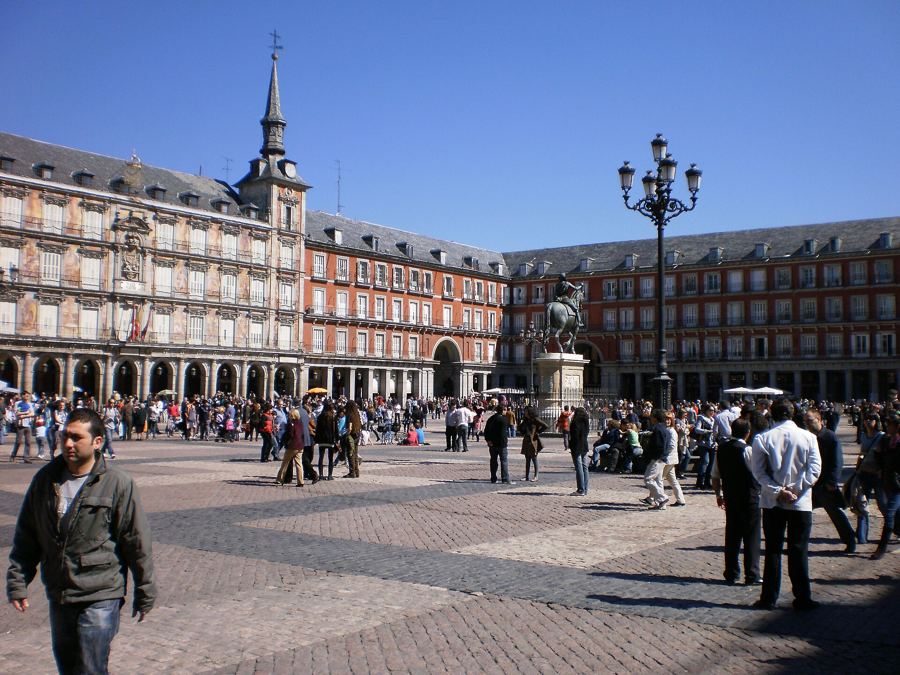 Change here for the Madrid lineMadrid de los Austrias
Walk on · North along the central promenade to the large roundabout, 3 minutes.
Plaza de Cibeles
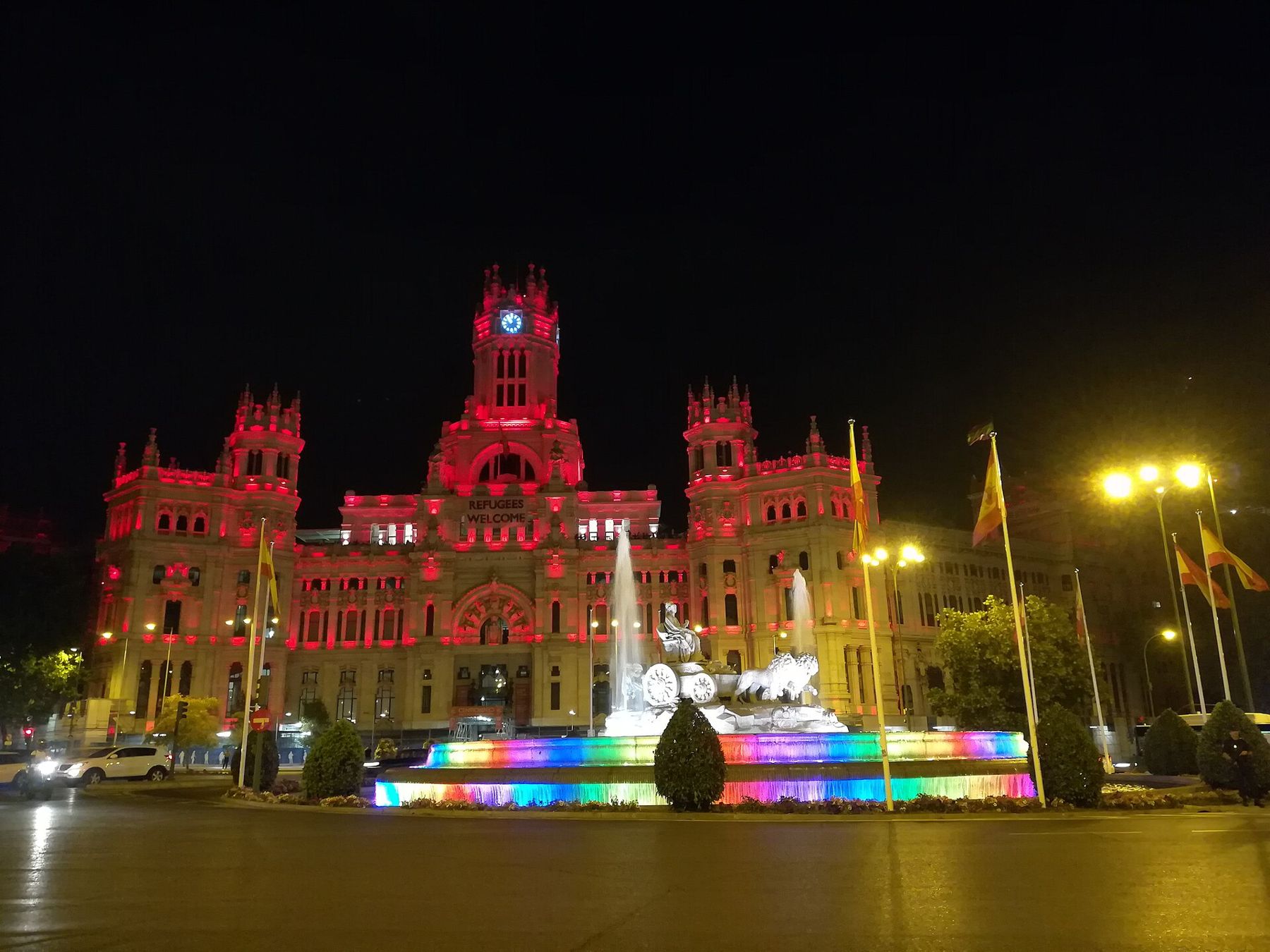
Look at the goddess Cybele riding her chariot pulled by two lions.
The fountain of Cybele, the goddess of the earth and fertility, is the third of Ventura Rodríguez's designs, carved by Francisco Gutiérrez with lions by Roberto Michel. It was finished in the early 1780s and later moved to the centre of the square, where it has become one of the symbols of the city, and the gathering place of Real Madrid's supporters.
The four corners of the square hold four landmarks. The white palace with towers is the Palacio de Cibeles, built as the main post office and opened in 1919; since 2007 it has been Madrid's city hall, with a cultural centre inside. Opposite are the Bank of Spain, the army headquarters in the Buenavista palace, and the Linares palace. During the Civil War the fountain was covered over to protect it from bombing.
Walk on · East up Calle de Alcalá, gently uphill, to the gate in the square, 6 minutes.
Puerta de Alcalá
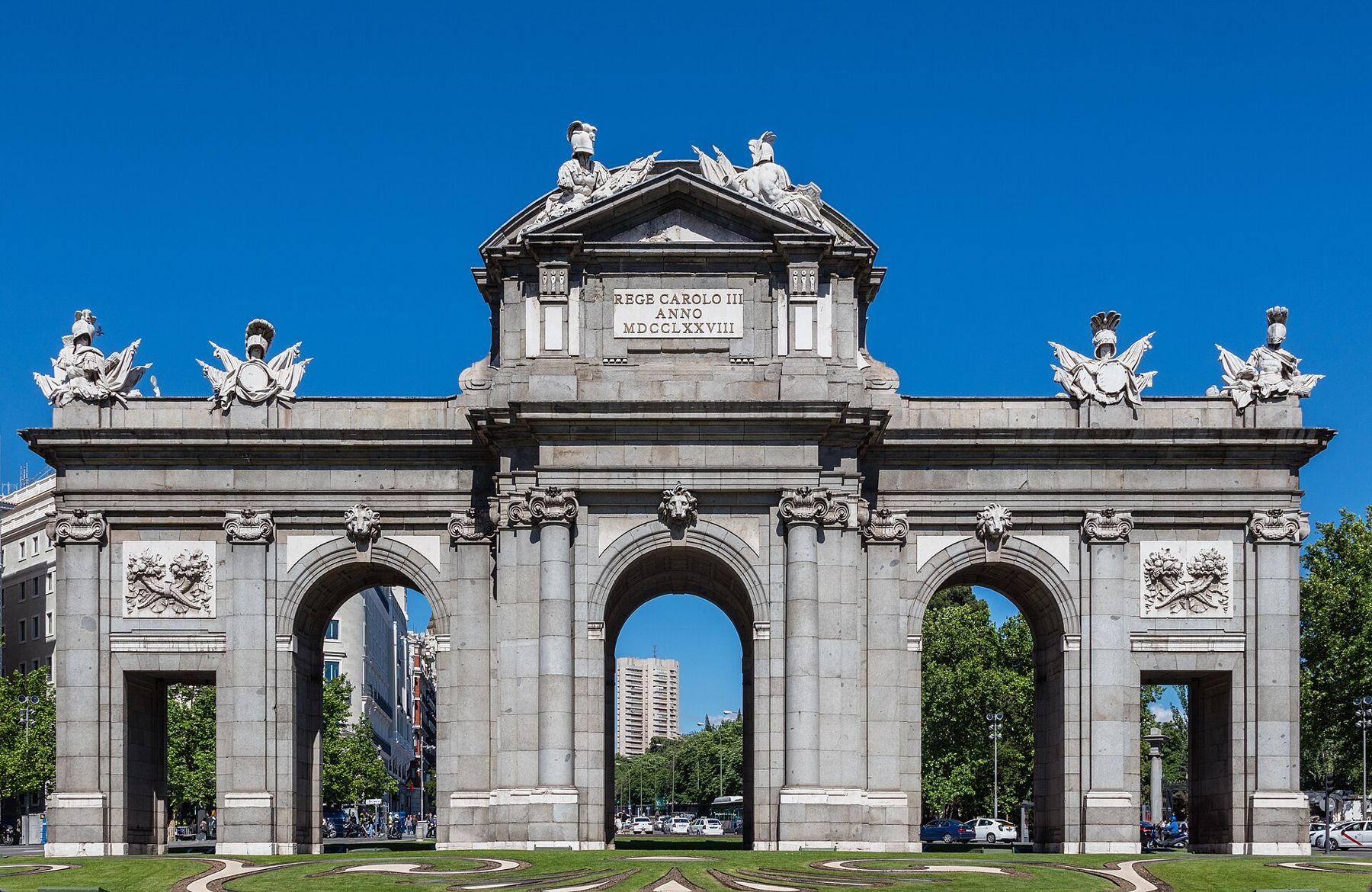
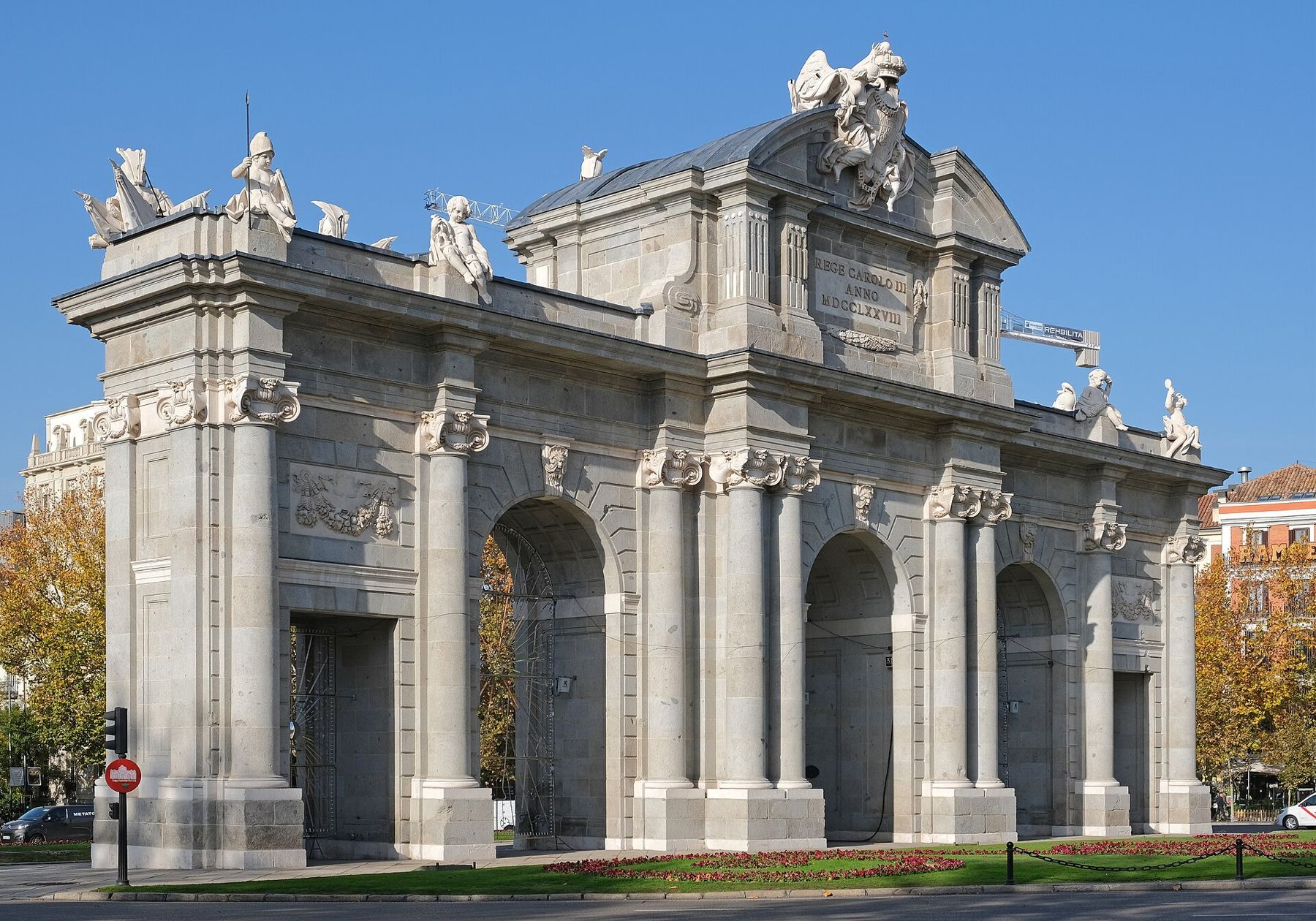
Look at the three arches and two square openings set in pale granite.
The gate was built for Charles III by Francesco Sabatini and finished in 1778, replacing an older gate on the road to Alcalá de Henares. It was the main entrance to the city from the east, and a statement of royal power: a classical triumphal arch, with five openings, three of them arched.
The gate stands in the Plaza de la Independencia, now a busy roundabout, and once marked the edge of the city. Walk around it and compare the two faces: the side facing the city is decorated differently from the side facing out. It survived the city's growth around it and is now one of Madrid's emblems, with a well-known popular song of the 1980s named after it.
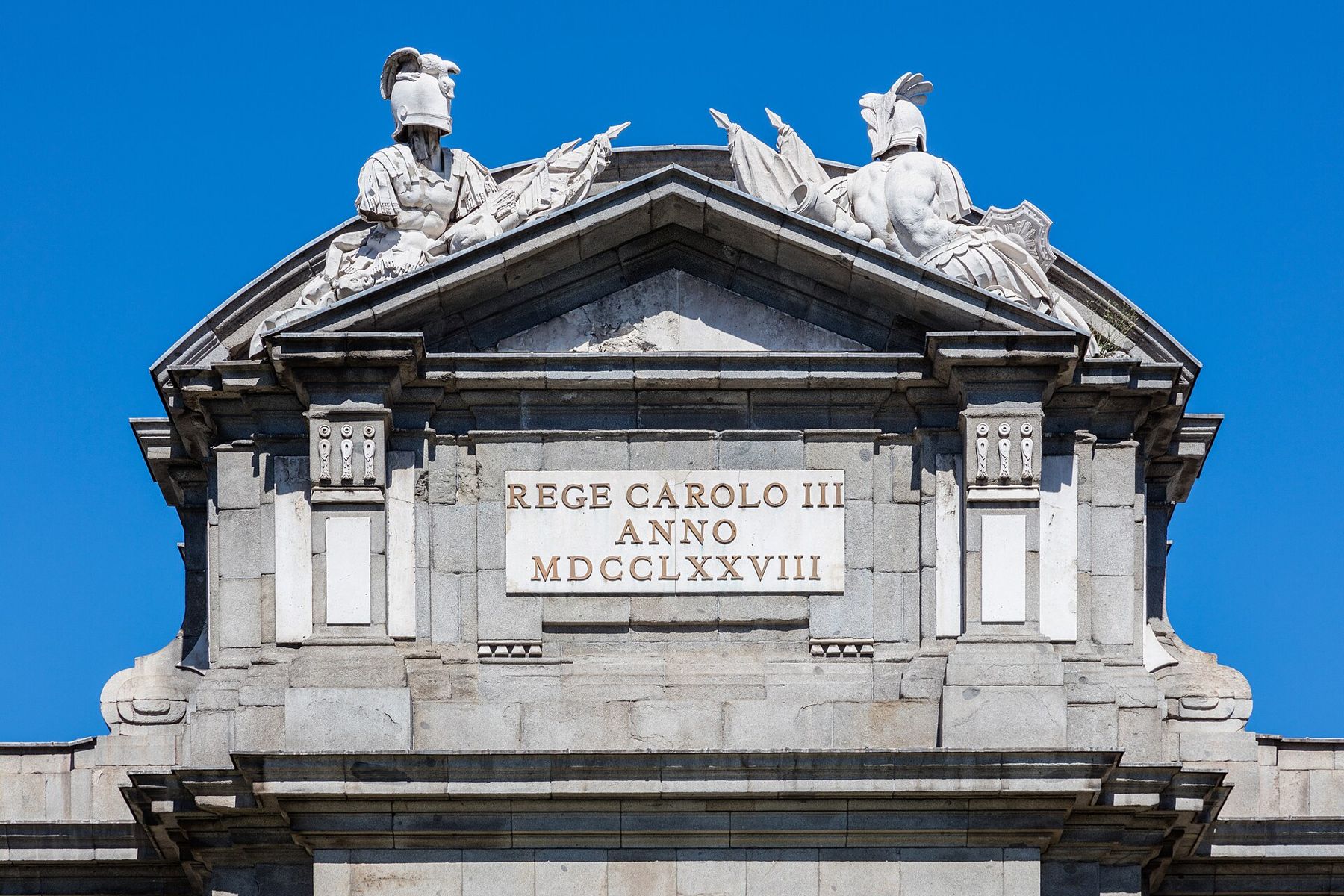
Walk on · Into the Retiro through the gate on the corner, then straight to the lake, 8 minutes.
Estanque Grande del Retiro
Look across the water at the colonnade and the equestrian statue of Alfonso XII.
The Retiro was laid out in the 1630s as the garden of the Buen Retiro palace, built by Philip IV and his minister the Count-Duke of Olivares as a retreat on the edge of the city. The palace was largely destroyed during the Napoleonic wars; only two of its buildings survive, near the Prado. The gardens became a public park in 1868.
The great lake was dug for the palace and used for boating parties and mock naval battles staged for the court. Today you can hire rowing boats, though prices and times change. On the far side, the monument to Alfonso XII, completed in the early twentieth century, is a half-circle of columns with the king on horseback at the top. Notice the steps down to the water, where people sit in the sun in winter and the shade in summer.
Walk on · South along the paths past the lake's south end to the glass palace, 8 minutes.
Palacio de Cristal
Look at the glass pavilion and its reflection in the pond with tall cypresses.
The Palacio de Cristal was built in 1887 by Ricardo Velázquez Bosco to house plants for an exhibition about the Philippines, then a Spanish colony. It followed the iron and glass buildings of London and Paris, and was put up in a few months. Today it is used for contemporary art exhibitions run by the Reina Sofía museum, which change through the year.
The pond in front has swamp cypresses growing in the water, with their roots rising like knees, and ducks and turtles on the banks. Walk around the building to see how light passes through it at different times of day. The Retiro is large, and paths from here lead to the rose garden and the statue of the Fallen Angel, often said to be one of the few public statues of the devil anywhere.
Finishing in the Retiro
The walk ends at the Palacio de Cristal, in the south half of the park. Retiro metro, on line 2, is at the north edge; the Atocha station is about fifteen minutes south-west through the park's southern gate. The Prado and the Paseo are ten minutes back to the west.
Shade, water and toilets
The Paseo del Prado's central path is shaded by its trees, and the Retiro has plenty of shade under its plane trees and chestnuts, but the squares around Cibeles and the Puerta de Alcalá are open to the sun. In summer, start early or late in the day. There are drinking fountains in the park and public toilets near the lake. Traffic around the roundabouts is heavy: cross at the lights.
Next
For the older city, walk across the Paseo into the Barrio de las Letras, or head to the palace and Plaza Mayor on the Madrid de los Austrias walk.