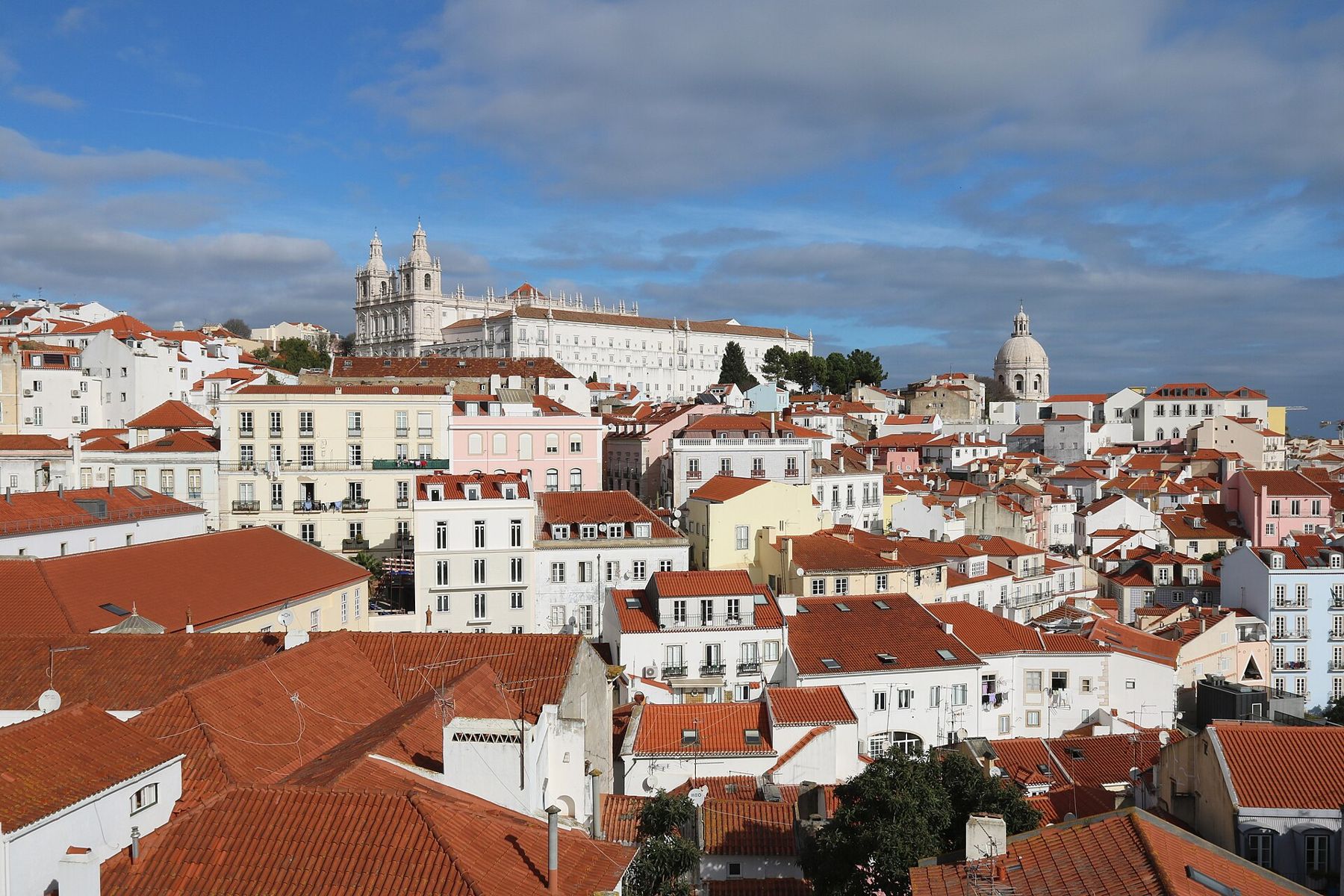
This is the walk that explains why Lisbon is where it is. The hill of São Jorge rises straight from the river, and every people who held the city, from the Romans to the Moors to the first kings of Portugal, built on it. In little more than a kilometre you climb from the cathedral, past the stones of a Roman theatre and two terraces that look over Alfama's roofs, to the walls of the castle at the top.
The distance is short, but the climb is real: steep lanes, steps and polished stone paving. Allow about an hour and a half with time to look, longer if you go inside the cathedral or the castle grounds, which charge for entry and keep hours that change through the year.
Start at the small church of Santo António, across the street from the Sé. Tram 28 stops beside the cathedral, and the Baixa is a ten-minute walk downhill if you are already in the centre.
Igreja de Santo António
Look at the small baroque front, pressed between the tram rails and the street.
Lisbon has always claimed this spot as the birthplace of its favourite saint. Fernando Martins de Bulhões, known to the wider world as Saint Anthony of Padua, was born in Lisbon in the 1190s, and the church stands where his family's house is said to have been. A crypt below is shown as the room of his birth.
The earlier church fell in the 1755 earthquake. What you see is the rebuilding, designed by Mateus Vicente de Oliveira and paid for in part by the alms of the faithful. In June the whole city turns its festivities toward Santo António, with garlands strung across the lanes of Alfama and the group weddings known as the Santo António weddings. Notice the bronze statue of the saint on the little square outside, holding the Christ Child: people leave flowers at its feet in every season.
Walk on · Cross the street to the cathedral's front steps, 1 minute; watch for trams on the bend.
Sé de Lisboa
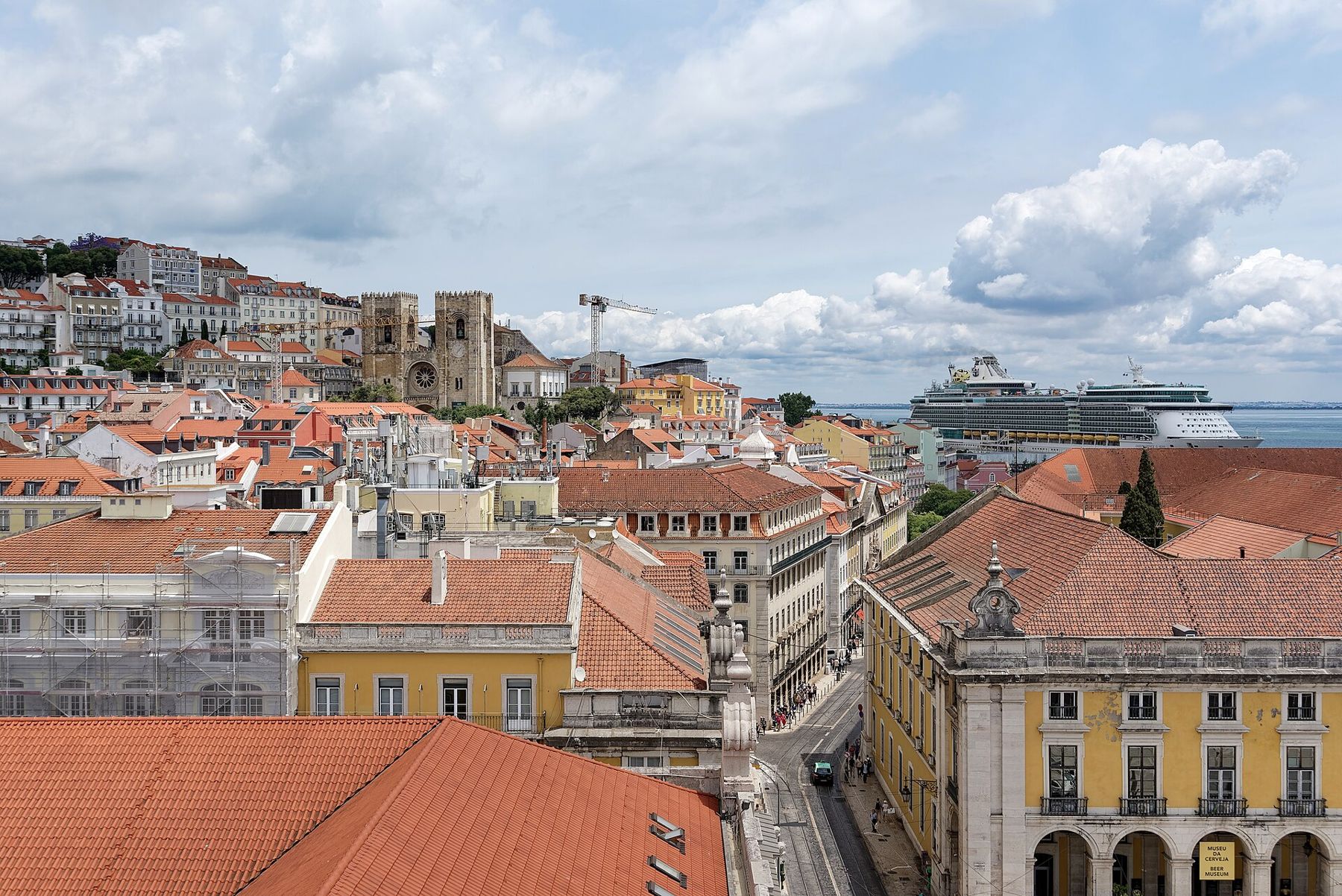
Look up at the two square, battlemented towers and the rose window between them.
The Sé, from sedes, the seat of a bishop, was begun soon after 1147, when Afonso Henriques, the first king of Portugal, took Lisbon from its Moorish rulers with the help of crusaders on their way to the Holy Land. It stands on the site of the city's main mosque, and it looks like what it was meant to be: a stronghold of the new faith in a newly taken city, with towers that could serve as a keep.
Earthquakes reshaped it, in 1344 and again in 1755, so the Romanesque front leads to a Gothic chancel and later chapels. In the cloister, excavations have opened up a Roman street, walls from the Moorish city and medieval houses, one layer on another. Before you move on, stand on the far pavement for a minute and watch a tram take the curve in front of the doors; the rails pass only a few metres from the steps.
Walk on · Uphill along the tram rails, then left into Rua de São Mamede, 3 minutes.
Teatro Romano
Look for the curve of the stone seating below street level.
To the Romans, Lisbon was Olisipo, and its theatre was cut into this hillside facing the river in the time of the emperor Augustus. An inscription records a rebuilding under Nero, in the year 57. Later centuries buried it under houses, and it was the rebuilding after 1755 that brought it back to light at the end of the eighteenth century. Serious excavation came much later, in the twentieth century.
What survives is a section of the seating and the front of the stage, enough to give its scale. The audience looked out over the water much as you will from the terraces above. A small museum beside the ruins keeps the finds; its days and hours change, so check before planning a visit. Even from the street you can read the arc of the rows and see how the builders used the slope of the hill instead of fighting it.
Walk on · Back to the tram street, then uphill to the terrace on your right, 4 minutes.
Miradouro de Santa Luzia
Look at the tiled panel showing the riverfront square as it was before 1755.
This terrace leans against the small church of Santa Luzia, and its walls carry two of the most useful azulejo panels in the city. One shows the riverfront square, then called Terreiro do Paço, with the royal palace that the earthquake and fire of 1755 destroyed; you walk the rebuilt square on the Baixa walk. The other shows Christian knights storming the walls of the castle in 1147.
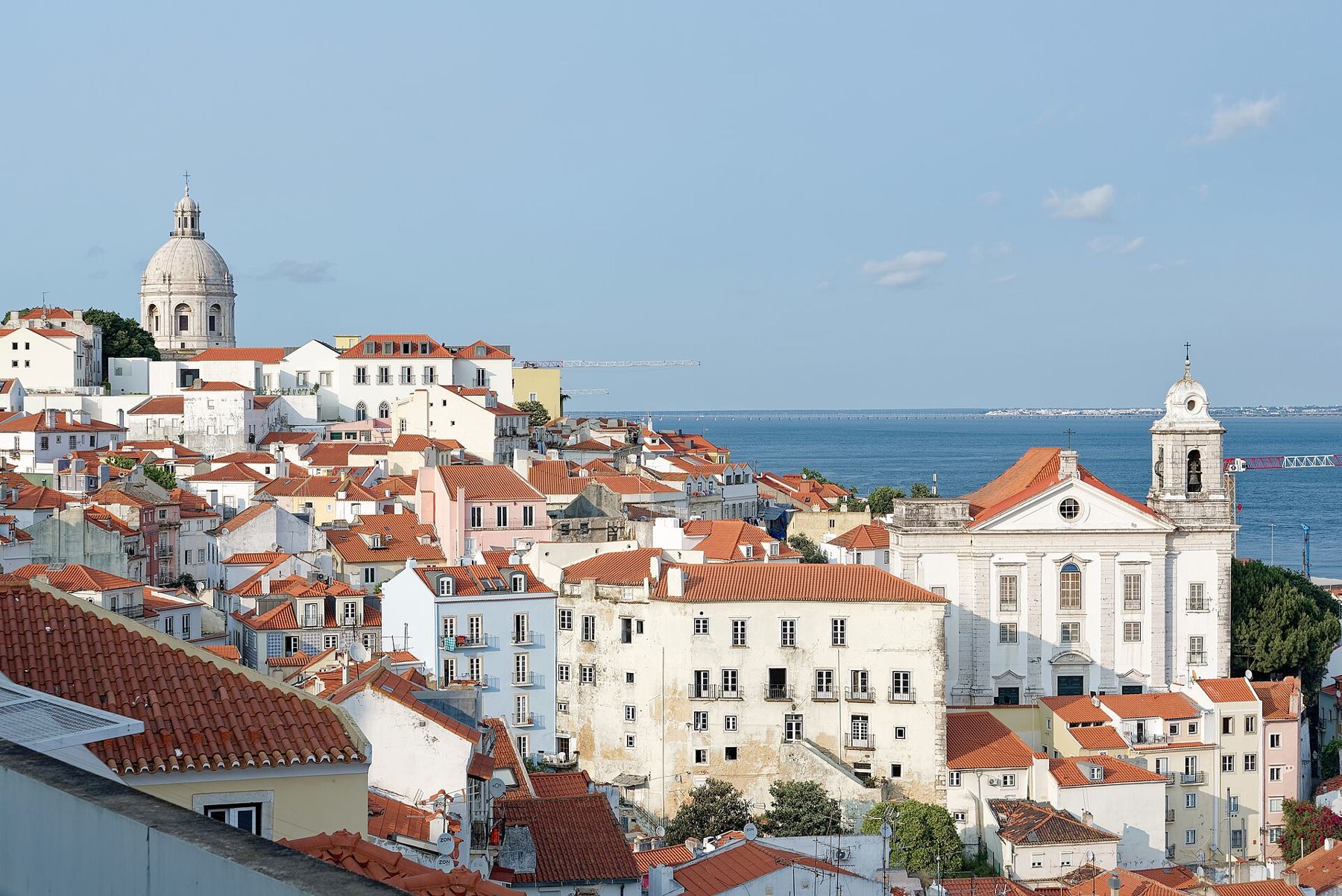
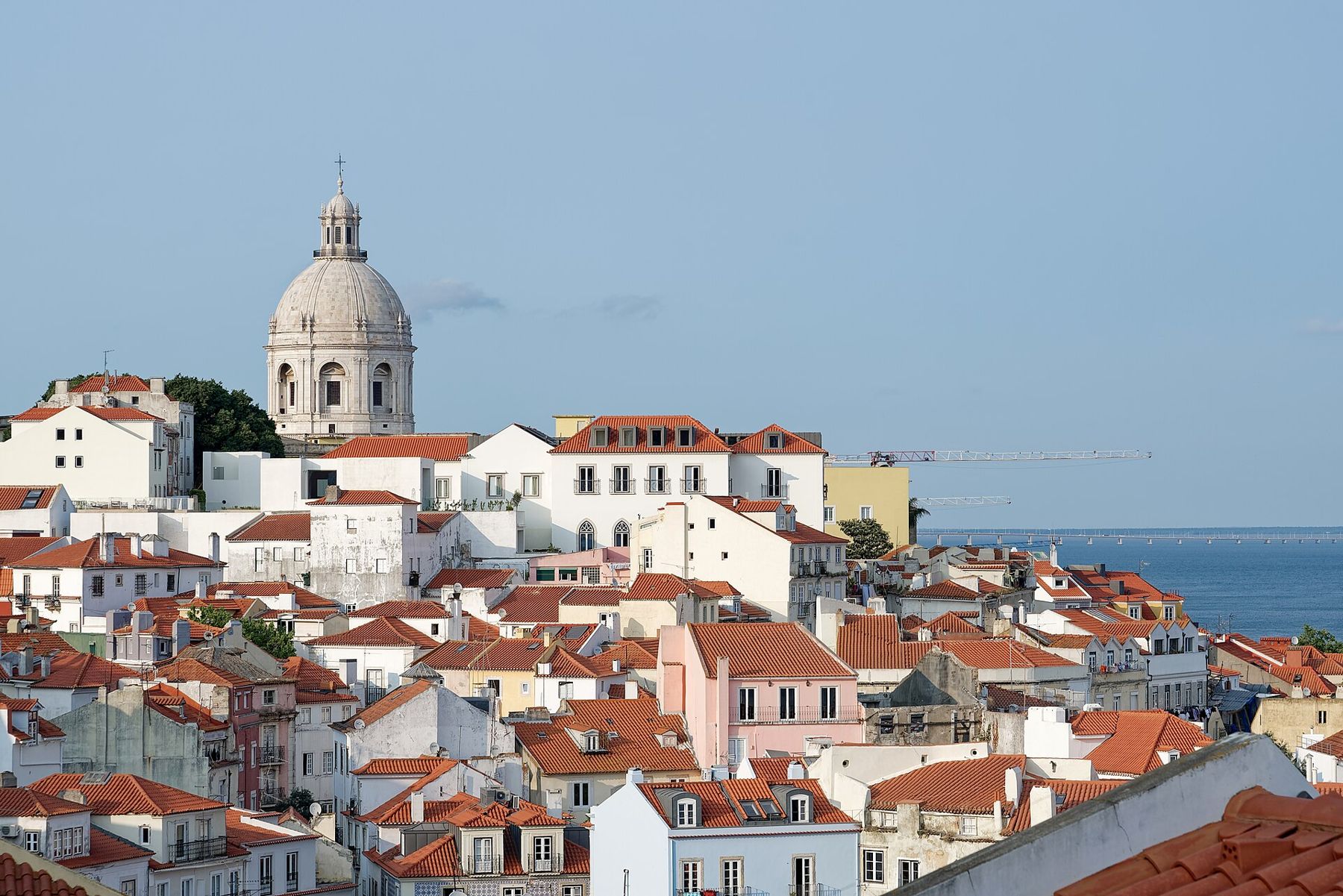
Under the pergola, bougainvillea and vines shade a row of benches. Below spread the roofs of Alfama, which stands on firmer rock and suffered far less in 1755 than the flat Baixa, so its medieval knot of lanes and stairways survives. Find the white dome of the National Pantheon and the twin towers of São Vicente de Fora to the east, the goal of the Graça walk.
Walk on · A few steps north along the same terrace to the open square, 1 minute.
Miradouro das Portas do Sol
Look at the statue of São Vicente cradling a ship with two ravens.
The name recalls a gate in the Moorish wall that faced east, towards the rising sun. The gate has gone, but the square still opens to the morning light over the river and the far bank. The statue is São Vicente, patron saint of Lisbon. His relics, the story goes, were brought to the city by sea in the twelfth century, watched over by two ravens. The ship and the ravens became the city's coat of arms, and once you know them you will see them on lamp posts, bollards and drain covers across Lisbon.
Lean on the parapet and follow the lanes down with your eye: the stairways, the washing lines and the small squares are the street plan of the Moorish town, never straightened.
 Change here for the Lisbon lineBelém, along the water
Walk on · Uphill on the lanes behind the square, following the castle signs, 7 minutes.
Largo do Chão da Feira and the castle gate
Look at the arched gateway leading into the castle quarter.
You are now inside the line of the old castle defences. The small square takes its name from a market that was once held here, and the gate ahead leads into the quarter of Santa Cruz do Castelo, a few streets of houses that still sit within the outer walls. The castle itself took the name of Saint George in the late fourteenth century, in the years of Portugal's alliance with England.
Inside the walls there is a gate named after Martim Moniz, a knight who, by tradition, jammed his own body in a half-open door during the siege of 1147 so that the attackers could force it. The story is told everywhere in Lisbon, and a metro station and a square downhill carry his name. This is also where the ticket line forms for the castle grounds. Entry prices and hours change, so check them on the day.
Walk on · Through the ticket gate and straight ahead to the cannon terrace, 3 minutes.
Castelo de São Jorge, Praça de Armas
Look at the bronze king with sword and shield standing above the terrace.
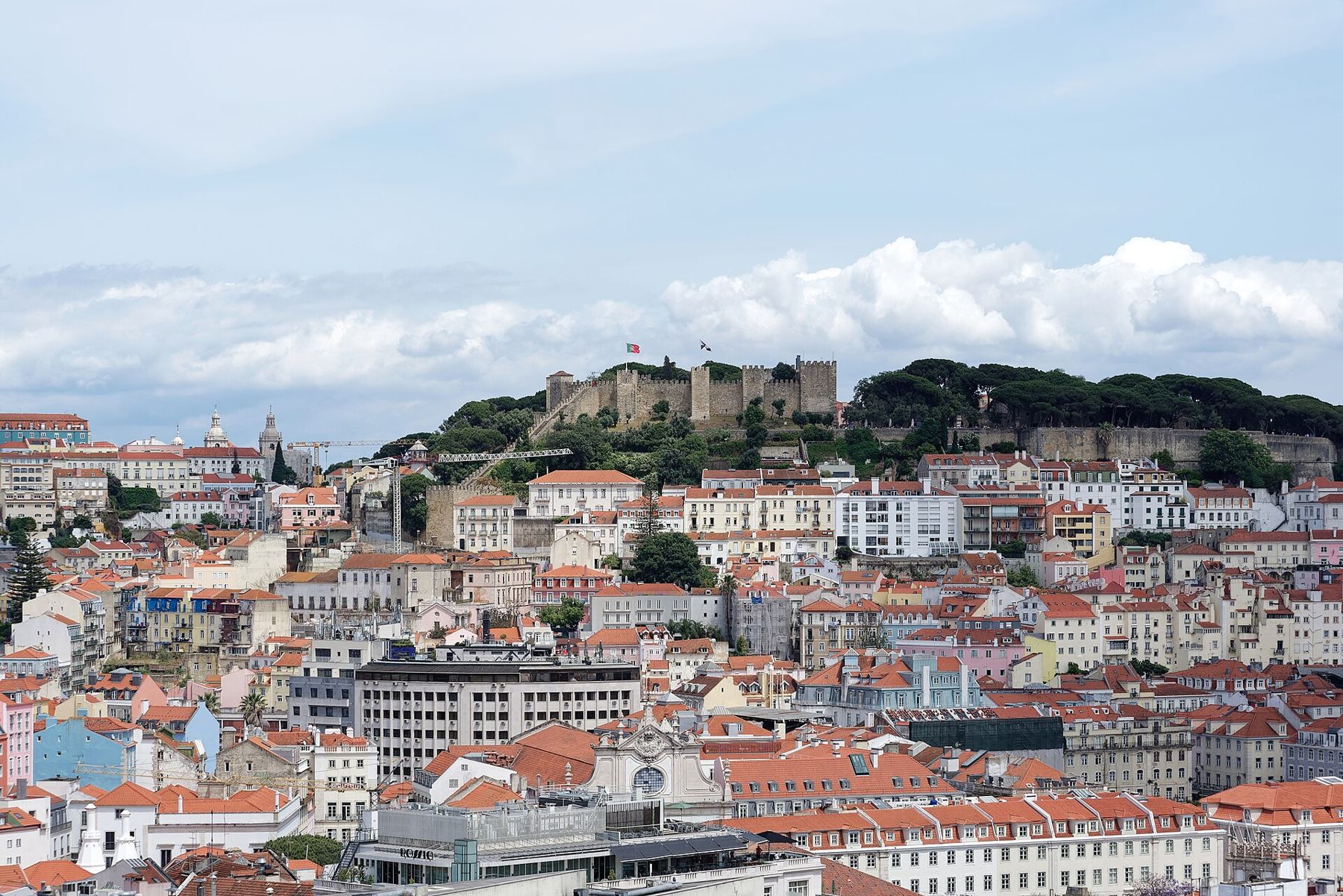
The statue is Afonso Henriques, the king who took the castle in 1147, and it is a copy of a nineteenth-century figure in Guimarães in the north, where he was born. The hilltop had been fortified long before the Moors, but the walls and towers you see follow the Moorish castle and the royal palace that grew inside it. Portugal's kings lived up here until the early sixteenth century, when King Manuel moved the court to a new palace on the river, the one the earthquake later destroyed.
Much of what looks medieval is a twentieth-century restoration: in the 1940s the walls were cleared of later buildings and the battlements rebuilt. Walk to the parapet and look west across the Baixa grid to the terraces of Bairro Alto, where the Chiado walk looks straight back at you. Peacocks wander the gardens, so keep an eye on your sandwich.
Finishing at the castle
The walk ends on the castle terrace, the highest point of the route. If you have not bought a ticket, the Praça de Armas is inside the paid area; the square by the gate and the lanes of Santa Cruz do Castelo give you a view without one. To go down, retrace the lanes to Portas do Sol and catch tram 28, or walk down the stairways of Alfama towards the river. A small bus also climbs to the castle area.
Shade, water and footing
Most of this route climbs in full sun after mid-morning, with shade only under the Santa Luzia pergola and the trees inside the castle. Carry water. Toilets are inside the ticketed castle grounds; elsewhere on the route there are few. The stone paving is smooth and slippery, worst after rain and on the downhill: wear shoes with grip. Tram 28 is crowded and is known for pickpockets, so keep bags closed and in front of you.
Next
From here the natural next step is east along the ridge to Graça, its viewpoints and the Pantheon dome, or down to the river and the rebuilt grid of the Baixa.