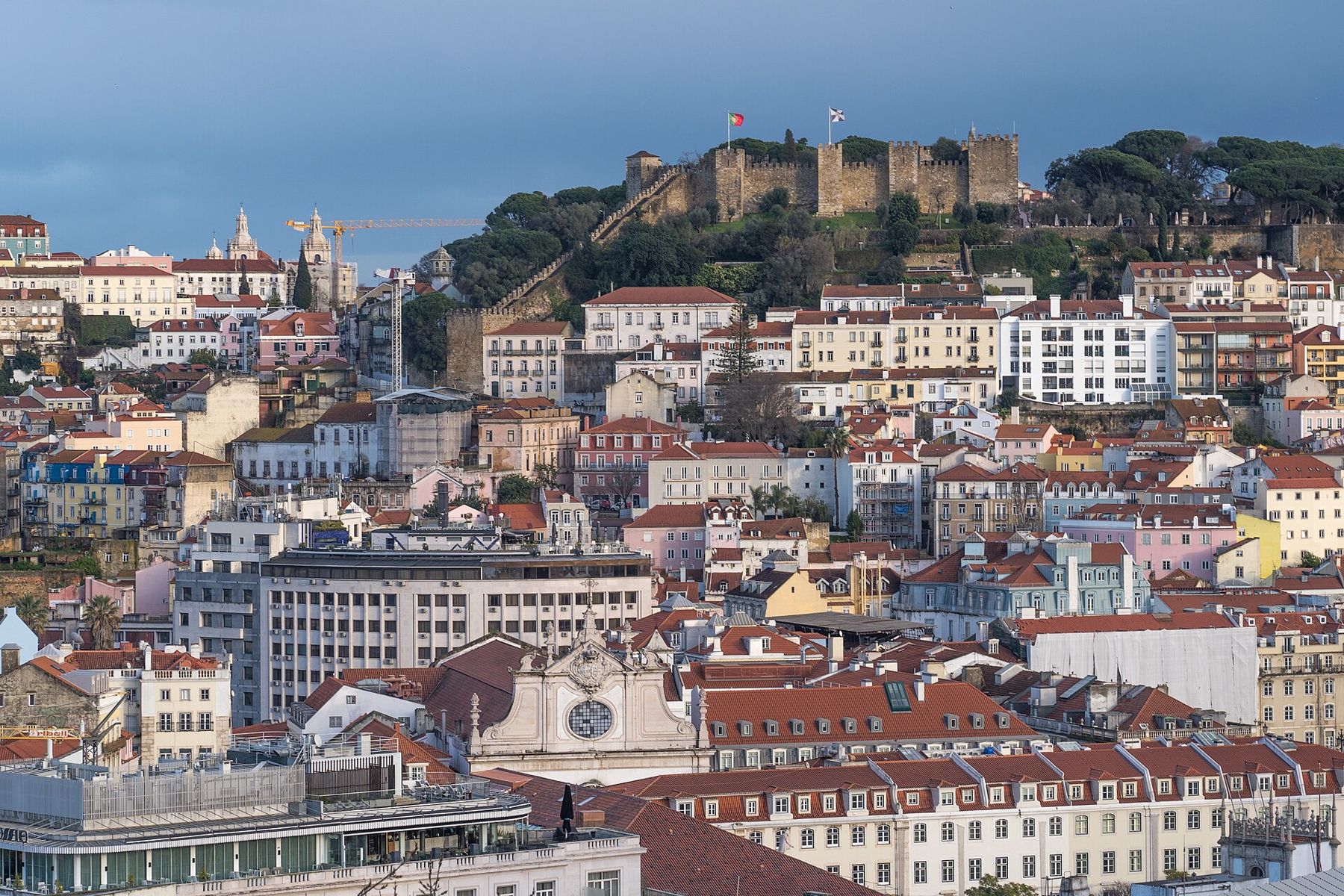
Across the valley from the castle rises the other hill of old Lisbon. The Chiado, at its foot, has been the city's literary and shopping quarter since the nineteenth century. Above it, the Bairro Alto is a grid of narrow streets laid out in the sixteenth century, quiet by day and crowded at night. Together they hold some of the city's best views and two of its most surprising churches.
This walk starts in the Largo do Chiado, climbs to the ruins of the Carmo convent and the Jesuit church of São Roque, crosses to the garden terrace of São Pedro de Alcântara, threads through the Bairro Alto and comes down past the statue of Camões to the Adamastor viewpoint. It ends by following the rails of the Bica funicular down to the river side of the hill. Allow about two hours, with some steady climbs.
The Baixa-Chiado metro station, on the blue and green lines, has an exit right by the start, and tram 28 passes through the square.
Largo do Chiado
Look at the seated bronze poet in a cloak, mid-gesture, on his plinth.
The quarter takes its name from the poet on the plinth, António Ribeiro, a sixteenth-century friar turned writer of satires who was known as o Chiado. Two churches face each other across the square, the Loreto, long the church of Lisbon's Italian community, and the Encarnação. A few steps along Rua Garrett, a bronze Fernando Pessoa sits at a table on the pavement, the most photographed statue in the city.
On 25 August 1988 a fire destroyed much of the Chiado, including old department stores and a block of eighteenth-century buildings. The rebuilding was led by the architect Álvaro Siza, who kept the old façades and the scale of the streets while renewing the buildings behind them. Notice how few signs of the fire remain: that was the point.
Walk on · Up Rua da Trindade or the stepped lanes towards Largo do Carmo, 4 minutes.
Convento do Carmo
Look through the doorway at the open sky where the roof used to be.
The Carmelite convent was founded at the end of the fourteenth century by Nuno Álvares Pereira, the commander who secured Portugal's independence from Castile and later became a friar here. Its church was among the largest in Lisbon until the earthquake of 1755 brought down the roof. It was never rebuilt. The bare Gothic arches were left standing, and today the ruins house an archaeological museum whose hours and fees change.
The square in front has its own history. On 25 April 1974 the head of the government, Marcelo Caetano, took refuge in the barracks of the national guard here, and surrendered that evening to the officers of the coup, with a crowd filling the square. Look at the fountain in the centre and the trees: this is one of the quieter squares in central Lisbon, and the walkway from the Santa Justa lift, a stop on the Baixa walk, opens onto it.
Walk on · West along Rua da Trindade and up to Largo Trindade Coelho, 5 minutes.
Igreja de São Roque
Look at the plain stone front, then go inside to the side chapels.
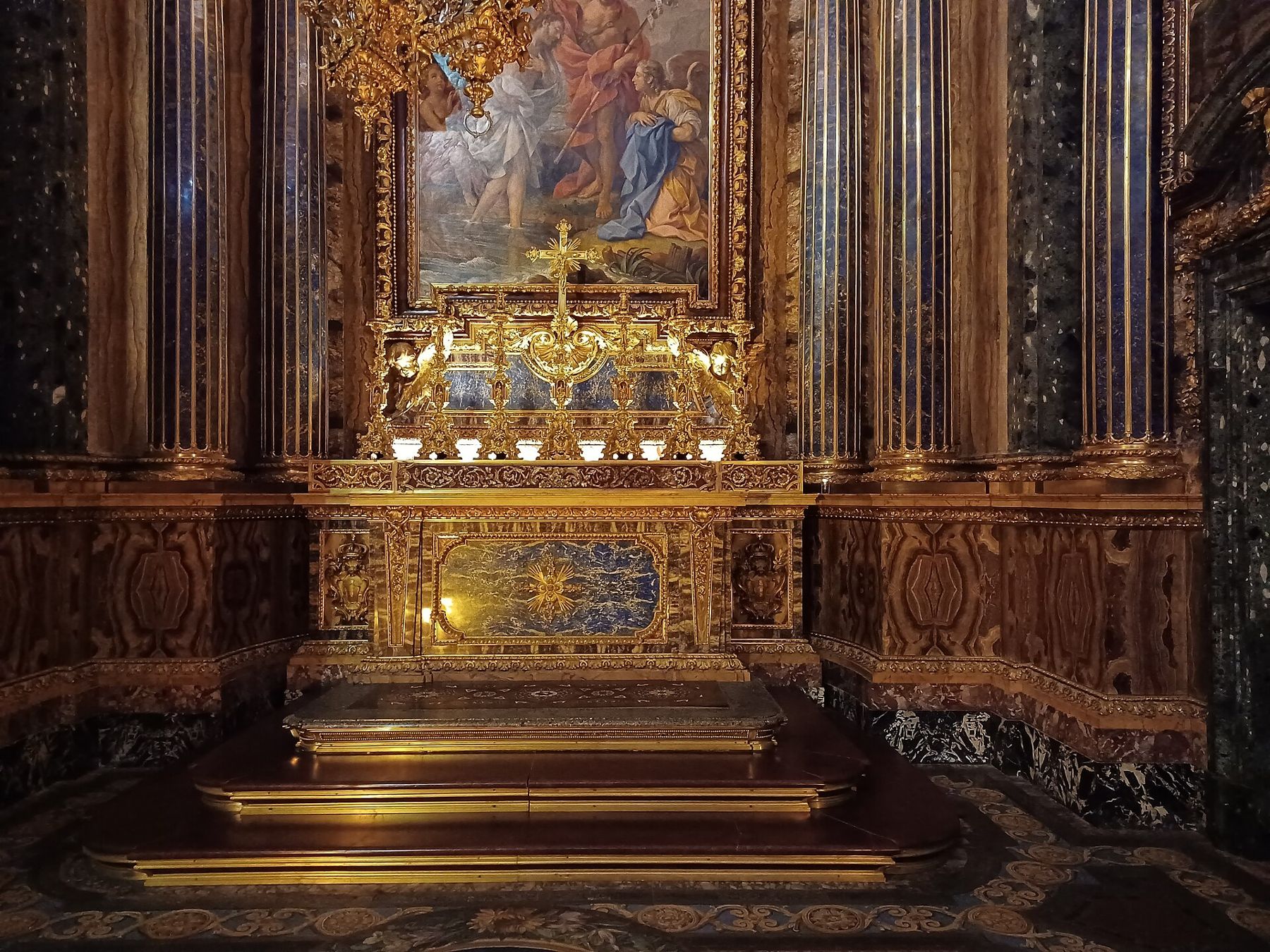
From outside, the Jesuit church of São Roque is one of the plainest in Lisbon; the front was rebuilt after 1755. Inside, it is one of the richest. The Jesuits built it in the sixteenth century, and its gilded chapels show what Portuguese wealth from Brazil could buy.
The Chapel of Saint John the Baptist, on the left side, is the famous one. King João V commissioned it in Rome in the 1740s, had it built there, blessed by the pope, then taken apart and shipped to Lisbon to be reassembled. What look like paintings are mosaics, and the stone includes lapis lazuli, agate and marble. Opening hours change. Outside, in the square, notice the bronze statue of a lottery-ticket seller, a tribute to a trade that has long been part of Lisbon's street life.
Walk on · North along Rua de São Pedro de Alcântara to the garden terrace, 3 minutes.
Miradouro de São Pedro de Alcântara
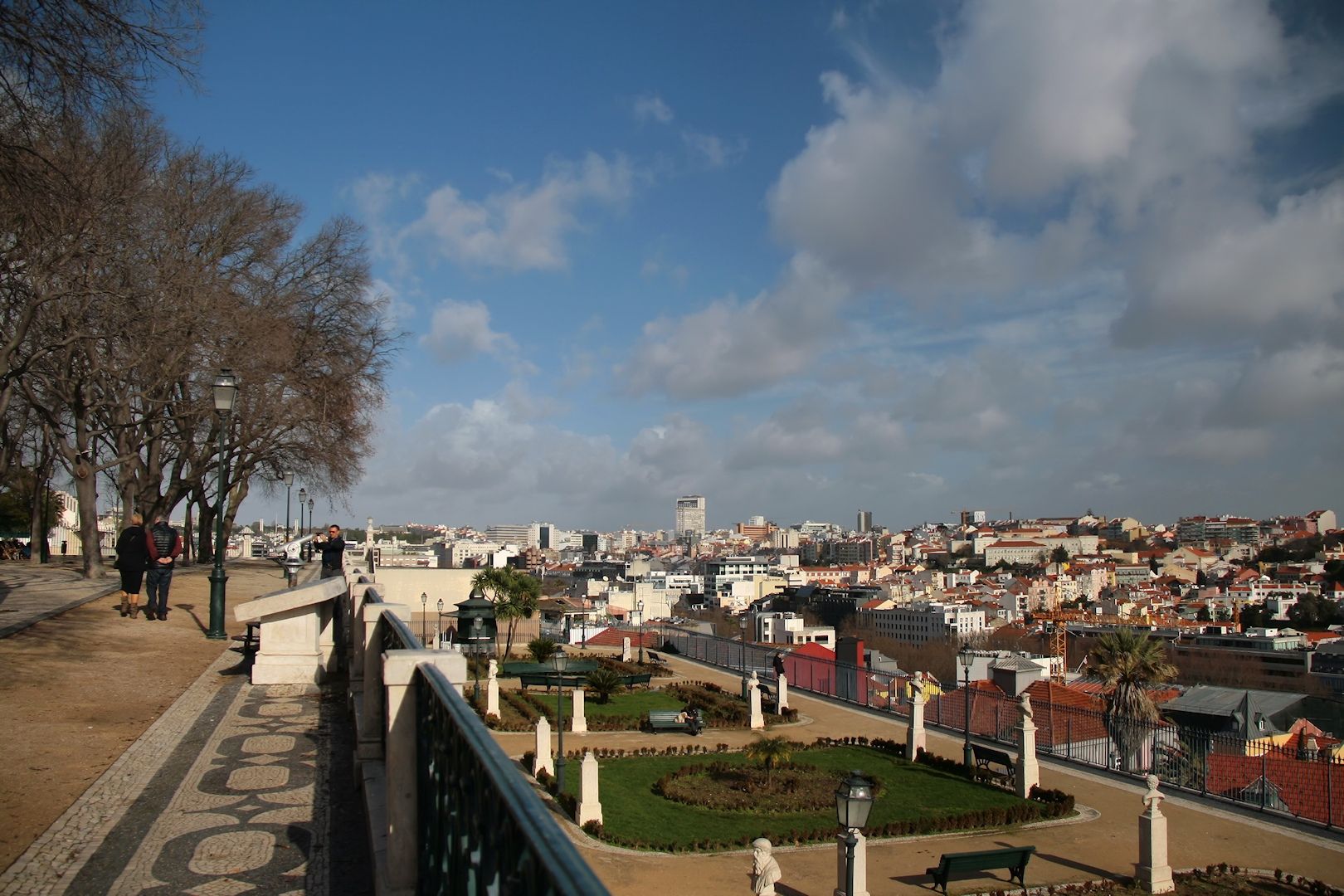
Look straight across the valley at the castle walls on the opposite hill.
This two-level garden terrace looks east across the Baixa valley to the castle, the Graça ridge and the dome of the Pantheon. A tiled panel on the parapet names the buildings you can see, which is useful for picking out where you have been and where you are going. The upper terrace has trees and benches; the lower garden, down the steps, has busts of figures from Greek and Roman myth.
At the near end you will see the yellow cars of the Elevador da Glória, a funicular that has climbed from Restauradores since 1885. On the terrace stands a monument to Eduardo Coelho, founder of a Lisbon daily newspaper, with a newspaper boy at his feet: Bairro Alto was for a century the city's printing and newspaper quarter. The Graça viewpoints on the far ridge look straight back at this one.
Walk on · Back south and right into the Bairro Alto grid, along Rua da Rosa, 6 minutes.
Bairro Alto, Rua da Rosa
Look along the street at the long straight line of balconies and laundry.
Unlike Alfama, the Bairro Alto was planned. In the sixteenth century the land was divided into a grid of narrow parallel streets for a growing city, and the Jesuits of São Roque soon became its most important residents. The quarter came through the 1755 earthquake better than the Baixa, so the street plan you walk is the original.
By day it is a residential neighbourhood of small houses, workshops and washing hung out to dry. At night the same streets fill with people drinking outside the bars until late, and the noise has become a long-running argument between residents and the city. Look at the corners for the tiled street names and at the small iron balconies, some still with their old wooden shutters.  Change here for the Lisbon lineBelém, along the water
Walk on · South down Rua da Rosa and left to the large square with the statue, 6 minutes.
Praça Luís de Camões
Look up at Camões holding his sword and book, ringed by eight smaller figures.
Luís de Camões wrote Os Lusíadas, the epic of Vasco da Gama's voyage to India, published in 1572, and Portugal's national day, 10 June, is the date of his death. His statue was put up in 1867, with eight smaller figures around the base representing Portuguese writers and chroniclers.
The square is the hinge between the Chiado and the Bairro Alto, and between the old city and the newer streets heading west. Tram 28 passes along its southern side. Look at the paving here too: the square is covered in patterned calçada, and on a sunny day its white limestone glares. Camões wrote about the giant Adamastor, whom you will meet at the next stop.
Walk on · West along Rua do Loreto, then left at the sign for Santa Catarina, 7 minutes.
Miradouro de Santa Catarina
Look at the rough stone giant rising from the rock below the terrace.
The figure is Adamastor, the monster of the Cape of Good Hope in Os Lusíadas, who rises from the sea to warn Vasco da Gama's sailors of the storms waiting for anyone who dares to pass him. The sculpture was carved in the 1920s, and Lisboetas often call this terrace simply the Adamastor.
The view here faces the other way from the earlier terraces: south and west over the port, the docks and the river to the long red suspension bridge, the Ponte 25 de Abril, and the Christ statue on the south bank. It is a favourite spot at sunset, when it fills with people sitting on the walls. Look down at the cranes and warehouses below: the port is still working, and the ships pass close under the bridge.
Walk on · East along Rua de Santa Catarina to Largo do Calhariz, then down the funicular rails, 8 minutes.
Elevador da Bica
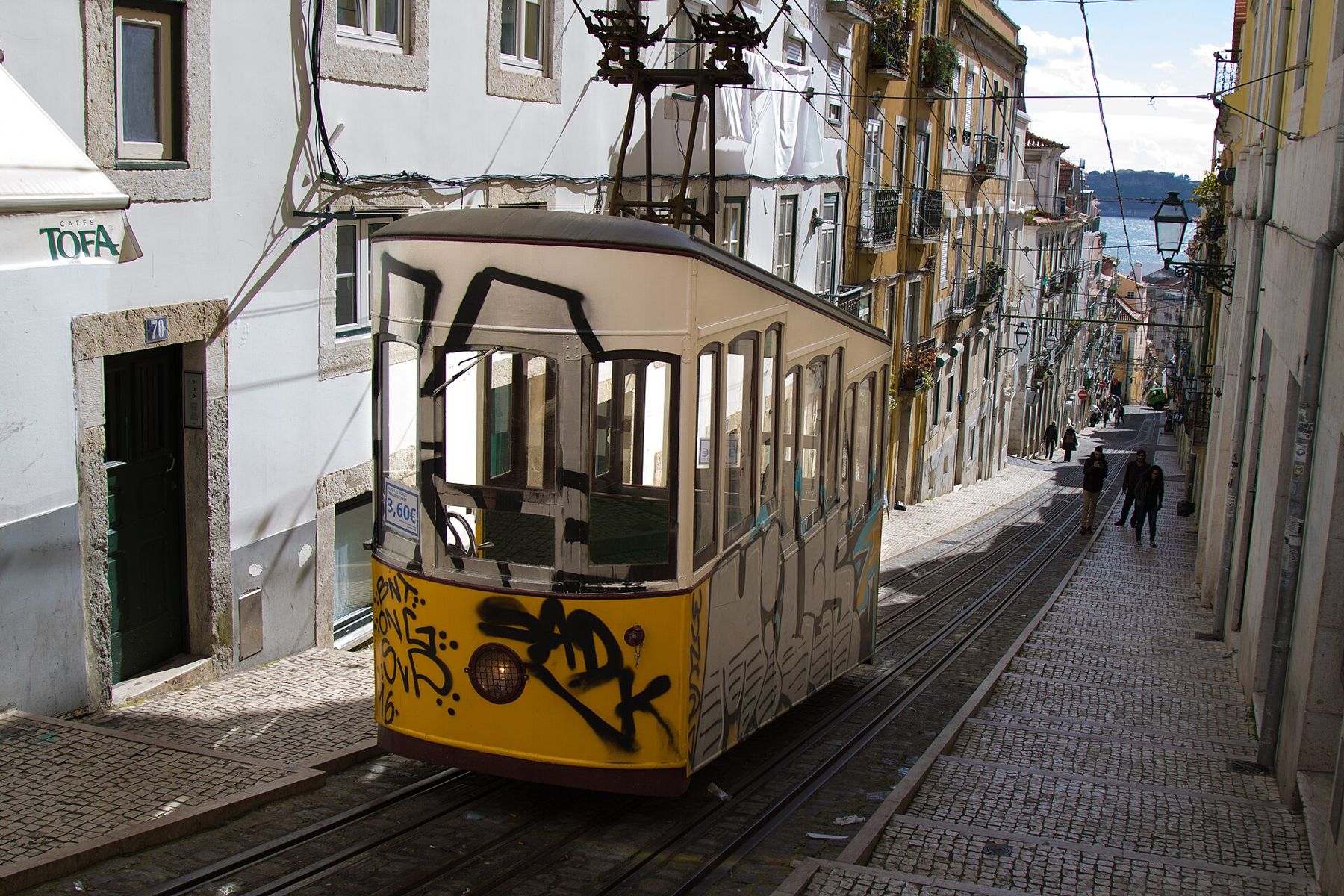
Look up the street at the yellow funicular car framed by the houses.
The Bica funicular has climbed this street since 1892, linking the riverside streets to the top of the hill at Calhariz. It runs along a narrow residential street, so the houses press right up to the rails. You have walked down beside it from the top.
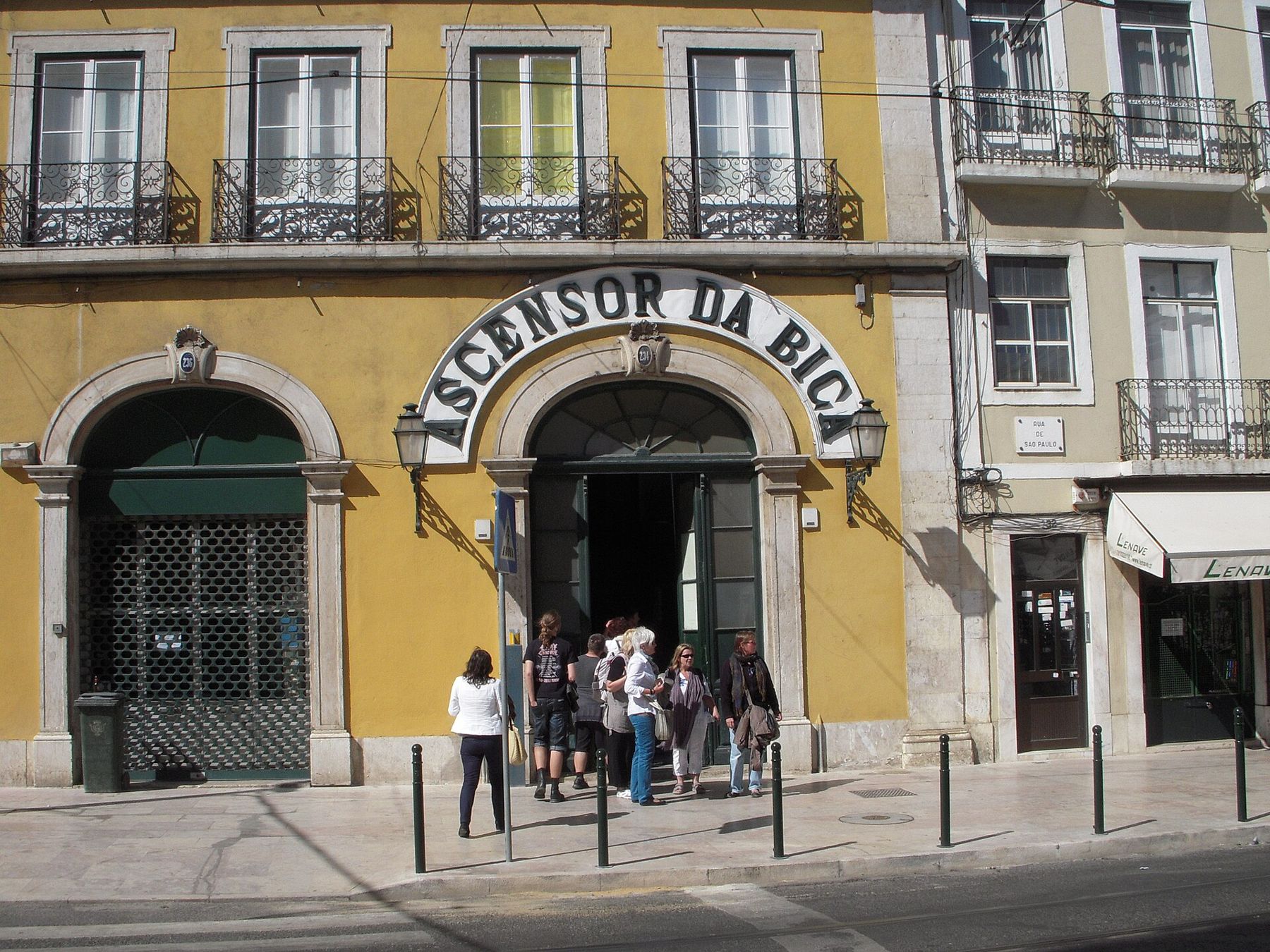
The lower station is set into a building on Rua de São Paulo, behind an arched entrance with the funicular's name painted above. Look back up the slope: the view of the car coming down between the houses, with the river glinting behind you, is the picture most people come for. Together with the Glória and the Lavra funiculars and the Santa Justa lift, the Bica is protected as a national monument.
Finishing at the Bica
The walk ends on Rua de São Paulo, a short walk from Cais do Sodré, where the metro green line, trains along the coast and ferries across the river all start. If your legs have had enough, you can ride the Bica back up instead of walking.
Climbs, shade and footing
There are three real climbs: up to Carmo, up to São Pedro de Alcântara and the steep descent beside the Bica rails, which is the hardest on the knees. The streets of the Bairro Alto are narrow and shady in the morning, while the viewpoints are open to the sun. Carry water. There are toilets at the São Pedro de Alcântara garden and inside the larger churches and museums; check before relying on them. The stone paving is slippery, especially on the Bica slope after rain.
Safety and next steps
By day this is an easy area to walk. At night Bairro Alto is crowded and loud; keep your phone and bag close. Next, cross to the castle hill for Alfama, or go down to the river for the Baixa walk.