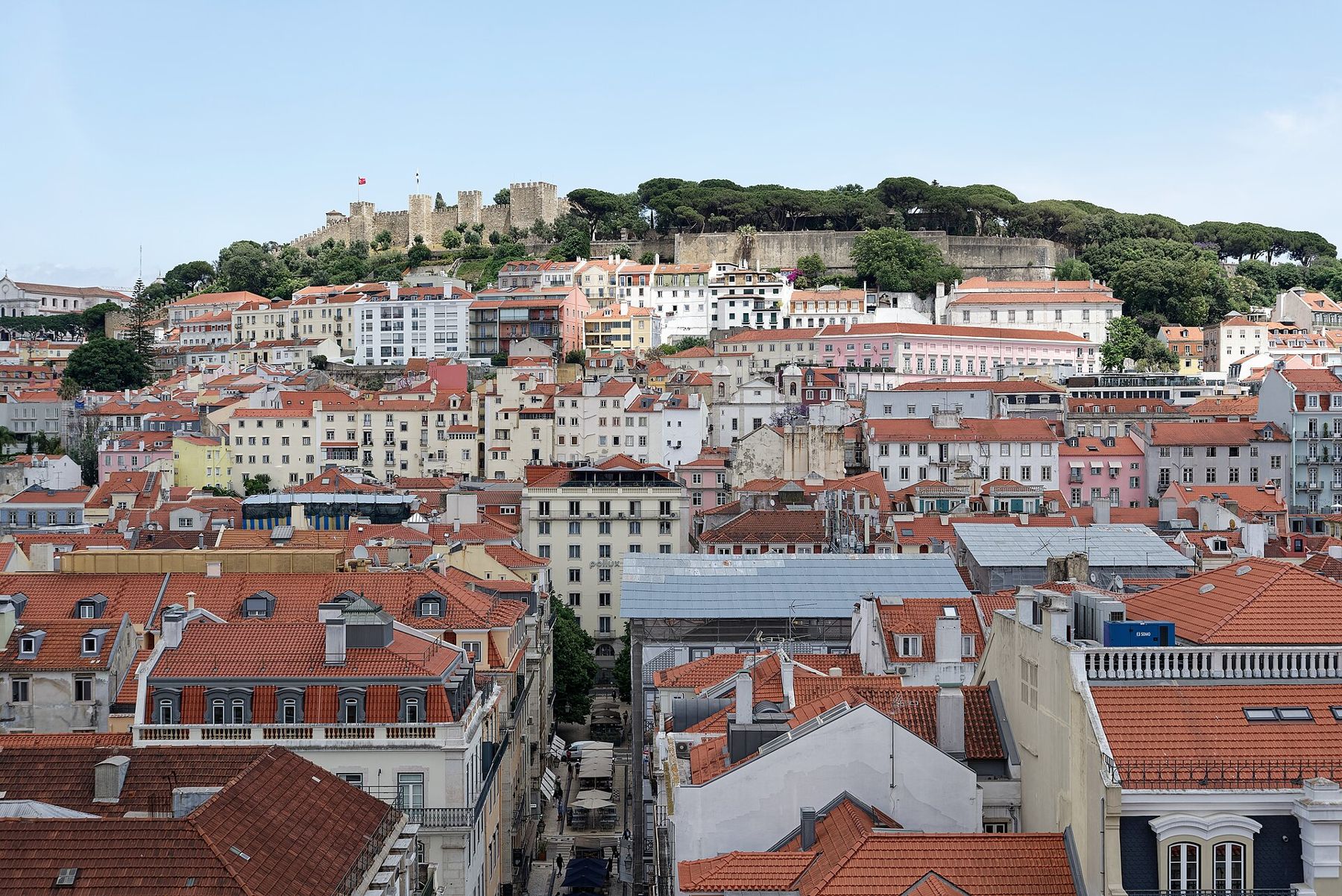
On the morning of 1 November 1755 an earthquake, the fire that followed and a series of waves from the river destroyed the low heart of Lisbon. What replaced it is the Baixa: a grid of straight streets laid out under the king's chief minister, later the Marquis of Pombal, and built to a standard design meant to survive the next shock. It is one of the earliest large planned rebuildings in Europe, and you can read it from the pavement.
This walk goes from Rossio, the old main square, past the iron lift that climbs to the Chiado, down the length of Rua Augusta, under its triumphal arch and out to the river. It ends a little east of the riverfront square at a house that the earthquake cut in half. The route is almost level and takes about an hour and twenty minutes at an easy pace.
Rossio has its own metro station on the green line, and Restauradores on the blue line is a few minutes north.
Rossio (Praça de D. Pedro IV)
Look down at the black and white paving laid in rolling waves.
Rossio has been Lisbon's main square since the Middle Ages, a place of markets, bullfights, festivals and executions. Its official name honours Pedro IV, king of Portugal and first emperor of Brazil, who stands on top of the tall column. The wave pattern underfoot, laid in the nineteenth century in small hand-cut stones, became a model for Portuguese paving across the world, and you will see it again on the other side of the Atlantic on Rio's Copacabana promenade.
On the north side, the National Theatre D. Maria II stands where the Inquisition had its palace, and the autos-da-fé of the Inquisition were staged in this square. Look to the north-west corner for the station front with its horseshoe doorways, built in the 1880s and 1890s in a revival of the Manueline style.
Walk on · South down Rua do Ouro, 4 minutes; the iron tower appears down a side street on your right.
Elevador de Santa Justa
Look up at the neo-Gothic ironwork climbing the tower towards the walkway.
The Baixa sits in a valley, and the Chiado and Carmo stand high above it on the west. In 1902 this lift opened to lift people up the difference. It was designed by Raoul Mesnier du Ponsard, an engineer born in Porto to French parents, and it ran on steam until it was electrified a few years later. A walkway at the top crosses to the Largo do Carmo, beside the ruined convent on the Chiado and Bairro Alto walk.
The lift is now as much a sight as a means of transport, and the queue at the bottom can be long; fares and hours change. From below, notice how the tracery of the ironwork repeats the pointed arches of a Gothic church, and how the tower stands at the end of a narrow street of the grid like a church spire.
Walk on · East to Rua Augusta, then right, downhill along the pedestrian street, 5 minutes.
Rua Augusta at Rua da Conceição
Look along the cross street at the tram rails and the matching façades.
Stand at this crossing and you can see the plan at work. Every block of the Baixa was built to the same few designs: shops on the ground floor, three or four storeys above, the same window frames and the same roofline, so that a whole street reads as one building. Inside the walls is the clever part. The Pombaline buildings were framed with a lattice of timber, the gaiola or cage, meant to flex in an earthquake rather than collapse.
The street names keep the old trades that were assigned to them: Rua do Ouro for goldsmiths, Rua da Prata for silversmiths, Rua dos Correeiros for leather workers, Rua dos Sapateiros for shoemakers. Look at the tram rails crossing here: they belong to routes that climb into Alfama and towards the Sé, the start of the walk up to the castle.
 Change here for the Lisbon lineBelém, along the water
Walk on · Continue straight down Rua Augusta towards the arch, 3 minutes.
Arco da Rua Augusta
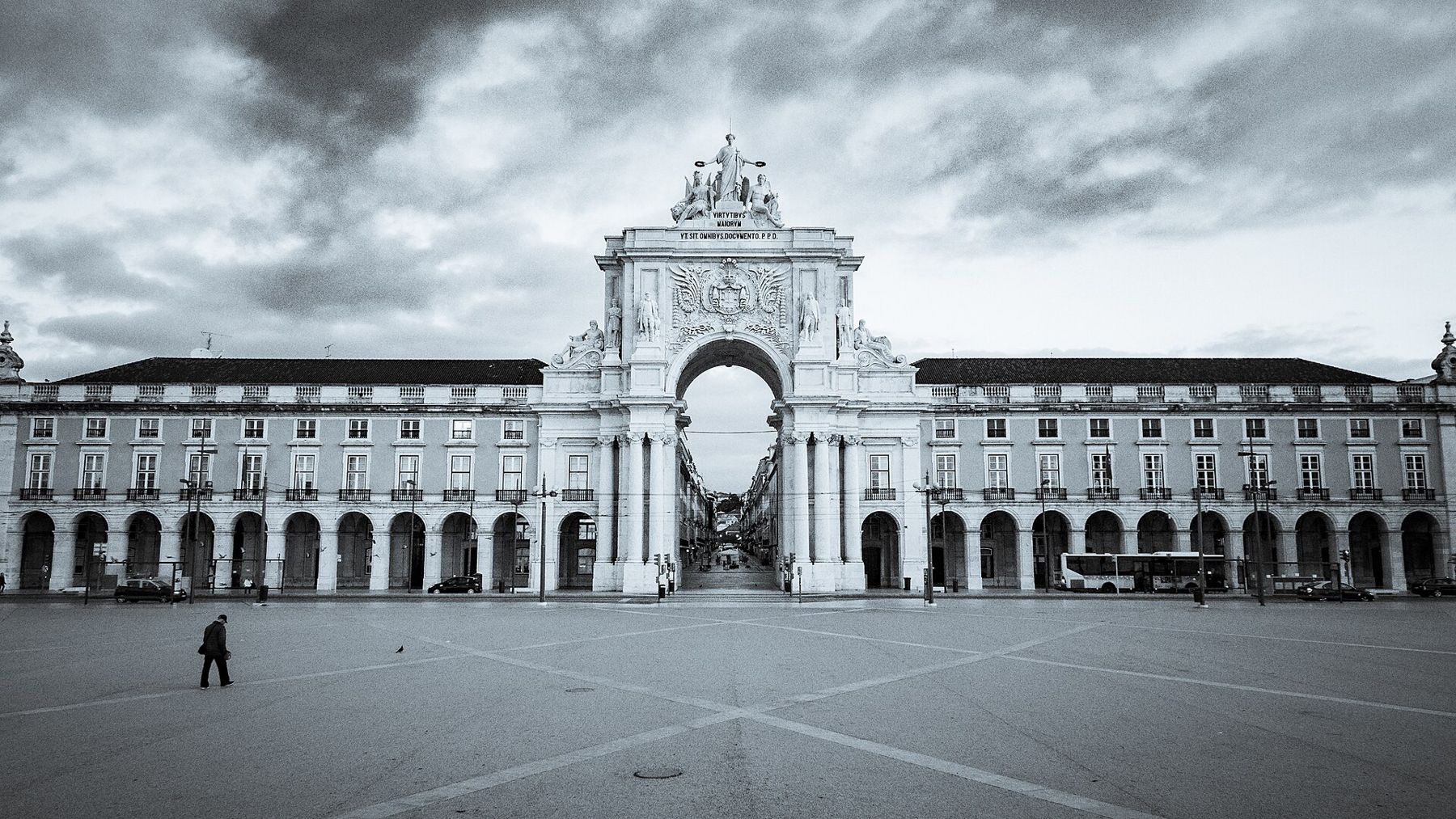
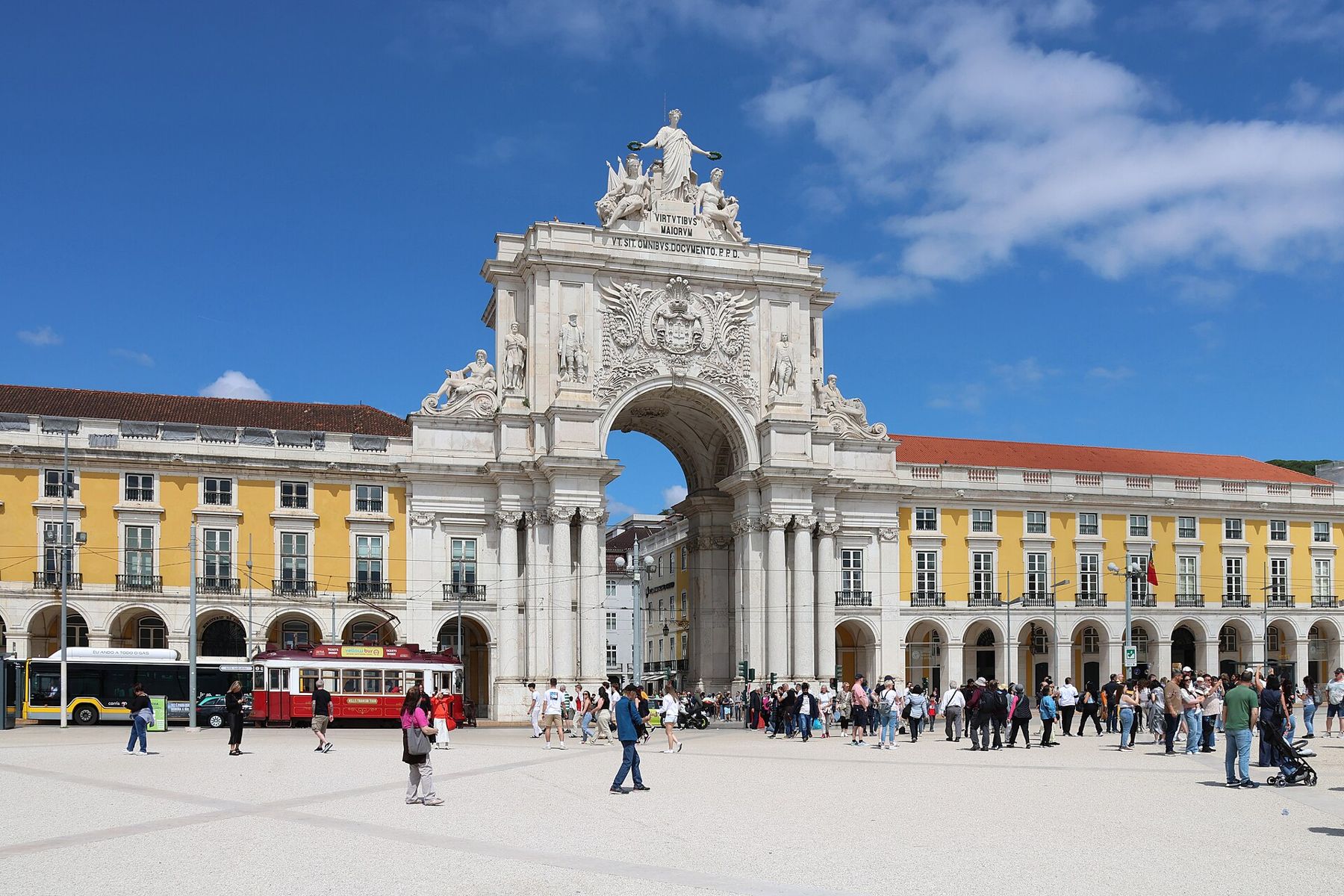
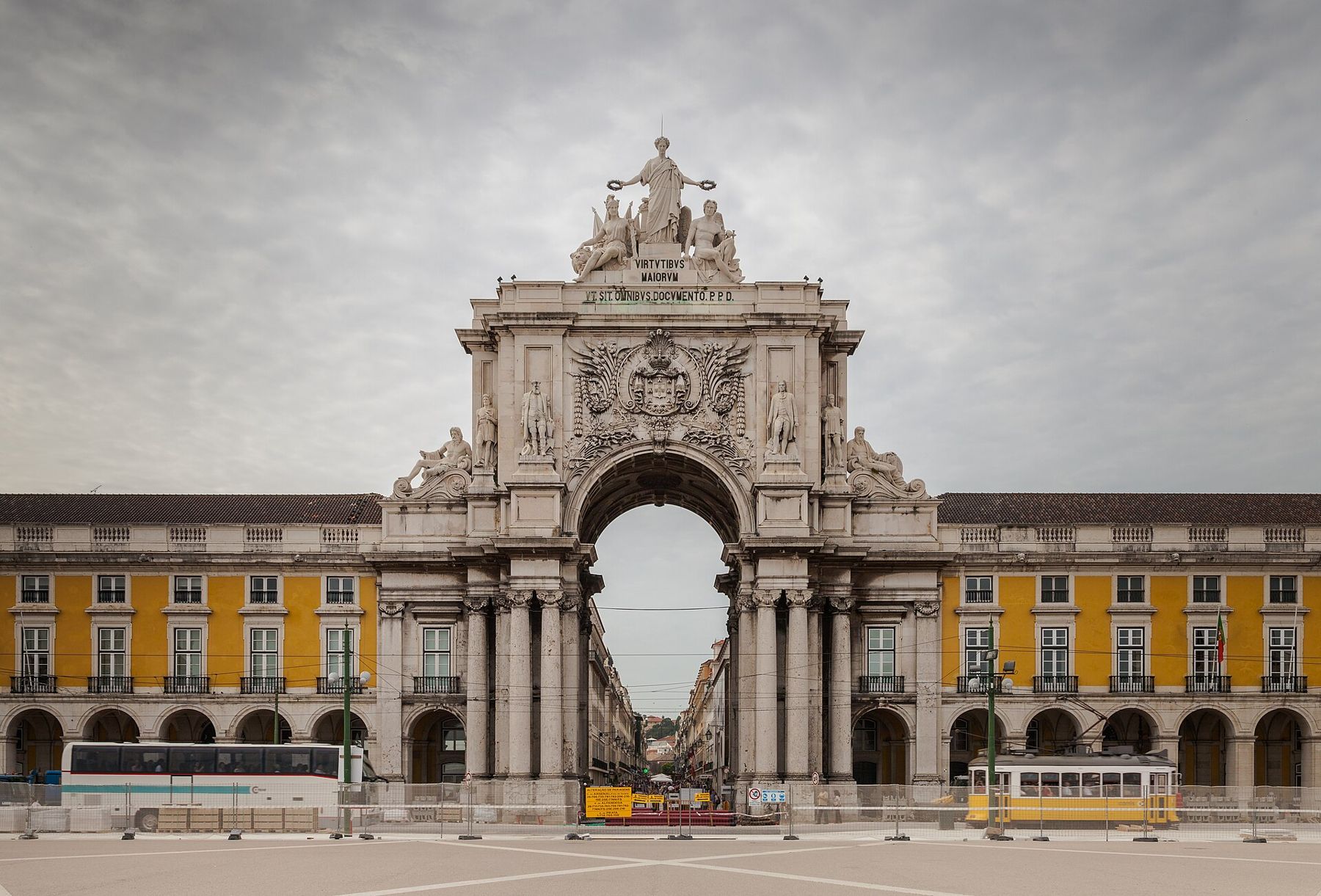
Look up at the figure of Glory crowning two seated figures on top of the arch.
The arch was part of the plan from the start but was only finished in 1875, more than a century after the earthquake. The sculpture on top shows Glory crowning Valour and Genius. Lower down stand statues of figures from Portugal's history, among them Vasco da Gama and the Marquis of Pombal himself. The Latin inscription dedicates the arch to the virtues of the ancestors, as an example to all.
Before you walk through, turn around. From under the arch the street runs back straight to Rossio, and on a clear day the column there lines up with the vault. There is a viewing terrace at the top of the arch, reached by lift and stairs; it charges for entry and hours change. Notice too the clock face set in the stonework.
Walk on · Through the arch and straight on to the equestrian statue, 2 minutes.
Praça do Comércio
Look at the bronze horse treading on snakes beneath King José.
This was Terreiro do Paço, the palace yard, and many in Lisbon still call it that. The royal Ribeira Palace stood on the west side of the square until 1755, and its library and archives were lost in the fire. The square that replaced it was given arcaded wings on three sides, open to the river on the fourth, to house the offices of state and the trade that paid for the rebuilding.
The statue of King José, by Joaquim Machado de Castro, was unveiled in 1775. Two later events took place here. In 1908 King Carlos and his heir were shot dead in the north-west corner of the square. On 25 April 1974 an army column occupied the square in the coup that ended the dictatorship, a day now called the Carnation Revolution.
Walk on · Straight across the square to the riverbank and the two columns, 2 minutes.
Cais das Colunas
Look at the two stone columns and the marble steps running down into the water.
For a city that lived by the sea, this was the front door. The steps were the formal landing place for royal visitors and heads of state arriving by boat, who walked up from the water straight into the square and the city. The two columns frame the river, which is so wide here that people still call it the sea of straw, from the colour of the light on it at sunset.
Look across to the far bank: the statue of Christ on its tall plinth stands above Almada, and the long suspension bridge crosses downstream to the west. The tide matters here; at high water the lower steps disappear and the river laps at your feet. The stone is slippery and covered in weed below the waterline, so stay off the lowest steps.
Walk on · East along the riverfront past the ferry station, then left to the square, 7 minutes.
Casa dos Bicos
Look at the façade studded all over with stones cut to diamond points.
This house was built in the early sixteenth century for Brás de Albuquerque, son of the viceroy of Portuguese India, Afonso de Albuquerque. Its front of pointed stones, the bicos, followed an Italian fashion that was rare in Lisbon. The earthquake of 1755 brought down the two upper storeys, and for more than two centuries the house stood cut short. The top floors were rebuilt in the 1980s, based on old views of the building.
Since 2012 it has been home to the José Saramago Foundation, named after the Portuguese writer who won the Nobel Prize in Literature in 1998. Notice the olive tree in front of the house: his ashes are buried beneath it. Beneath the building, excavations found remains of Roman fish-salting tanks, a reminder that the river has fed this city for two thousand years.
Finishing by the river
The walk ends at Campo das Cebolas, a few minutes east of Praça do Comércio. Terreiro do Paço metro station, on the blue line, is close by, and the ferries to the south bank leave from the terminal you passed on the way. From the Casa dos Bicos it is a short, steep climb into Alfama to the Sé.
Shade, water and safety
The Baixa streets are shaded for part of the day by their own buildings, but Praça do Comércio and the riverfront are wide open to the sun, so carry water and a hat in summer. There are public toilets around Praça do Comércio and in the metro area, though not always open. Rua Augusta is crowded and attracts pickpockets and people offering to sell you things; keep bags closed and walk on. The paving is smooth and slick after rain.
Next
Climb to the Chiado and Bairro Alto for the view back over the grid, or ride tram 15 west along the river to Belém and its monastery.