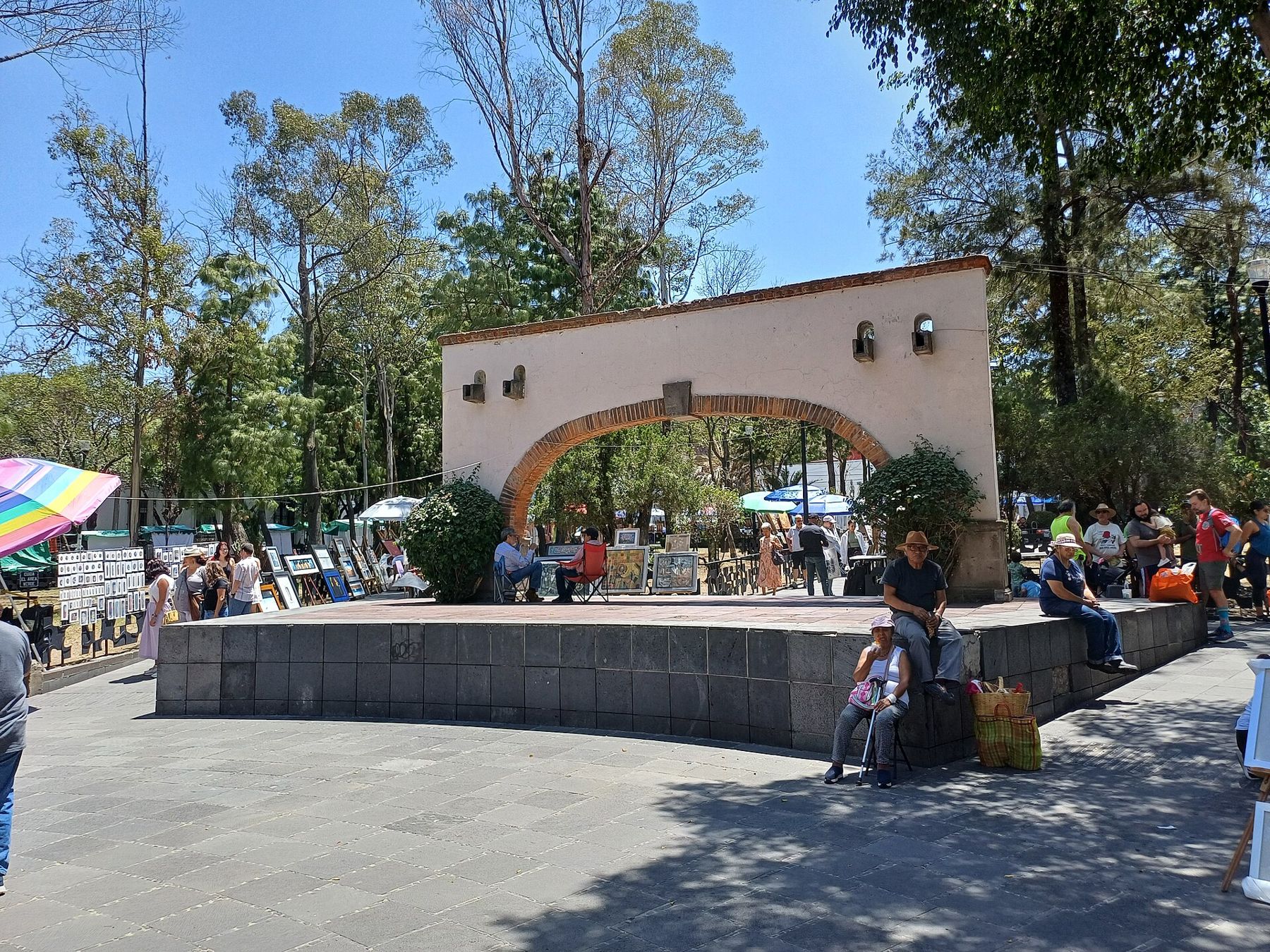
San Ángel was a country town of convents, orchards and summer houses south of the city, and it keeps much of that air: cobbled streets, high stone walls overhung with bougainvillea, quiet plazas and colonial churches. It takes its name from the Carmelite college of San Ángelo Mártir, built here in the seventeenth century.
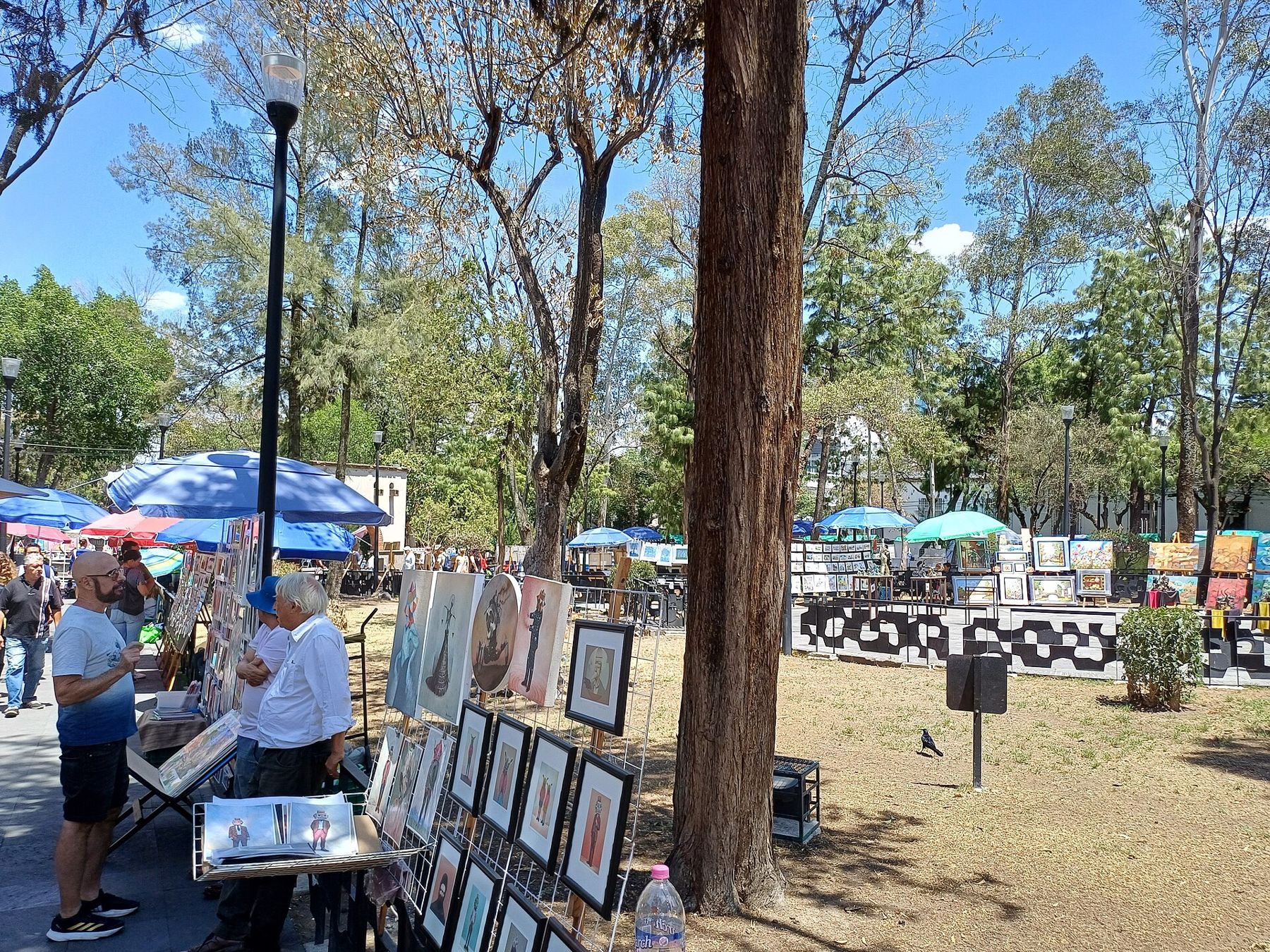
Saturday is the day to come. Artists hang paintings around Plaza San Jacinto and the nearby gardens, and a long-running Saturday bazaar of crafts fills a house on the square.
This walk starts at the monument in the Parque de la Bombilla, crosses to the Carmen convent museum, climbs gently to Plaza San Jacinto and its church, wanders the lanes around Plaza de los Arcángeles, and ends outside the twin studio houses of Diego Rivera and Frida Kahlo.
The route is about 2.4 kilometres and takes a little under two hours. The La Bombilla stop on Metrobús Line 1, along Avenida Insurgentes, is right at the start. Combine it with Coyoacán, a short taxi ride east.
Monumento a Álvaro Obregón
Look at the tall stone monument rising at the end of the park.
The Parque de la Bombilla takes its name from a restaurant that stood here. On 17 July 1928 General Álvaro Obregón, who had just been elected president for a second time, was shot dead at a lunch in his honour by José de León Toral, a young Catholic militant, during the years of conflict between the government and the Church.
The monument, built in the 1930s, marks the spot. For decades it also held the arm Obregón had lost in battle in 1915, preserved in a jar; it was finally cremated in 1989.
Notice the sculpted figures at the monument's base and the stern lines of 1930s public architecture.
Walk on · Cross Avenida Revolución at the lights to the convent with the tiled domes; 6 minutes.
Museo de El Carmen
Look up at the three domes covered in coloured glazed tiles.
The Carmelite friars built their college and church here in the early seventeenth century, and the college of San Ángelo Mártir gave the whole district its name. The church is still in use, and the former college is now the Museo de El Carmen.
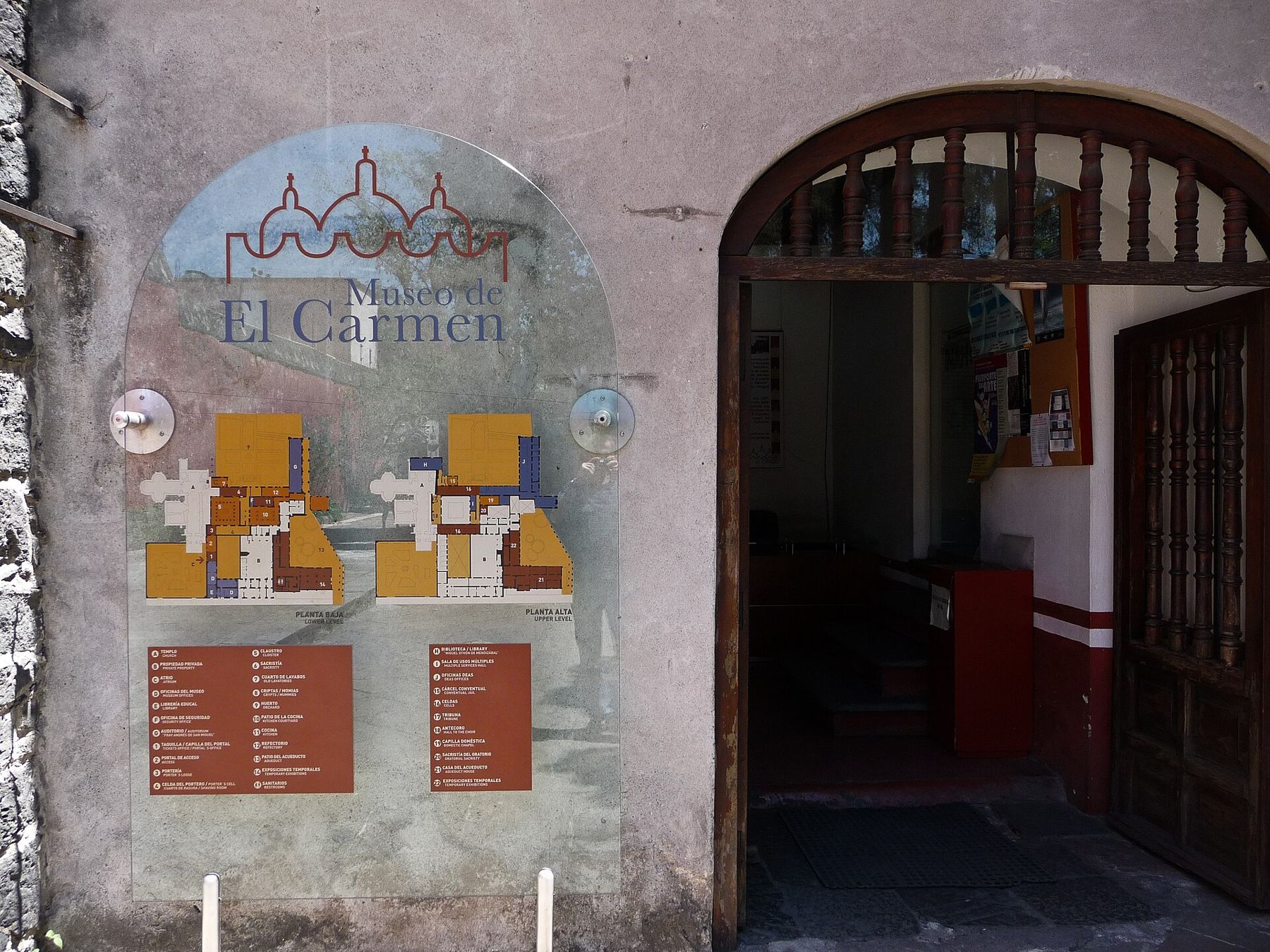
Inside are colonial paintings and furniture, tiled rooms and a peaceful garden that was once the friars' orchard. The museum is best known for its crypt, where naturally mummified bodies, discovered in the early twentieth century, are displayed.
Notice the tiled domes from the street: glazed tiles in yellow, blue, green and white, catching the light. Museum days and hours change, so check before visiting.
Walk on · Walk uphill west along Calle Madero to Plaza San Jacinto; 6 minutes.
Plaza San Jacinto
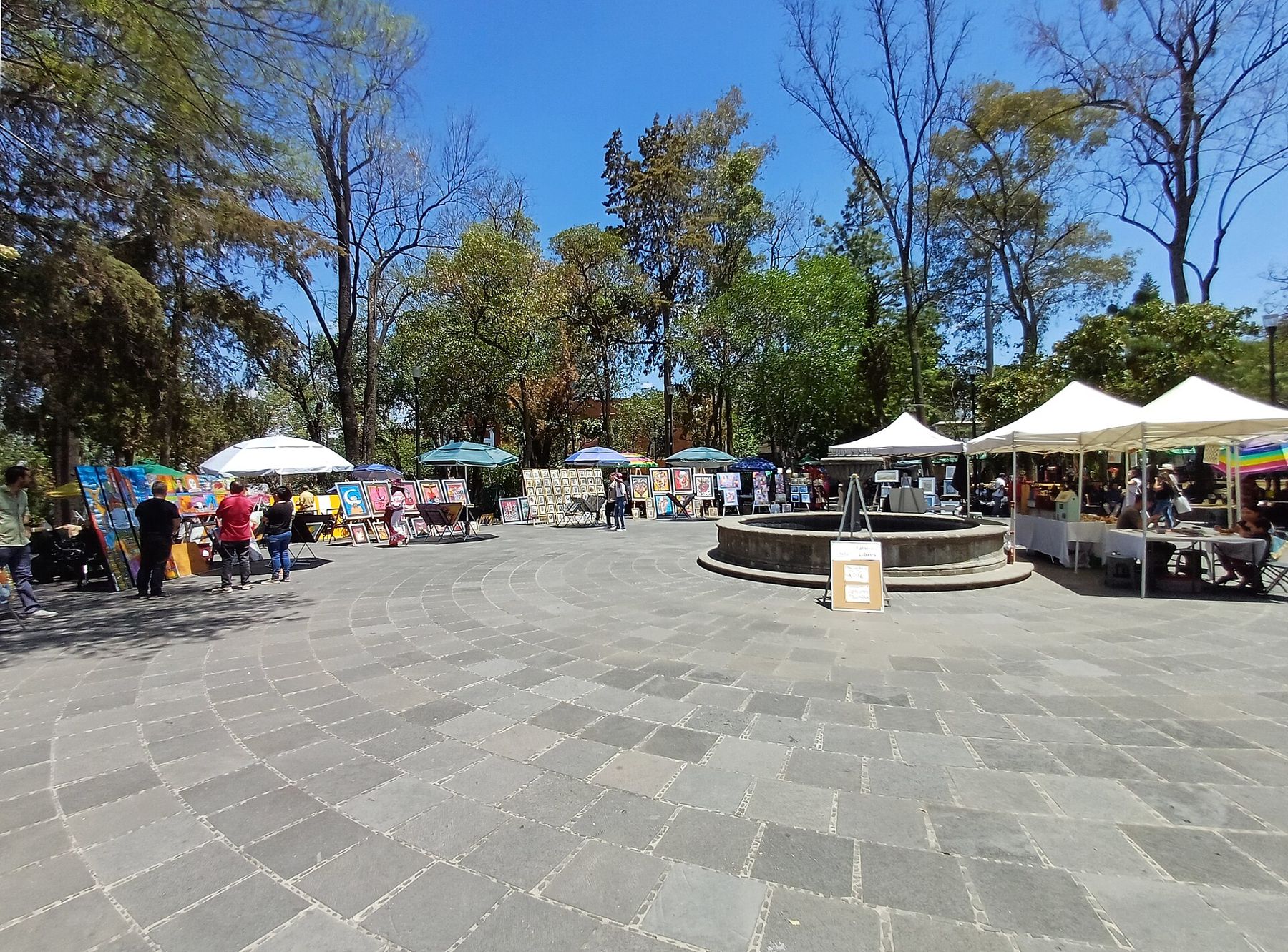
Look at the paintings propped against the trees and railings around the square.
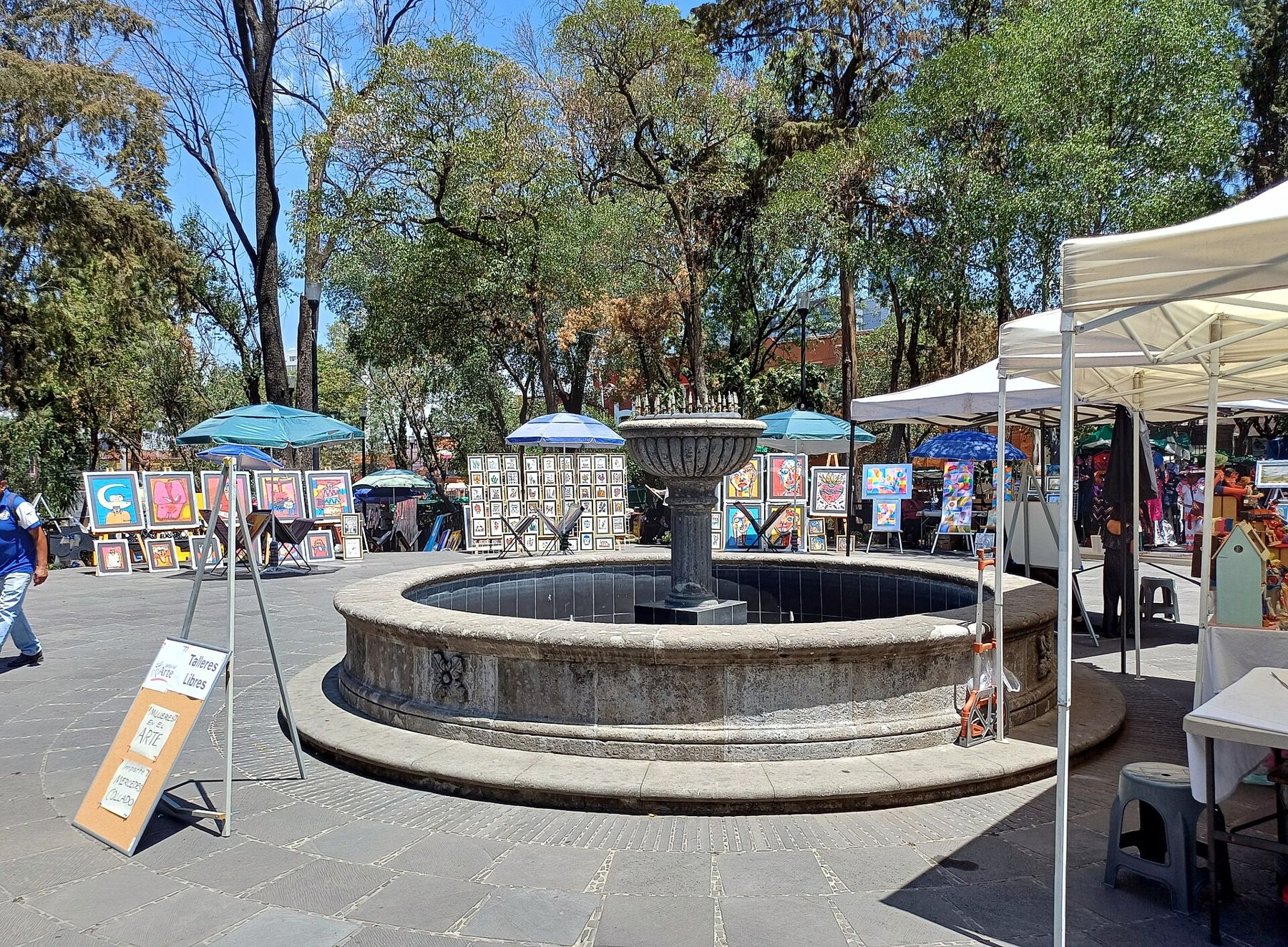
Plaza San Jacinto is the heart of San Ángel, a cobbled square shaded by trees and surrounded by old houses. On Saturdays it fills with artists selling paintings, and a long-running bazaar of crafts operates in a house on the square.
A plaque here remembers the soldiers of the San Patricio Battalion, mostly Irish immigrants who deserted from the United States army and fought for Mexico in the war of 1846 to 1848. After their capture, many were hanged in San Ángel and nearby in September 1847.
Notice the fountain and benches, and how the quiet weekday square changes completely on Saturday.
 Change here for the Bogotá lineUsaquén on a Sunday
Walk on · Cross the plaza to the house with the wide stone front on its north side; 1 minute.
Casa del Risco
Look through the doorway for the fountain covered in broken china.
The Casa del Risco is an eighteenth-century house on the square, now a museum and cultural centre. It is famous for the fountain in its courtyard, covered entirely in fragments of porcelain plates, tiles and shells, set into the plaster in elaborate patterns. The name comes from those risco fragments.
The house was later the home of Isidro Fabela, a diplomat and lawyer, who gave it to the nation with his collection of European and Mexican art.
Notice the scale of the fountain, which fills a whole wall, and the blue and white Chinese and European porcelain mixed with local pottery. The museum has its own opening hours; check before you go.
Walk on · Walk to the church at the western end of the plaza, through its garden gate; 2 minutes.
Templo de San Jacinto
Look at the plain church front behind its quiet walled garden.
The church of San Jacinto was built by Dominican friars in the sixteenth century, and it is one of the oldest buildings in San Ángel. It stands back from the plaza behind a walled atrium and garden, which makes it a calm place after the market.
Inside the church the decoration is restrained, with an altarpiece and colonial paintings. The surrounding garden, with its old trees and benches, is often the quietest spot in the district on a Saturday.
Notice the stone cross in the atrium and the lines of the old walls, which once enclosed a much larger friary.
Walk on · Walk south-west through the cobbled lanes to Plaza de los Arcángeles; 4 minutes.
Plaza de los Arcángeles
Look at the small sloping garden and the cobbled lanes leading off it.
Plaza de los Arcángeles is a small, quiet garden square tucked among the lanes behind San Jacinto. It is less a plaza than a sloping park, with old trees, benches and paths, used by neighbours walking dogs and children playing.
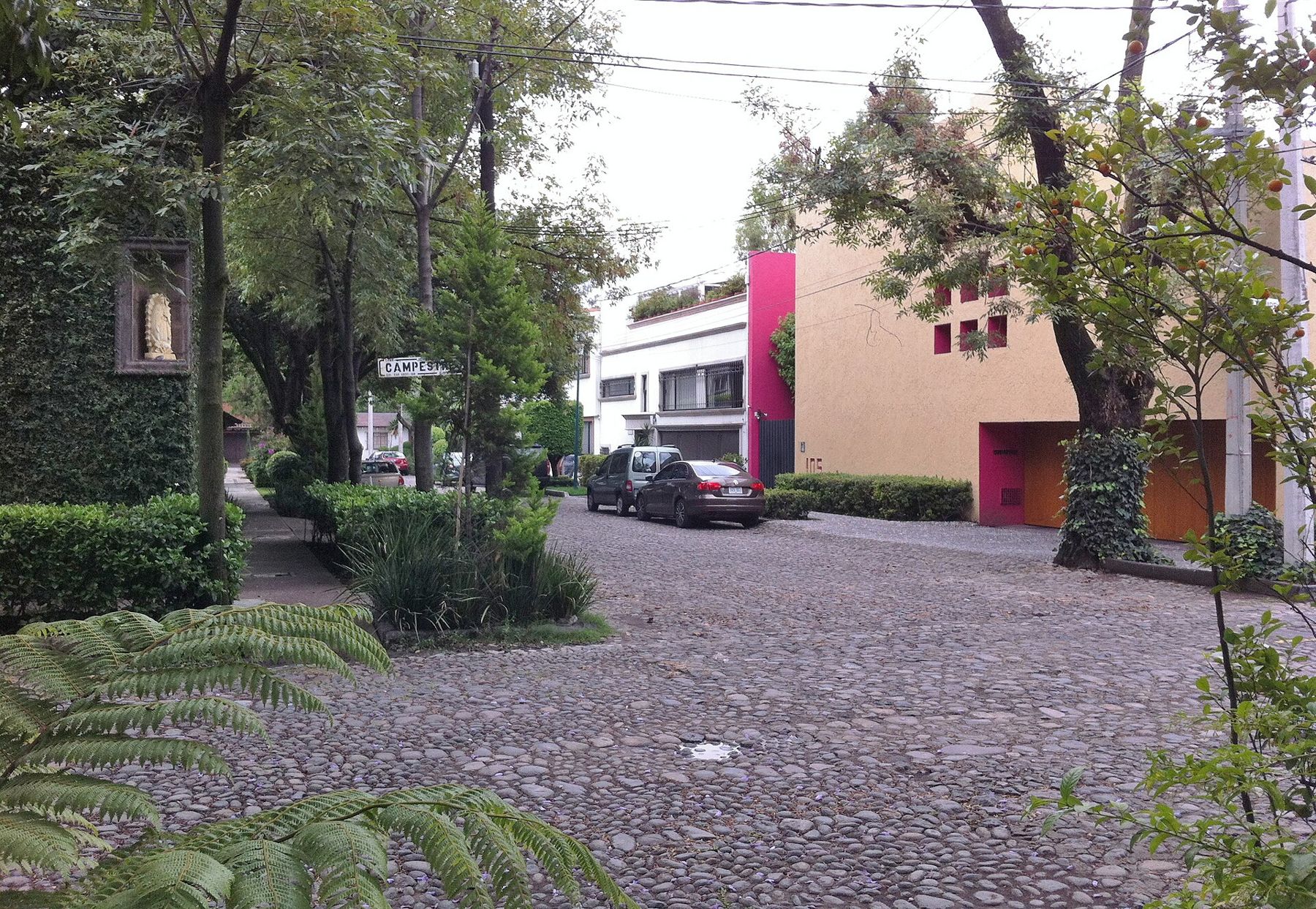
The lanes around it are what San Ángel is known for: narrow cobbled streets, often made of rounded river stones, between high walls with heavy wooden doors and bougainvillea falling over the top. Most of the houses behind them are private.
Notice the stone itself. Much of the building material here is volcanic rock from the Pedregal, the lava field to the south, which gives the walls their dark, rough texture.
Walk on · Walk back north past San Jacinto and on up to Avenida Altavista; 12 minutes.
Rivera and Kahlo studio houses
Look at the two cube-shaped houses, one red and white, one blue.
These two houses were designed by the architect and painter Juan O'Gorman for Diego Rivera and Frida Kahlo and completed in the early 1930s. They were among the first functionalist buildings in Mexico: bare concrete, exposed pipes, large windows and a cactus fence. The larger red and white one, with its saw-tooth roof, was Rivera's studio; the smaller blue one was Kahlo's.
A bridge joins the two at roof level, so each artist had a separate house and studio. Rivera died here in 1957. The houses are now a museum.
Kahlo lived and worked in the blue house for much of the 1930s, before settling back in the Casa Azul in Coyoacán, where she was born.
Notice the contrast with the colonial walls you have just walked past: in a few minutes you have moved from the seventeenth century to the modern movement, and the cactus fence ties the modern houses to the Mexican landscape.
Where you finish
You end on the corner of Altavista and Calle Diego Rivera. To leave, walk back east along Altavista to Avenida Revolución and Avenida Insurgentes for buses and the Metrobús, or take a taxi. Coyoacán, the other old town of the south, makes the natural companion walk. If you still have energy for gardens, the castle and lake of Chapultepec are a longer ride north.
Footing, shade and toilets
The cobbles here are made of rounded stones that are hard on ankles and slippery when wet; wear firm shoes and take the lanes slowly. The route climbs gently from the Bombilla to San Jacinto and the lanes beyond. Shade is good in the plazas and along the walls. Museums have toilets for visitors, and some public ones charge a small fee.
Safety sense
San Ángel is generally calm. On Saturdays the plaza is crowded, so keep your bag in front and your phone close. Cross Avenida Revolución and Avenida Insurgentes only at the lights: traffic is fast and heavy.