The Vieille-Ville sits on a small hill above the point where the Rhône leaves the lake. People have lived up here since before the Romans, and for most of Geneva's history this hilltop was the city: the bishop's church, the council house, the market square and the walls. It is small enough to cross in ten minutes, which is why it rewards walking slowly.
This walk starts in the old market square, climbs to the Cathédrale Saint-Pierre, where Jean Calvin preached during the Reformation, then works west past the town hall and the arsenal to the Promenade de la Treille. It ends below the old ramparts at the Reformation Wall, in the Parc des Bastions. Allow about an hour and forty minutes with time inside the cathedral; longer if you climb the towers or visit the museum in the Maison Tavel.
To reach the start, take any tram or bus to Rive, at the foot of the hill, and climb the short streets south-west to Place du Bourg-de-Four, about five minutes uphill. The lanes are cobbled and some are steep, so wear shoes with grip. Opening hours for the cathedral and museums change through the year; check them on the day.
Place du Bourg-de-Four
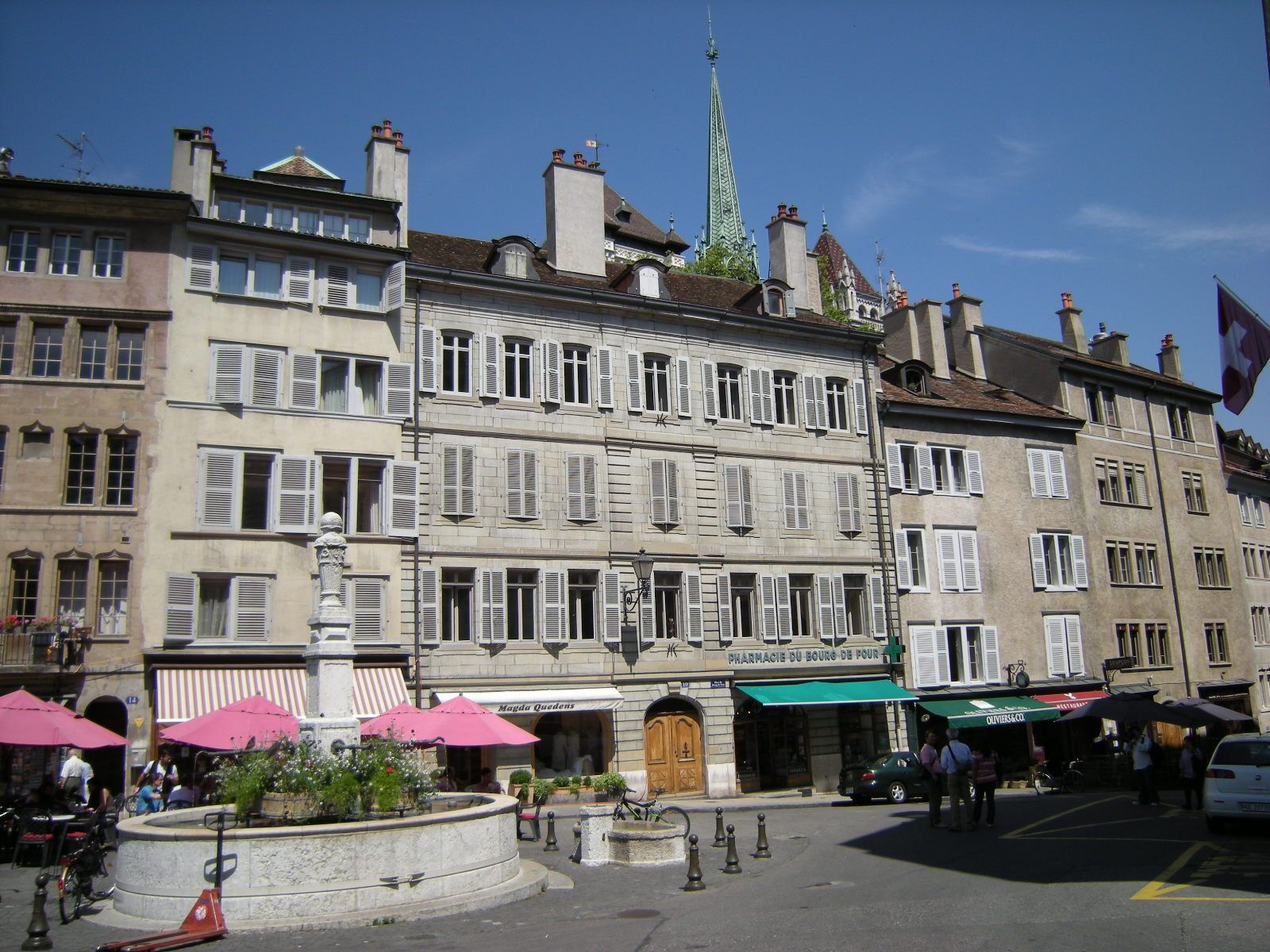
Look at the stone fountain, then at the uneven ring of tall shuttered houses.
This sloping square is usually called the oldest in Geneva. It grew on the line of a Roman road and was a market place through the Middle Ages, where roads from Savoy and the south arrived at the town. The name comes from the old word for an outlying settlement, a bourg outside the first walls.
The houses you see now are mostly seventeenth and eighteenth century, built tall and narrow because space inside the walls was precious. Count the storeys, and notice how some upper floors were added later in a slightly different stone. The large building on the south side is the Palais de Justice, the courthouse.
The fountain in the middle was a working water supply long before it was decoration; Geneva's public fountains still run with drinking water unless a sign says otherwise. Early in the day the square belongs to people on their way to work, and it is the quietest time to see its shape.
Walk on · Uphill north-west from the fountain; the cathedral's green spire shows the way, 3 minutes.
Cathédrale Saint-Pierre
Look at the columned portico, then step back to see the Gothic church behind it.
The cathedral was begun in the twelfth century as the seat of the bishops of Geneva. In 1535 and 1536 the city broke with Rome, the statues and altars were removed, and the church became Protestant. Calvin preached here from the late 1530s until his death in 1564; a plain wooden chair inside is traditionally called his.
The front surprises people. In the middle of the eighteenth century the crumbling medieval façade was replaced by the neoclassical portico you see, with its columns and pediment, so a Roman-style temple front now stands before a Gothic nave. Inside, the bare walls are what the Reformation left, and the colour comes from the windows and from the side chapel of the Maccabees, restored with painted decoration.
Beneath the church an archaeological site shows the remains of earlier churches and buildings on this hill; the towers can be climbed for a view over the lake. Both have their own entry rules and times.
Walk on · Leave by the main door, turn left and follow the cathedral's south side, 1 minute.
Auditoire de Calvin
Look for the plain chapel facing the cathedral's south flank across a small square.
This modest church stands on the site of a much older one and served the Reformation as a lecture hall, which is what auditoire means. Calvin taught theology here, and the building became a meeting place for the Protestant refugees who came to Geneva from across Europe.
Those refugees changed the city. English and Scottish exiles held services here in the 1550s, and the Scottish reformer John Knox preached to them before returning home. Italian and Dutch congregations used the building too. Their presence helps explain why Geneva became a printing centre and a city of incomers, a role it still plays in a different way.
Notice how close everything is: the cathedral, the lecture hall and the houses of the clergy all sit within a few steps of each other. The whole religious life of the city was packed into this corner of the hill.
Walk on · Back past the cathedral front and north-west into Rue du Puits-Saint-Pierre, 2 minutes.
Maison Tavel
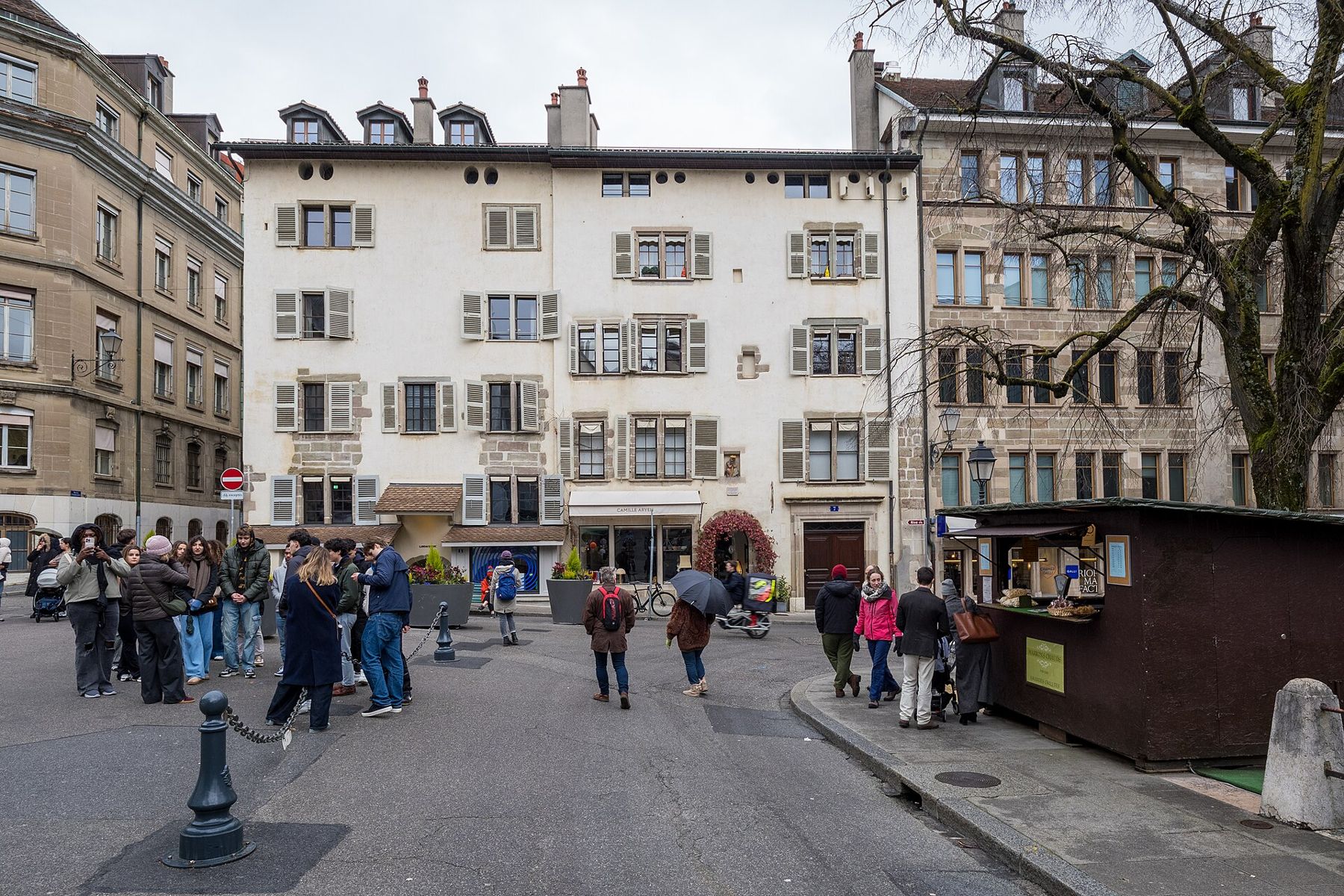
Look up at the tall grey stone house, the oldest in the city.
The Maison Tavel is the oldest private house in Geneva. A great fire swept the upper town in 1334, and the Tavel family rebuilt their home in stone soon afterwards. Much of what you see dates from that rebuilding, with later changes as the house passed from family to family over the centuries.
Today it is a city museum about everyday life in old Geneva. Its best-known piece is a large relief model of the city as it looked around 1850, before the fortifications were pulled down. If you go in, find your route on it: the walls, the bastions and the moats you will walk past at the end of this walk all appear, still intact.
From the street, notice how the house turns its strongest face to the lane, with small high windows below and larger ones above. It was a town house built for a family who wanted to be seen and also to feel safe.
Walk on · A few steps on to Rue de l'Hôtel-de-Ville and the arched door of the town hall, 1 minute.
Hôtel de Ville
Look through the arch at the cobbled ramp spiralling up inside the tower.
Geneva's town hall has been the seat of the city and canton government for centuries, and it still is. Its oddest feature is inside the courtyard: a square tower containing a cobbled ramp instead of stairs. It allowed people to ride, or be carried, up to the council rooms on the upper floors.
The building also has a place in international history. In August 1864 the first Geneva Convention, on the care of wounded soldiers in war, was signed in a room here, the step that grew into the modern Red Cross movement. A few years later the same room hosted an international arbitration between Britain and the United States over the warship Alabama, and the room now carries that name.
This is a working government building, so access inside varies; the courtyard and ramp can often be seen from the entrance. Look at the coats of arms over the doors: the half eagle and the key of the city appear again and again.
 Change here for the Geneva lineThe Ariana park and the international quarter
Walk on · Cross the lane to the open arcade opposite, under a minute.
Ancien Arsenal
Look at the old cannons under the arcade, then at the mosaics on the back wall.
This arcaded building began as a covered grain market and was later used as the city arsenal, which is why bronze cannons stand under its arches. Today it holds the state archives, and the arcade is open to the street.
The back wall carries large twentieth-century mosaics that tell Geneva's story in a few scenes: the Romans arriving, a medieval fair, and the Protestant refugees reaching the city in the sixteenth century. They give a simple picture of how the city sees its own past, with trade and refuge at the centre of it.
Notice the cannons' decoration up close, and then look at the arches themselves: the building is a reminder that this quiet hilltop was once a fortress town, with walls, gates and guns, living in fear of attack by the Dukes of Savoy. That fear has its own festival, the Escalade, which recalls a failed night attack by Savoy in 1602.
Walk on · Downhill beside the town hall to the tree-lined terrace on the south side, 2 minutes.
Promenade de la Treille
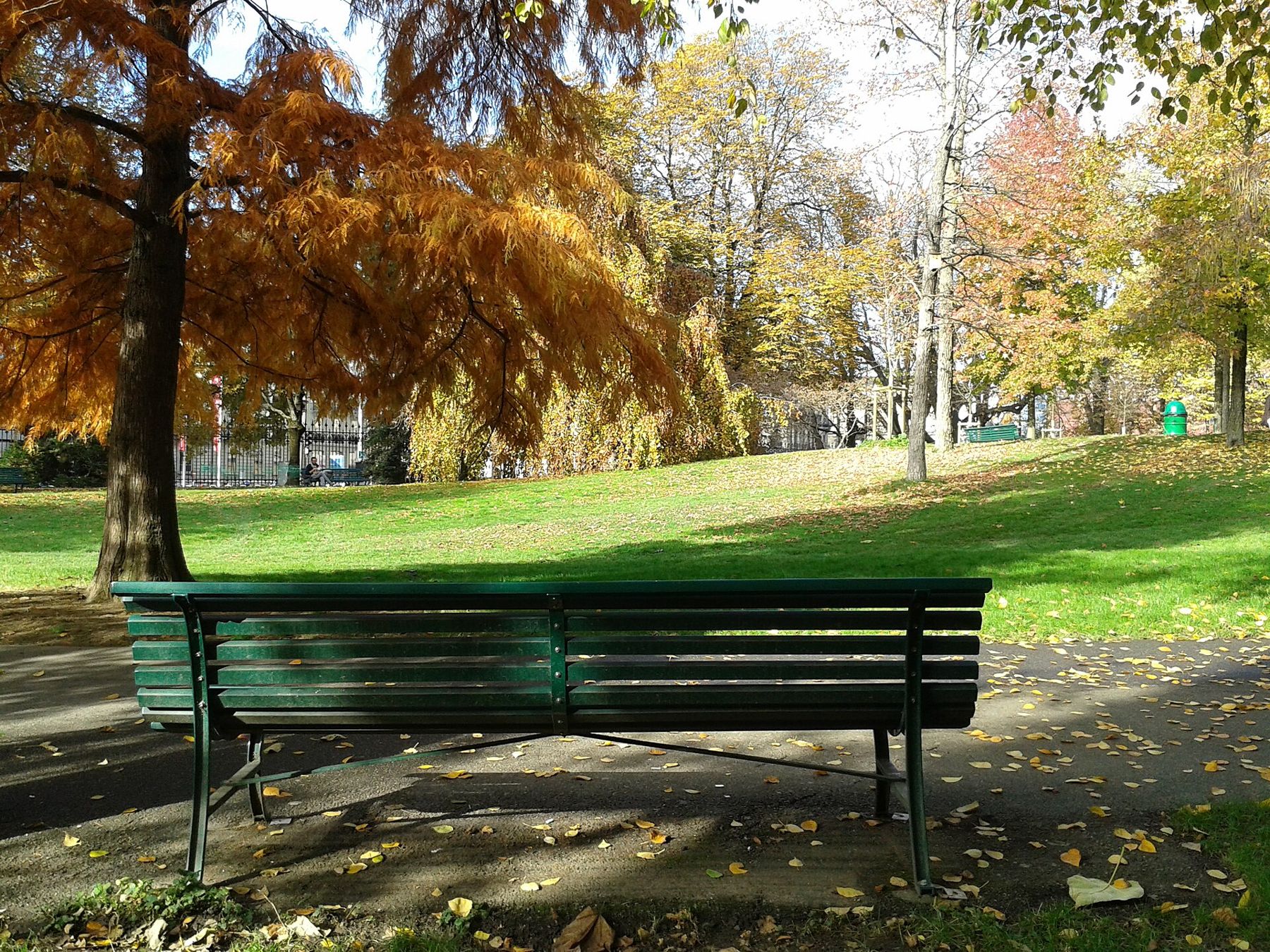
Look along the green wooden bench that runs almost the whole length of the terrace.
The Treille is a raised terrace on the old ramparts, shaded by chestnut trees, looking south over the Parc des Bastions towards the Salève. Its long green bench, around 120 metres, is often called one of the longest in the world. Sit for a while: this is one of the few places in the old town where nothing is asked of you.
One of the chestnut trees here is the official chestnut of the Republic and Canton of Geneva. Since the early nineteenth century an official of the cantonal parliament has watched for its first bud each spring and recorded the date, which the newspapers then report. The tree has been replaced over the years, and in some years the first bud has appeared surprisingly early in the winter.
Notice the view across the park: the university building, the wide lawns and, on clear days, the long limestone ridge of the Salève, which actually lies across the border in France.
Walk on · Down the ramp at the terrace's west end into the Parc des Bastions, 4 minutes.
Mur des Réformateurs
Look at the four tall stone figures standing in the centre of the long wall.
The Reformation Wall runs along the foot of the old ramparts, set into what was once the city moat. It was begun in 1909, the four hundredth anniversary of Calvin's birth, and completed after the First World War. The four central figures, each around five metres tall, are Guillaume Farel, Jean Calvin, Théodore de Bèze and John Knox.
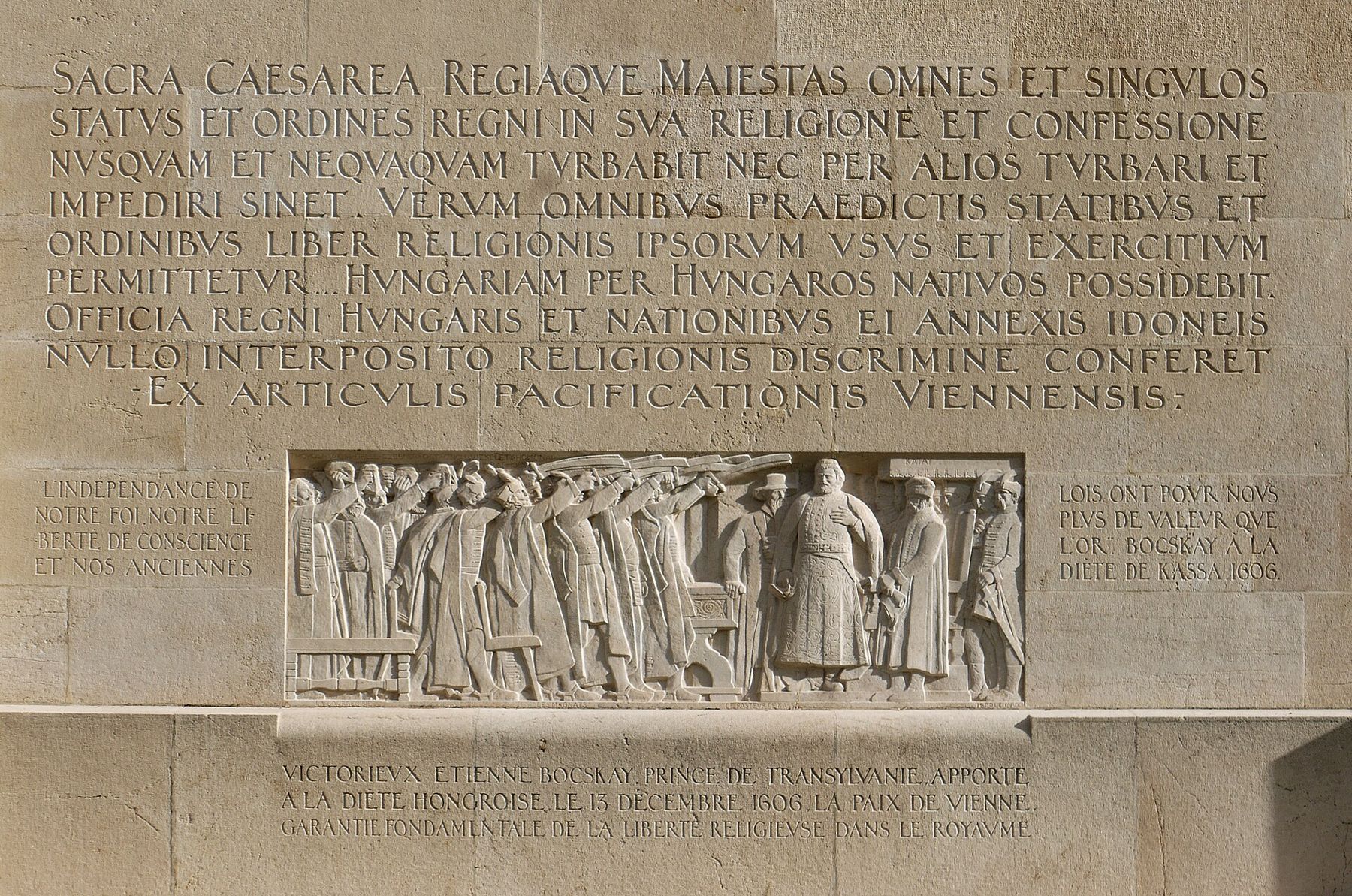
Above them runs the city's motto, Post Tenebras Lux, after darkness, light. Smaller statues and carved scenes along the wings honour Protestant leaders from other countries, among them figures from the Netherlands, Hungary, England, Scotland and the American colonies, a reminder that the Reformation in Geneva was an international movement.
Walk to the ends of the wall to find the inscriptions. One panel recalls the Treaty of Vienna of 1606, which guaranteed religious freedom in the Kingdom of Hungary. Most visitors photograph the four giants and leave; the side panels are where the stories are.
Finishing in the Parc des Bastions
The walk ends inside the Parc des Bastions, a large shaded park with benches, giant chessboards on the ground and plenty of trees. There are drinking fountains in the park and public toilets nearby; the old town above has few, so plan accordingly. The gate at the north-west corner of the park opens onto Place Neuve, with its opera house and trams.
Steps, cobbles and the weather
The cobbles on the hill can be slippery after rain and in winter frost, and the lanes between the cathedral and the square are steep. Most of the walk is shaded by tall buildings rather than trees, so it stays cool in summer, while the Treille and the park give real shade. The old town is calm and safe, but keep an eye on bags in the busier spots near the cathedral.
What to walk next
From Place Neuve it is a short stroll to the Grand Théâtre and the start of the museum quarter around Plainpalais. If you would rather have open water and air, walk down to the Rhône and follow the walk along the lakeside to the Jet d'Eau.