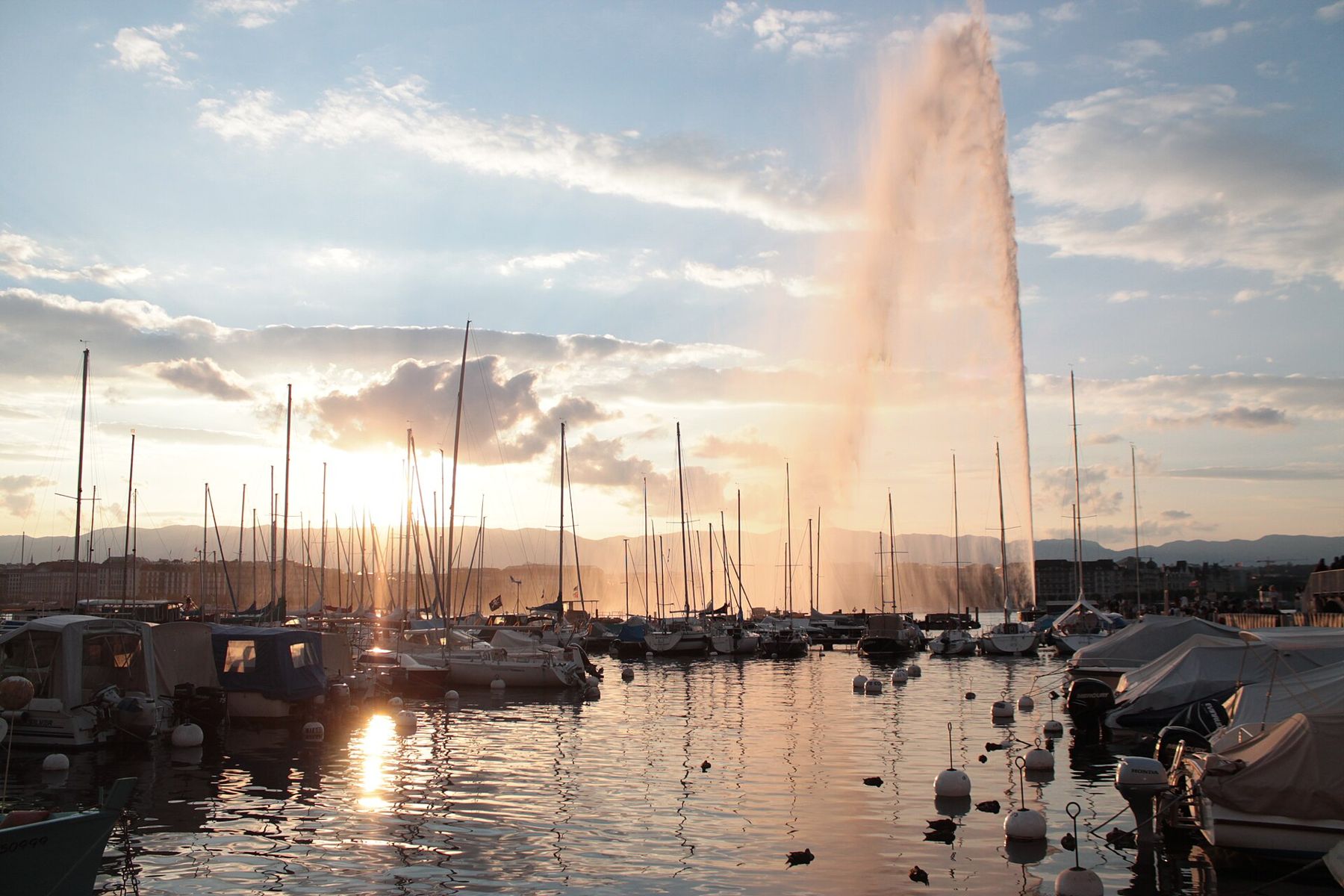
Geneva is built around the spot where the Rhône leaves Lake Geneva, and most of its postcard views come from the few hundred metres where river turns into lake. This walk follows that edge. It starts on a bridge over the fast green river, crosses to the little Île Rousseau, follows the right bank past grand hotels and quays to the Bains des Pâquis, then crosses the Pont du Mont-Blanc to the Jardin Anglais and ends on the jetty beside the Jet d'Eau.
It is flat all the way, about 3.8 kilometres, and takes around two hours at an easy pace with stops. Mornings are calm and clear; late afternoon brings the light behind the fountain and a crowd along the quays. On hot days there is little shade on the jetties.
To reach the start, walk down from Place Bel-Air, a major tram and bus stop on the left bank, to the Pont de la Machine, a minute away. The Jet d'Eau does not always run: it is switched off in strong wind, in freezing weather and at some times of year, so do the walk in the other direction if you want to be sure of seeing it early.
Pont de la Machine
Look down at the speed and colour of the river rushing under the bridge.
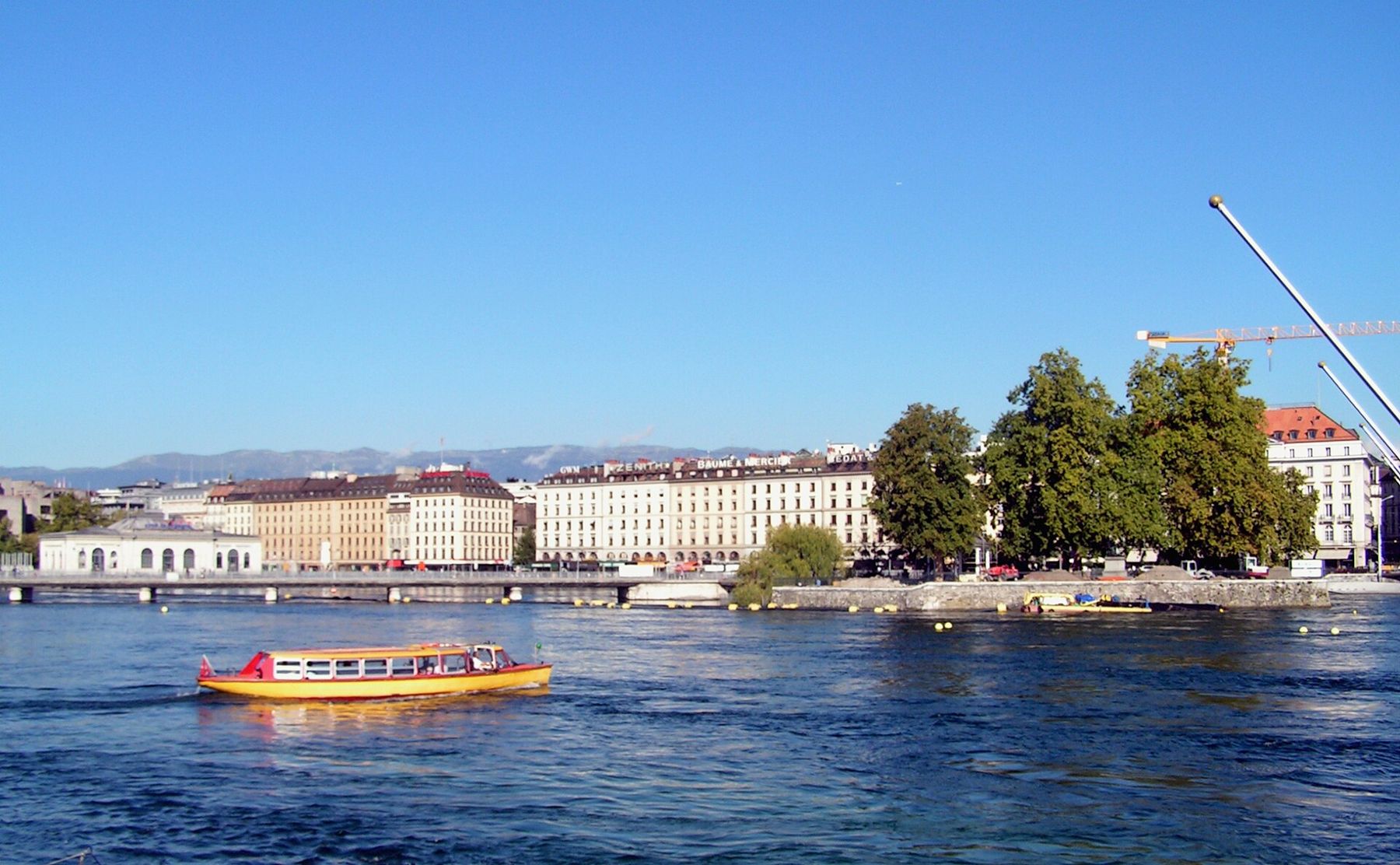
This footbridge crosses the Rhône just below the lake. The building that sits on it took its name from a hydraulic machine installed in the nineteenth century to pump river water up to the city's fountains and houses. The river here is part of the system that controls the level of Lake Geneva, and the barriers you see in the water are used to manage the flow.
Notice the colour of the Rhône: on most days it runs an intense clear blue-green, because the lake behind acts as a settling basin for the silt brought down from the Alps. A little further downstream it meets the grey, cloudy Arve, and the two colours run side by side for a while before they mix.
From the middle of the bridge, look upstream to see the next two bridges and the trees of the Île Rousseau between them.
Walk on · Cross to the right bank and turn right along Quai des Bergues, 4 minutes to the next bridge.
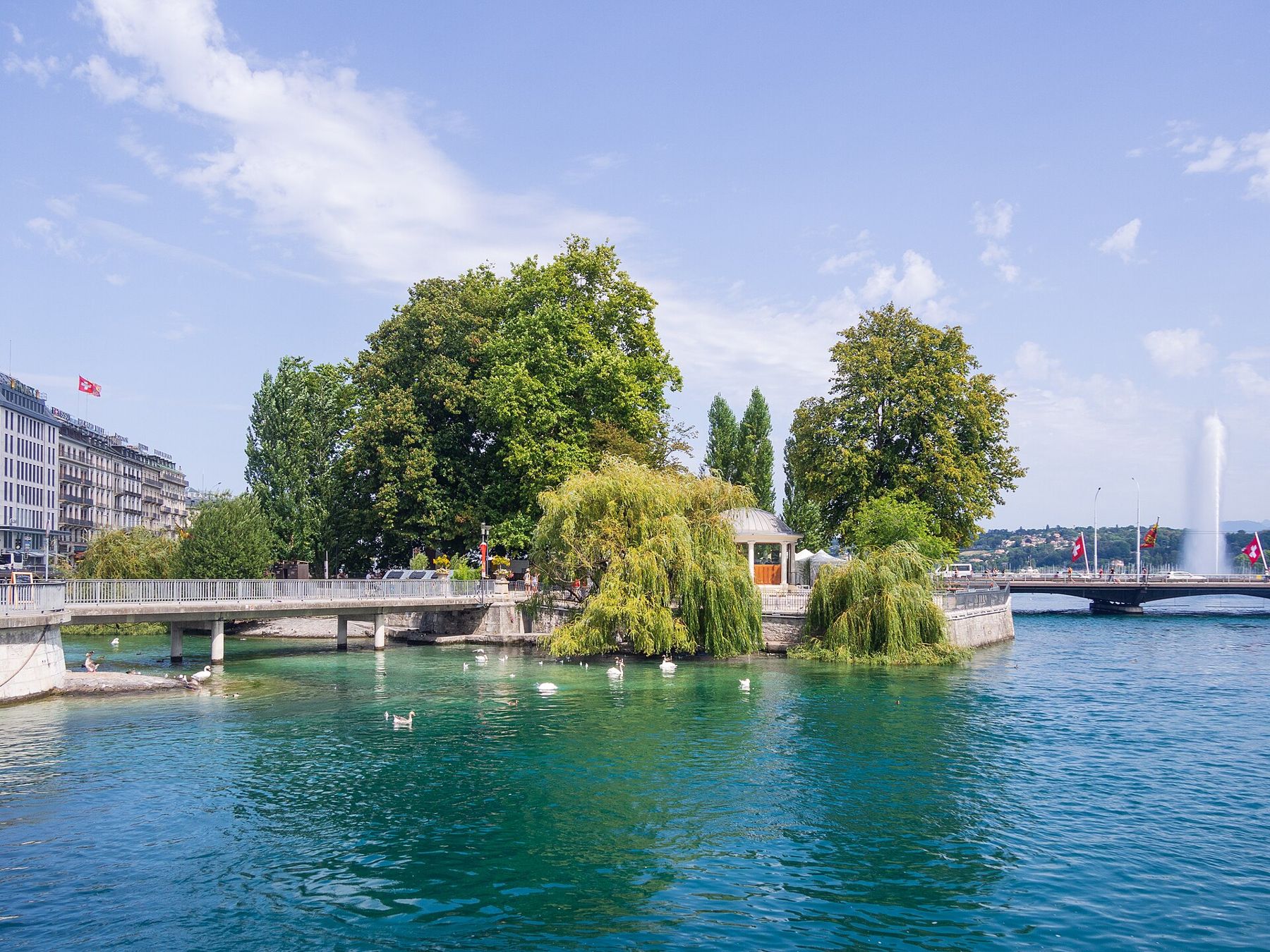
Île Rousseau
Look for the bronze seated figure of Rousseau among the trees.
This small island, reached from the middle of the Pont des Bergues, was once part of the city's defences. In the nineteenth century it became a garden and was named after Jean-Jacques Rousseau, the philosopher and writer, who was born in Geneva in 1712. His statue, by the Geneva-born sculptor James Pradier, was set up here in the 1830s.
Rousseau had a difficult relationship with his home city: his books were condemned and burned here in the 1760s, and he renounced his citizenship. The statue shows how much opinion had changed within a few generations.
Sit on a bench and watch the water birds; swans, ducks and grebes gather around the island because the current is gentler here. Look east, past the next bridge, to catch your first view of the lake opening out and, if it is running, the white plume of the Jet d'Eau.
Walk on · Back to the right bank, then left along the quays past the bridge, 6 minutes.
Brunswick Monument
Look up at the tall Gothic tomb with a rider on horseback on top.
This elaborate monument on the Quai du Mont-Blanc is the tomb of Charles II, Duke of Brunswick, a German ruler who was driven from his duchy, spent years in exile and died in Geneva in 1873. He left his fortune to the city on condition that it built him a grand mausoleum.
Geneva kept its side of the bargain. The monument copies the medieval tombs of the Scaliger family in Verona, with a canopy of pinnacles and an equestrian statue. The duke's money helped pay for public buildings in the city, including the Grand Théâtre.
The garden around it is a good place to look across the water at the left bank: the old town on its hill, with the cathedral towers, and the Salève ridge behind. The long row of grand nineteenth-century buildings behind you shows how the right bank was built up to face the lake once the city walls came down.
Walk on · Continue north along the quay and turn out onto the stone jetty of the Pâquis, 6 minutes.
Bains des Pâquis
Look along the low white bathing pavilions on the jetty, then out to the lighthouse.
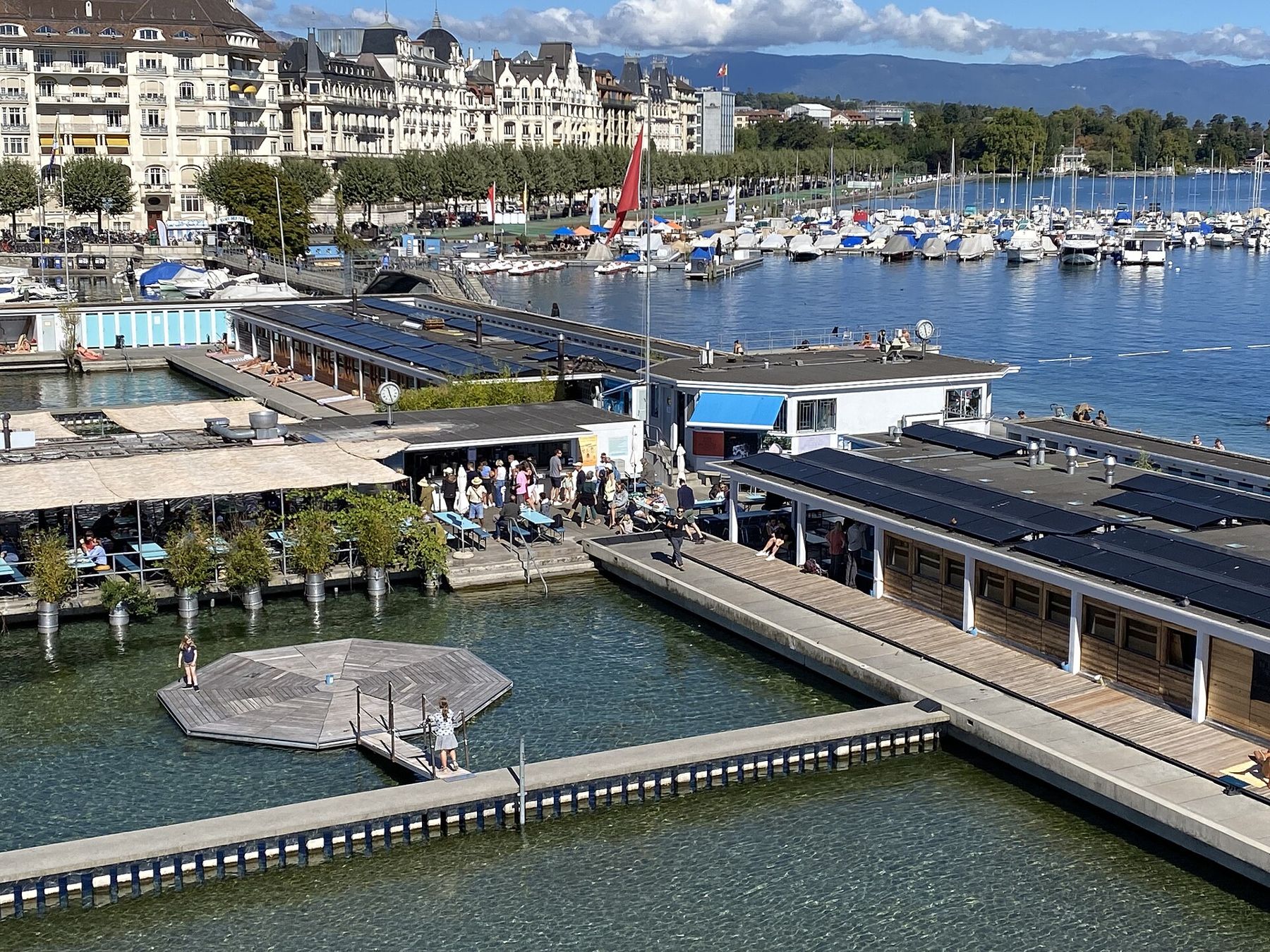
The Bains des Pâquis are public lake baths built on the Pâquis jetty, with changing rooms, wooden platforms and steps down into the water. Bathing has taken place here since the nineteenth century; the present buildings date from the 1930s. When the baths were threatened with demolition in the 1980s, Geneva's voters chose to keep them, and they have been a much-loved part of city life ever since.
People swim here in summer, and a hardy few all year. Entry rules and times change with the season, so check on the day. You can walk out along the jetty to the small lighthouse at its tip, which marks the harbour entrance.
From the end of the jetty you get one of the best views of the Jet d'Eau, straight across the harbour, with the Alps beyond on a clear day.
 Change here for the Geneva lineVieille-Ville, from the cathedral to the Bastions
Walk on · Back along the quay to the Pont du Mont-Blanc and across the lake outlet, 12 minutes.
Pont du Mont-Blanc
Look north-east from the middle of the bridge, up the length of the lake.
The Pont du Mont-Blanc spans the exact point where Lake Geneva becomes the Rhône. It was first built in the 1860s and later rebuilt and widened, and it is the busiest crossing in the city for buses and cars as well as people on foot. On days of celebration it is hung with flags.
Despite its name you will only see Mont Blanc from here on a very clear day, far to the south-east, above the nearer mountains. More often you see the long wall of the Jura to the north-west and the Salève to the south.
Look down at the water on either side: on the lake side it is calm, on the river side it starts to pick up speed. On the lake side, near the left bank by the Jardin Anglais, two rounded granite rocks rise from the water. These are the Pierres du Niton, glacier-carried boulders, and a mark on the larger one was used as the base point for altitude measurements across Switzerland.
Walk on · Off the bridge on the left bank and right into the Jardin Anglais, 3 minutes.
Jardin Anglais and the flower clock
Look at the huge clock face planted in flowers, and watch its long second hand move.
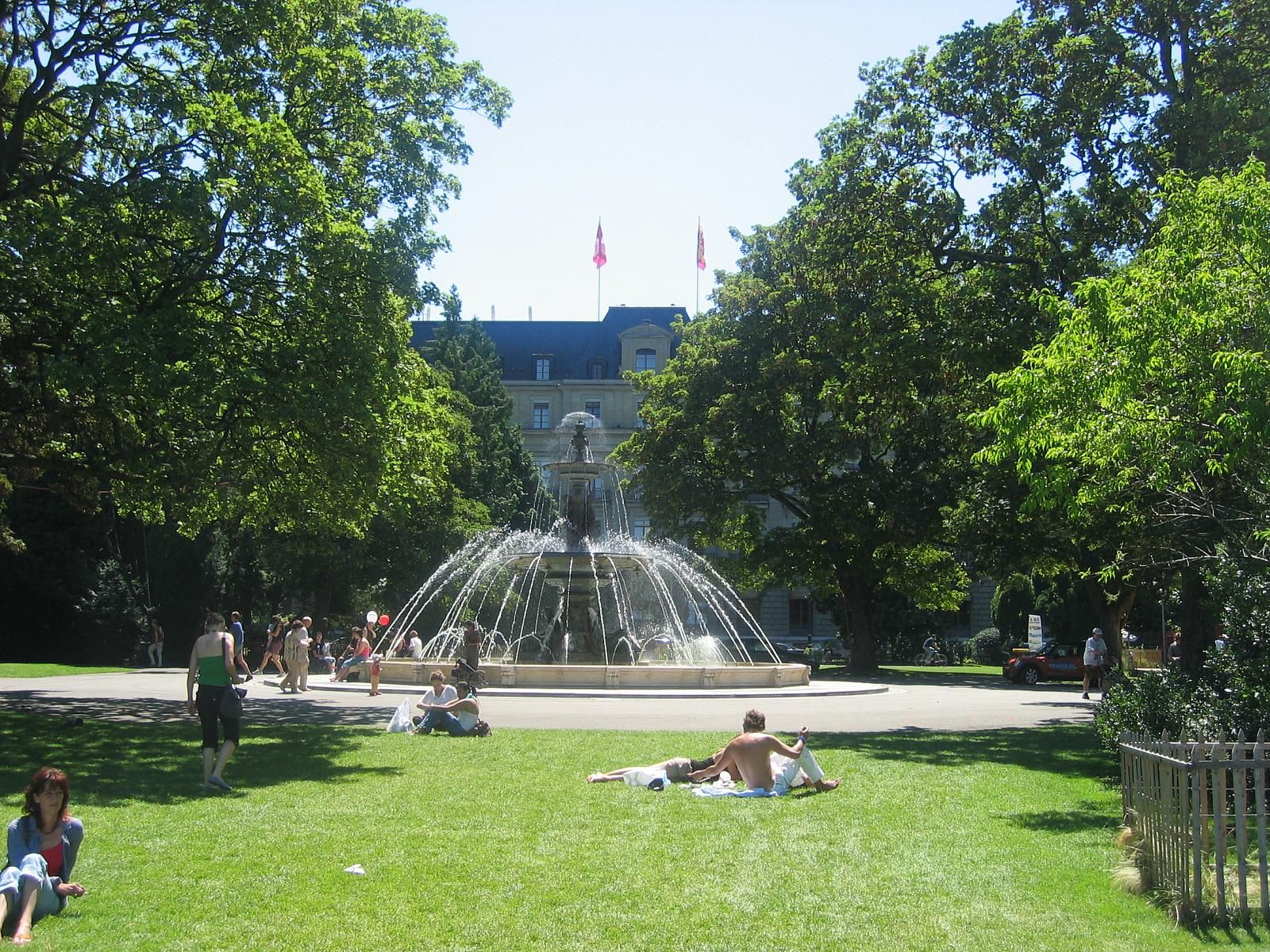
The Jardin Anglais, the English Garden, was laid out in the 1850s on land along the shore. Its best-known feature is the flower clock, the Horloge fleurie, created in 1955 as a tribute to Geneva's watchmaking. The face is planted with thousands of flowers and small plants, redesigned with the seasons, and its second hand is one of the longest anywhere.
Further into the garden stands the National Monument, two bronze women representing Geneva and Helvetia, which commemorates Geneva's joining the Swiss Confederation in 1815. Before that, Geneva had been an independent republic and then, for some years, part of Napoleonic France.
Notice how the garden faces the water: it was designed for strolling and looking out, not for sitting in the middle of flowerbeds, and the best benches are along the lakeside edge.
Walk on · East along Quai Gustave-Ador by the lake, then left onto the long jetty, 12 minutes.
Jet d'Eau
Look up at the column of water and follow it to the top of its arc.
The Jet d'Eau began as an accident of engineering. In the 1880s a hydraulic works on the Rhône needed a valve to release excess pressure in the evenings, and the result was a fountain of water that people came to watch. It was moved to the lake as a deliberate attraction in 1891, and the present pumping station was installed in 1951.
Today the jet throws lake water to a height of about 140 metres, with several hundred litres a second in the air at any moment. The water falls back over the jetty when the wind shifts, so expect to get wet if you walk to the end; the stones can be slippery.
Notice which way the plume leans: it shows the wind before you feel it, and the fountain is switched off when the wind would blow the spray onto the quays. On sunny days, stand with the sun behind you and look for a rainbow in the spray.
Finishing at the Jet d'Eau
The walk ends on the Jetée des Eaux-Vives. Walk back to Quai Gustave-Ador for buses along the lake, or back towards the Jardin Anglais and the trams at Rive, about ten minutes on foot. There are public toilets near the Jardin Anglais and in the Pâquis baths area, and drinking fountains along the quays; Geneva's public fountains carry drinkable water unless marked otherwise.
Sun, wind and water
This walk has little shade apart from the Jardin Anglais and the trees on the quays, so carry water and a hat in summer. When the bise, the cold north-east wind, blows in winter, the jetties are exposed and spray can freeze. The quays are wide and safe, but bicycles and scooters use some stretches, so keep to the walking side. Swimming outside the bathing areas is not advised: boats use the harbour.
What to walk next
From Rive it is a short climb into the old town on its hill. For more lakeside parks and the international quarter, take the walk through the Ariana park and the botanical garden, which ends on the shore north of the Pâquis.