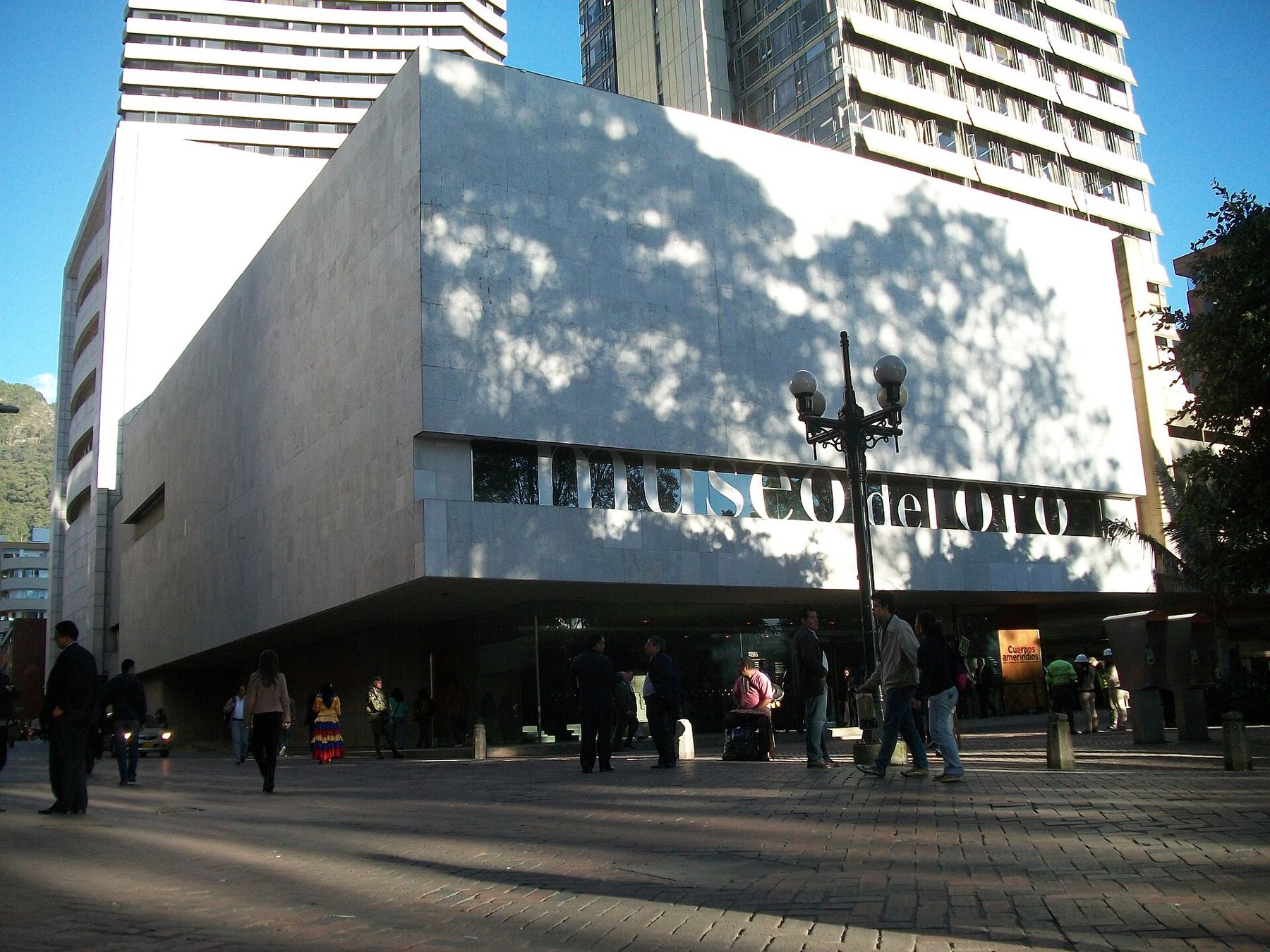
This walk links the two great set pieces of central Bogotá. It starts at the Museo del Oro, the gold museum of the central bank, and follows Carrera Séptima, the old main street, south to Plaza de Bolívar, where the cathedral, the Congress, the courts and the city hall face each other across one square. It finishes outside the presidential palace.
On the way you pass the oldest surviving church in the centre, the spot where a political murder set the city on fire in 1948, and the house where a quarrel over a flower vase in 1810 started the movement toward independence.
The route is about 1.3 kilometres, slightly downhill, and takes around an hour and forty minutes without going into the museums. The gold museum alone deserves two hours, so if you plan to go in, start early. It sits right next to La Candelaria, and the two walks fit into one day.
The TransMilenio stop called Museo del Oro, on Avenida Jiménez, is a minute from the start. Museum opening days and hours change, so check them before you set out.
Museo del Oro
Look at the windowless marble block with the museum's name across it.
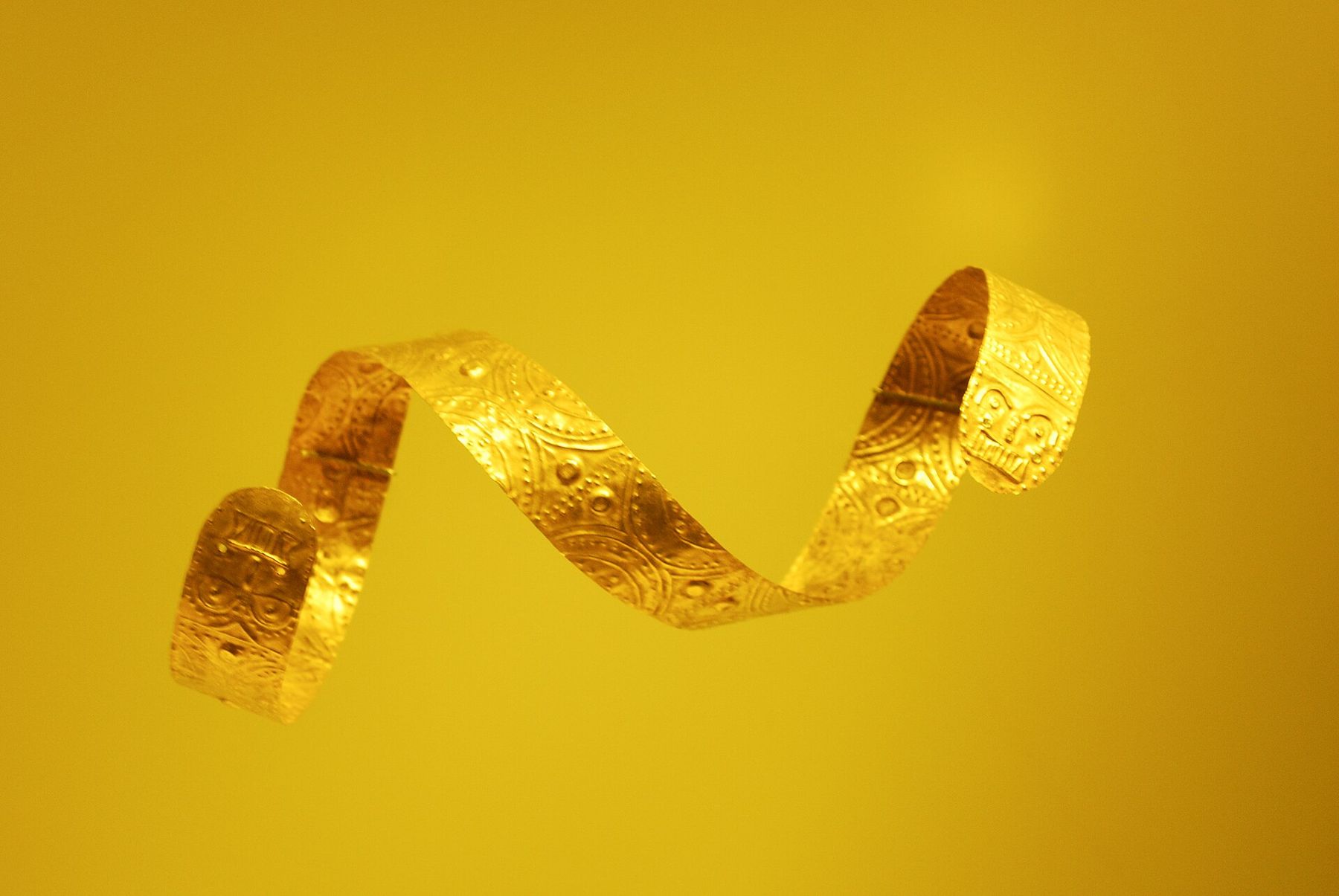
The Banco de la República began this collection in 1939 by buying a single gold poporo, a container for the lime chewed with coca leaves, made by Quimbaya goldsmiths. Today the museum holds tens of thousands of objects in gold and tumbaga, an alloy of gold and copper, from cultures across Colombia: Muisca, Quimbaya, Tairona, Zenú, Calima and others.
Its most famous piece is a small gold raft with figures, found in 1969 in a cave in Cundinamarca. It is linked to the Muisca ceremony at the lake of Guatavita, where a new ruler covered in gold dust offered gold to the water, the root of the El Dorado legend.
Notice the building's closed walls: a vault, more than a gallery.
Walk on · Step out into the square directly in front of the museum; 1 minute.
Parque Santander
Look at the statue of Santander standing at the centre of the square.
The square is named after Francisco de Paula Santander, Bolívar's vice-president and later president, remembered in Colombia as the man of laws. In colonial times this was the open ground in front of the Franciscan church.
Along its southern edge runs Avenida Jiménez, which covers the San Francisco river. Rogelio Salmona redesigned the avenue around 2000 as a walkway with shallow water channels that recall the buried river.
A few steps north on Carrera Séptima, Jorge Eliécer Gaitán, a popular Liberal leader, was shot on 9 April 1948. The riots that followed, known as the Bogotazo, burned much of the centre. Notice also the men standing in small groups near the corner: this area has long been the street market of the emerald traders.
Walk on · Cross to the corner of Carrera Séptima and Avenida Jiménez; 1 minute.
Iglesia de San Francisco
Look at the plain stone tower, then go in and face the altar.
San Francisco was built by the Franciscans in the second half of the sixteenth century and is the oldest church still standing in central Bogotá. The outside is plain, almost severe.
Inside is the reason to stop: the main altarpiece, carved and covered in gold leaf, rises behind the altar in tier upon tier of saints, scenes and plant forms. It is one of the most elaborate pieces of colonial woodwork in the country. Let your eyes adjust to the dim light before you look for detail.
The church sits at the meeting of two very different Bogotás: the colonial city to the south and the twentieth-century office towers to the north. Respect services in progress, and keep voices low.
Walk on · Walk south down the pedestrian Carrera Séptima for about two blocks; 4 minutes.
Carrera Séptima
Look down the long straight street toward the cathedral towers.
Carrera Séptima was the Calle Real, the royal street, of the colonial city, linking the main square with the road north. It is still Bogotá's spine: the same carrera runs for many kilometres up the eastern side of the city. This stretch has been closed to cars and given over to walkers.
Expect street vendors, chess players, musicians and people selling everything from fruit to phone covers. It is lively and generally good-humoured by day.
Notice the mix of buildings along the street: republican facades from the late nineteenth and early twentieth centuries, mid-century office blocks, and colonial fragments squeezed between them. Much of what stood here was lost in the 1948 fires.
 Change here for the Mexico City lineThe Centro Histórico
Walk on · Continue south to the corner of Calle 11, where the square opens; 3 minutes.
Casa del Florero
Look at the corner house with the wooden balcony above the square.
On 20 July 1810 a group of criollos, American-born men of Spanish descent, went to the shop of a Spanish merchant on this corner to borrow a flower vase for a dinner in honour of a royal official. The merchant refused, insults followed, a crowd gathered, and by the end of the day the city had formed its own governing council. The date is celebrated as Colombia's independence day.
Many accounts hold that the quarrel was planned to provoke exactly that reaction, and historians treat the vase as the spark rather than the cause.
The house is now the Museo de la Independencia, and the famous vase is on display inside. Notice how small the building is for the weight of its story.
Walk on · Walk a few steps south along the square's eastern side to the cathedral steps; 1 minute.
Catedral Primada
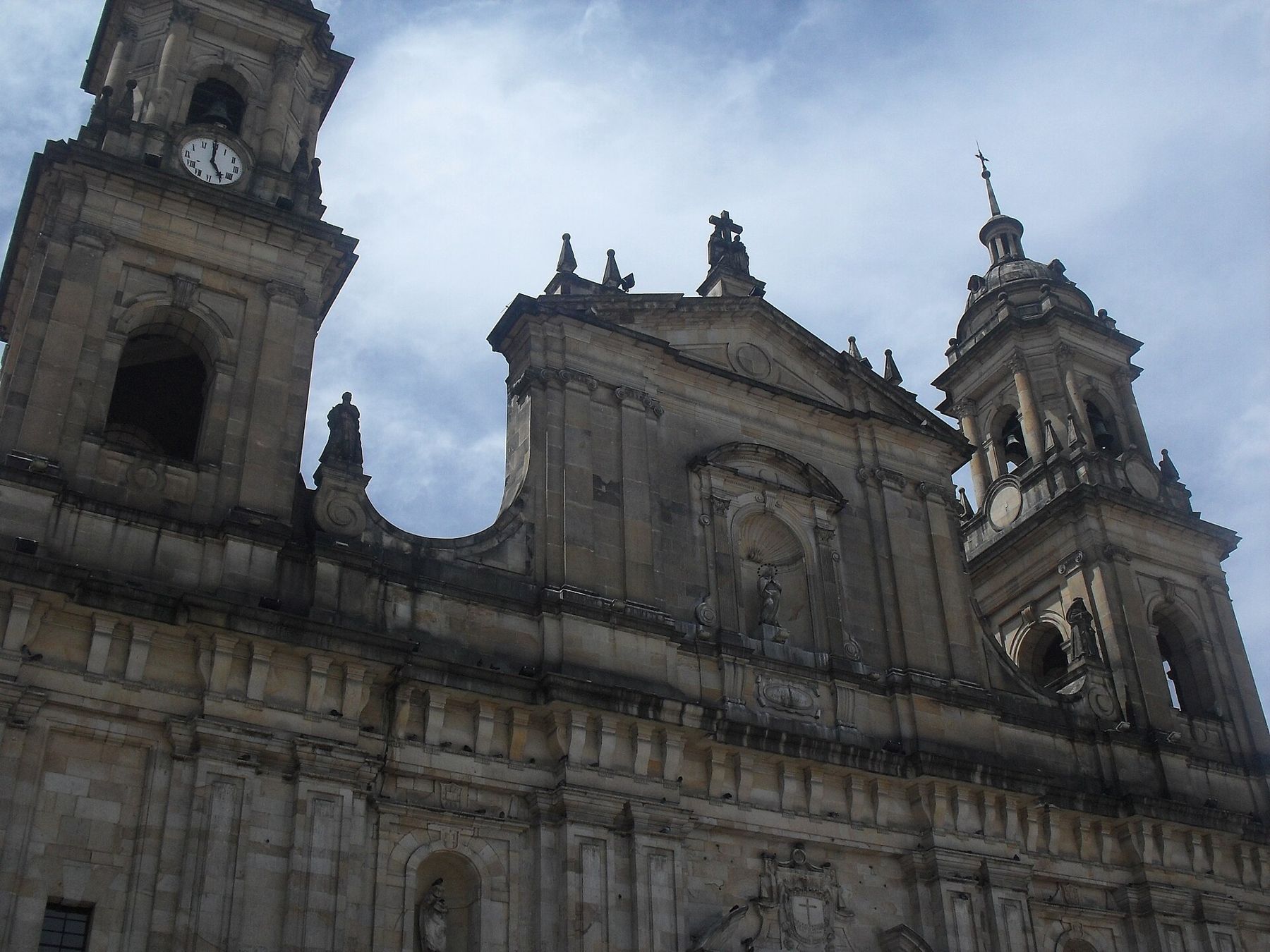
Look up at the twin towers and the broad stone front above the steps.
A church has stood on this side of the square since the first years of the city. Earlier buildings fell or were pulled down, and the present cathedral, in a sober neoclassical style, was designed by the Capuchin friar Domingo de Petrés and finished in 1823, soon after independence.
Inside it is wide and calm, with white walls and gilded details. One of the chapels holds the remains of Gonzalo Jiménez de Quesada, who founded the city in 1538.
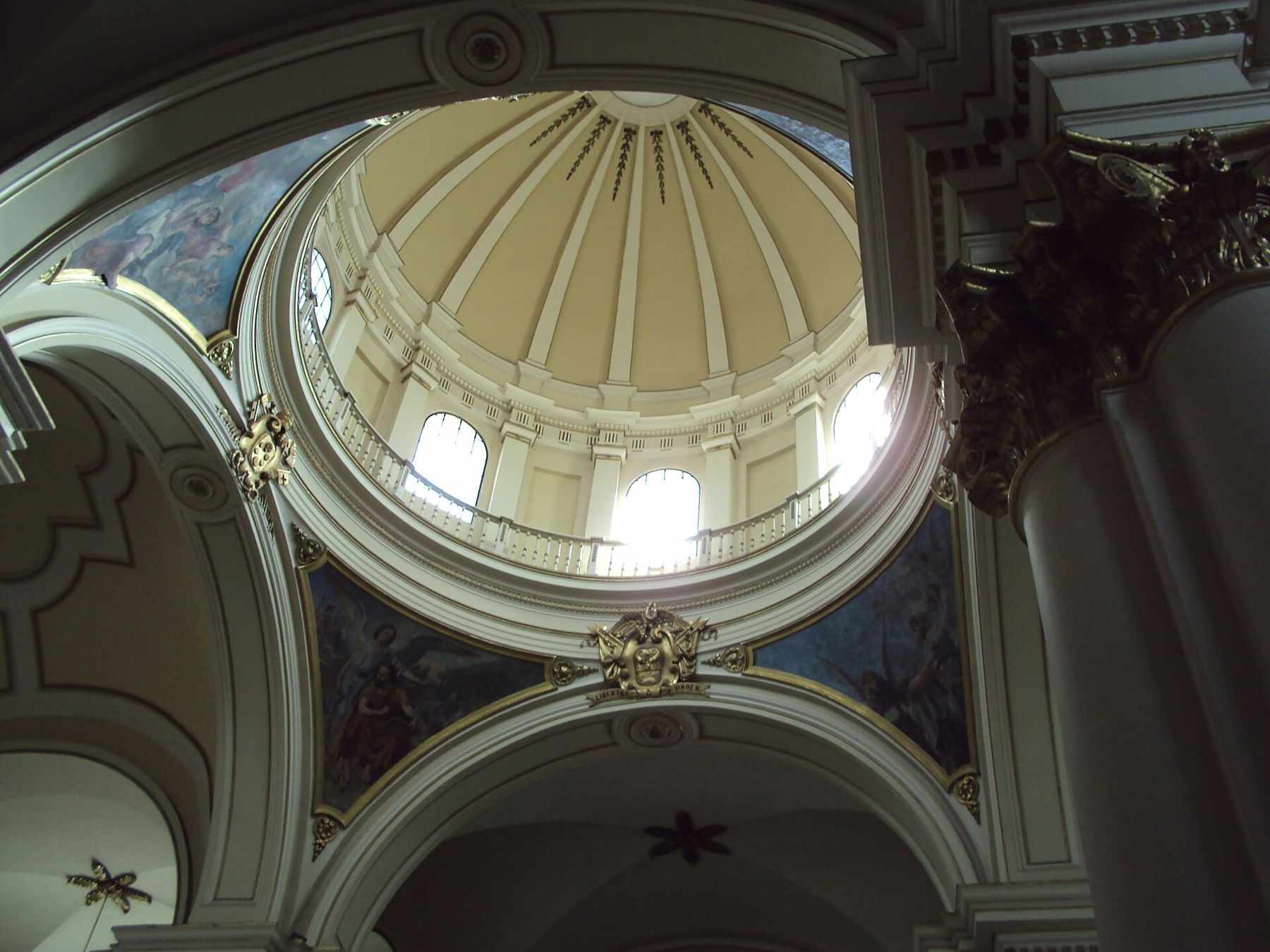
Notice the smaller church attached to the cathedral's side, the Capilla del Sagrario, with its own carved front.
Walk on · Walk into the middle of the square to the statue; 2 minutes.
Plaza de Bolívar
Look at the bronze Bolívar, then turn slowly through all four sides.
The statue of Simón Bolívar, by the Italian sculptor Pietro Tenerani, was put up in 1846 and is the oldest public monument in the city. The square around it holds the whole state in one view: the cathedral to the east, the Capitolio to the south, the city hall in the French-style Palacio Liévano to the west, and the Palace of Justice to the north.
The Palace of Justice is a modern building because the old one was destroyed. On 6 November 1985 guerrillas of the M-19 seized it, the army retook it by force, and around a hundred people died, among them judges of the Supreme Court. The building was rebuilt afterwards.
Notice how the square slopes, and how often it is used: for protests, concerts and ceremonies.
Walk on · Cross to the colonnaded building on the square's southern side; 2 minutes.
Capitolio Nacional
Look at the long row of stone columns across the front.
The Capitolio Nacional is the seat of Colombia's Congress. Work began in 1848, to a design by the English-born architect Thomas Reed, and civil wars, lack of money and changes of plan stretched the building out until 1926.
The front is a deep colonnade facing the square, and through it you can see an inner courtyard. Access to the inside is limited and depends on the business of Congress, so treat this as a building to read from outside.
Notice the security around it: police and barriers are normal on this side of the square, and more so on the next stop. Follow any directions they give.
Walk on · Walk south past the Capitolio's side toward Carrera 8 and the palace railings; 4 minutes.
Casa de Nariño
Look through the railings at the palace front and the guards in dress uniform.
The Casa de Nariño is the official home and office of the president of Colombia. It stands on the site of the house where Antonio Nariño was born in 1765. Nariño translated the French Declaration of the Rights of Man in 1793 and spent years in prison for it, and he is counted among the forerunners of independence.
The present palace was built and rebuilt in the twentieth century, with a large reconstruction in the 1970s. The guard is formed by the presidential guard battalion, whose uniforms recall those of the independence era.
You can only see it from the edge of the security zone, and the streets closest to it are sometimes closed. Within the palace grounds stands the old Observatorio Astronómico Nacional, built in 1803 and among the oldest observatories in the Americas.
Where you finish
You end at the security line outside the Casa de Nariño. To return to the square, walk back north a few minutes; from there La Candelaria climbs to the east. The white church on the ridge above you is the goal of the walk up Monserrate, best saved for a clear morning.
Pace, shade and toilets
This is a short, mostly flat walk with a gentle downward slope from north to south. Shade is scarce on the Séptima and in the square, but the air is cool. The museums on and near the route have toilets for visitors, and there are places to sit on the cathedral steps and around the statue. Carry water and a rain layer: afternoon showers are common.
Safety sense
The Séptima and the square are crowded by day, which is good for safety but also good for pickpockets. Keep your phone in a front pocket, wear a bag across your body, and be polite but firm with anyone who presses you to buy emeralds or to pose for a paid photograph. Demonstrations sometimes fill the square; if one starts, step away and take another route. The area empties after office hours, so plan to finish in daylight.