Kyoto became the imperial capital in 794, laid out on a grid in a basin ringed by hills. The eastern hills, Higashiyama, were always the place for temples, tombs and pilgrimage routes, and the slopes between Kiyomizu-dera and Yasaka Shrine still hold the city's best-preserved run of old lanes: stone steps, wooden house fronts, temple gates and glimpses of pagodas.
This walk starts at the top, at Kiyomizu-dera, and works downhill all the way: through Sannenzaka and Ninenzaka, past the Yasaka pagoda, along the lane named after a woman who founded a temple in her husband's memory, and through Maruyama Park to Yasaka Shrine. It is about 2.6 kilometres and takes two and a half hours with a visit to Kiyomizu-dera.
The lanes fill up quickly, so start early. To reach the start, take a city bus to the Kiyomizu-michi or Gojō-zaka stop, or walk from Kiyomizu-Gojō station on the Keihan line, then climb the busy approach street to the temple's vermilion gate, about fifteen to twenty minutes uphill from the stops. Temple opening times and entry rules change, so check them on the day.
Niōmon, Kiyomizu-dera
Look up at the vermilion gate and the guardian figures standing in its side bays.
The Niōmon is the main gate of Kiyomizu-dera, painted bright vermilion and guarded by two fierce wooden figures, the Niō, one with an open mouth and one with a closed one. Together they are said to stand for the beginning and end of all things. Stone guardian lions sit on the steps below.
Kiyomizu-dera is older than the capital itself: by tradition it was founded in 778, around a spring on the hillside. Its name means pure water. The buildings you see were mostly rebuilt in the 1630s after fires, and the temple is part of the World Heritage listing for the historic monuments of ancient Kyoto.
Behind the gate, notice the three-storey pagoda, also vermilion, rising above the trees. Turn round on the steps for a view back over the rooftops of the city towards the western hills.
Walk on · Up through the temple precinct, following the signed route to the main hall, 6 minutes.
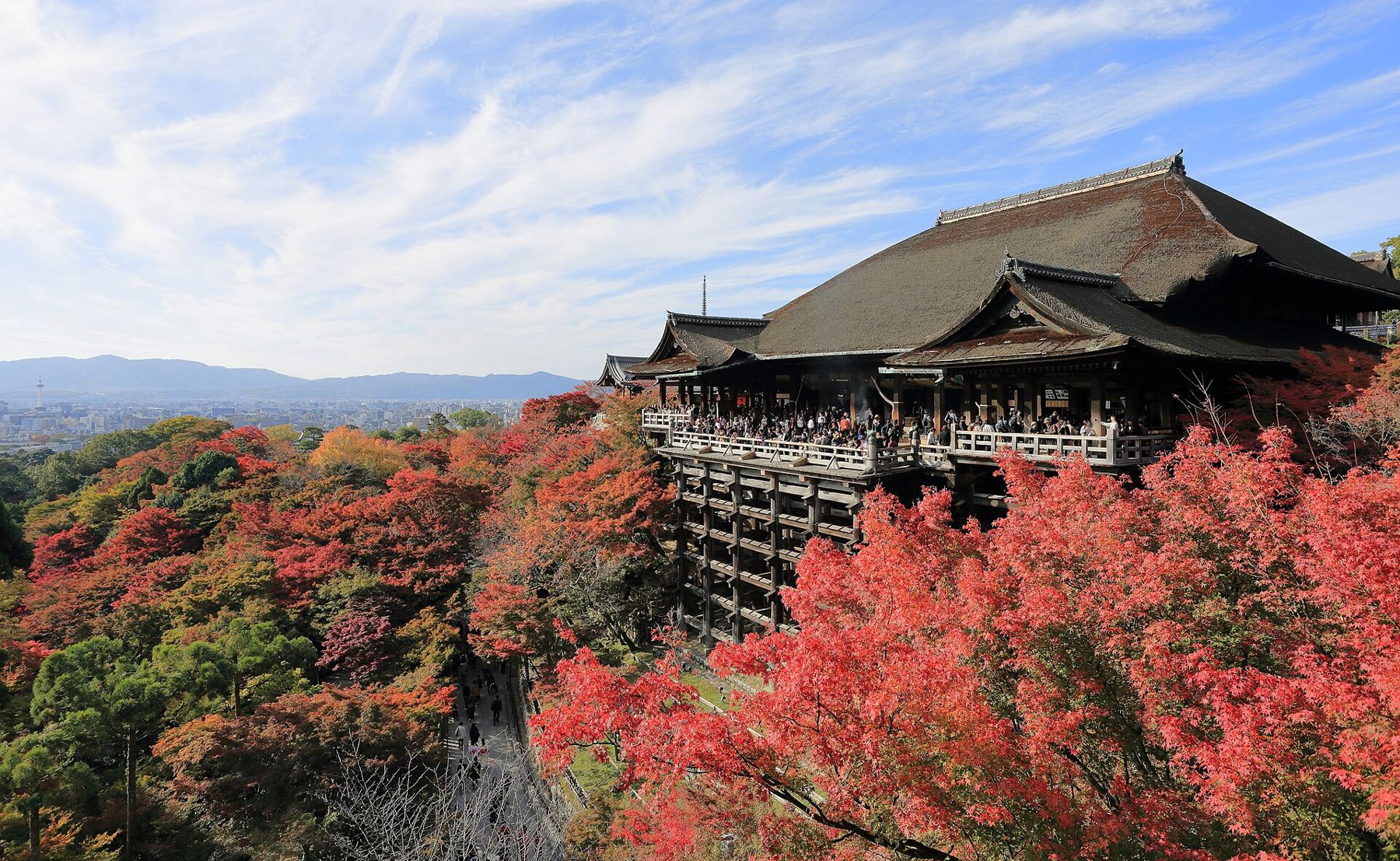
Kiyomizu-dera main hall and stage
Look out from the wooden stage over the treetops to the city below.
The main hall of Kiyomizu-dera stands at the edge of a steep slope, and its famous stage juts out over the valley on a framework of tall wooden pillars and beams, fitted together with traditional joinery. The current hall was rebuilt in 1633. The view from the stage, over a sea of maple and cherry trees, changes with the seasons.
A Japanese saying, to jump from the stage of Kiyomizu, means to take a bold decision. Do not try it.
Walk on along the signed route to look back at the hall from the opposite slope: from there you can see the whole timber structure that holds up the stage. Below it is the Otowa waterfall, where three streams of spring water fall from a roof into a pool and visitors queue with long-handled cups. The water is the pure water that gives the temple its name.
Walk on · Back out through the Niōmon and right down the stone steps of Sannenzaka, 10 minutes.
Sannenzaka
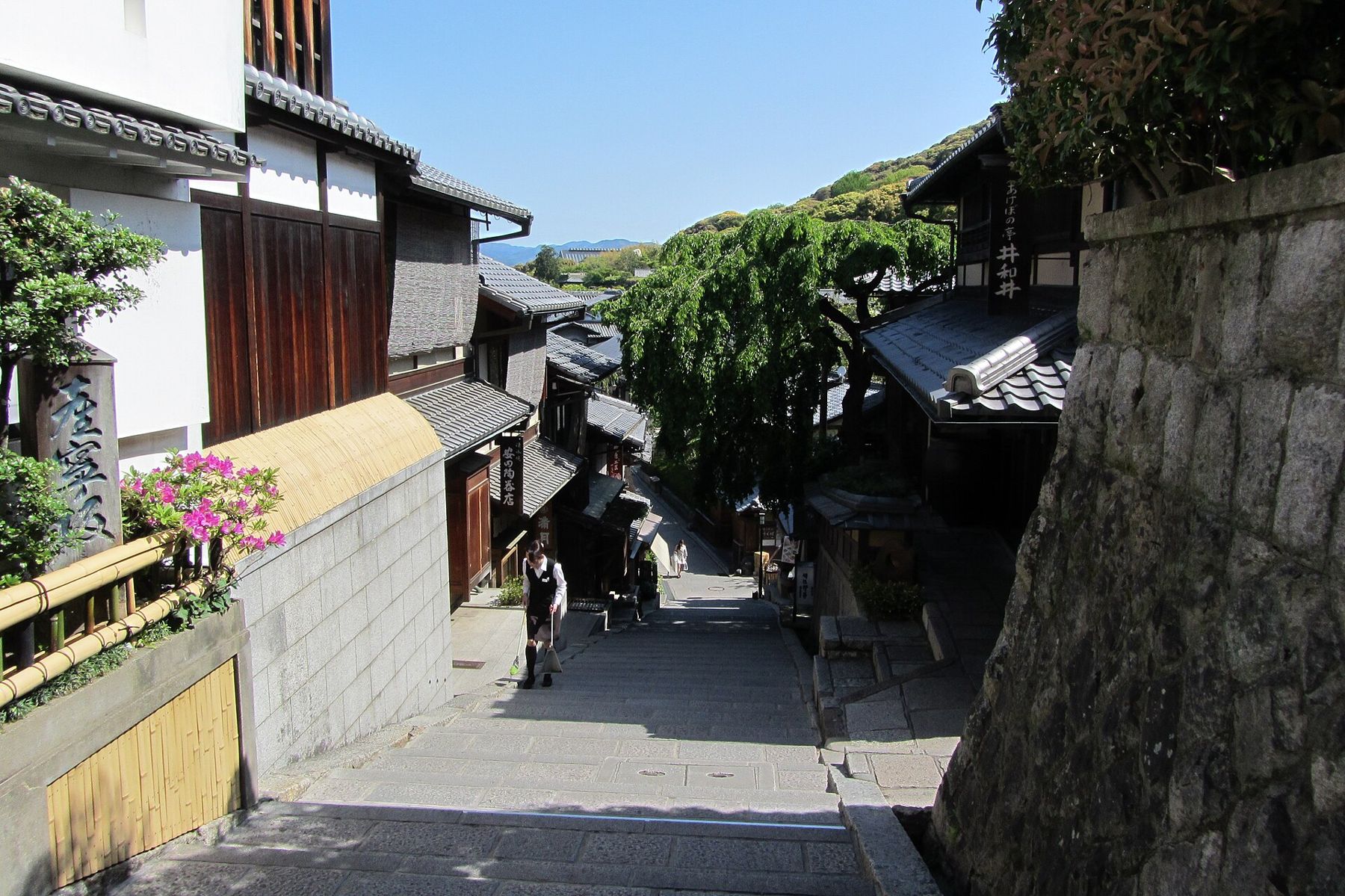
Look down the flight of stone steps between the wooden house fronts.
Sannenzaka, the three-year slope, is a stepped stone lane lined with two-storey wooden buildings, their dark lattice fronts and tiled roofs typical of old Kyoto townhouses. It was one of the old pilgrims' routes up to Kiyomizu-dera.
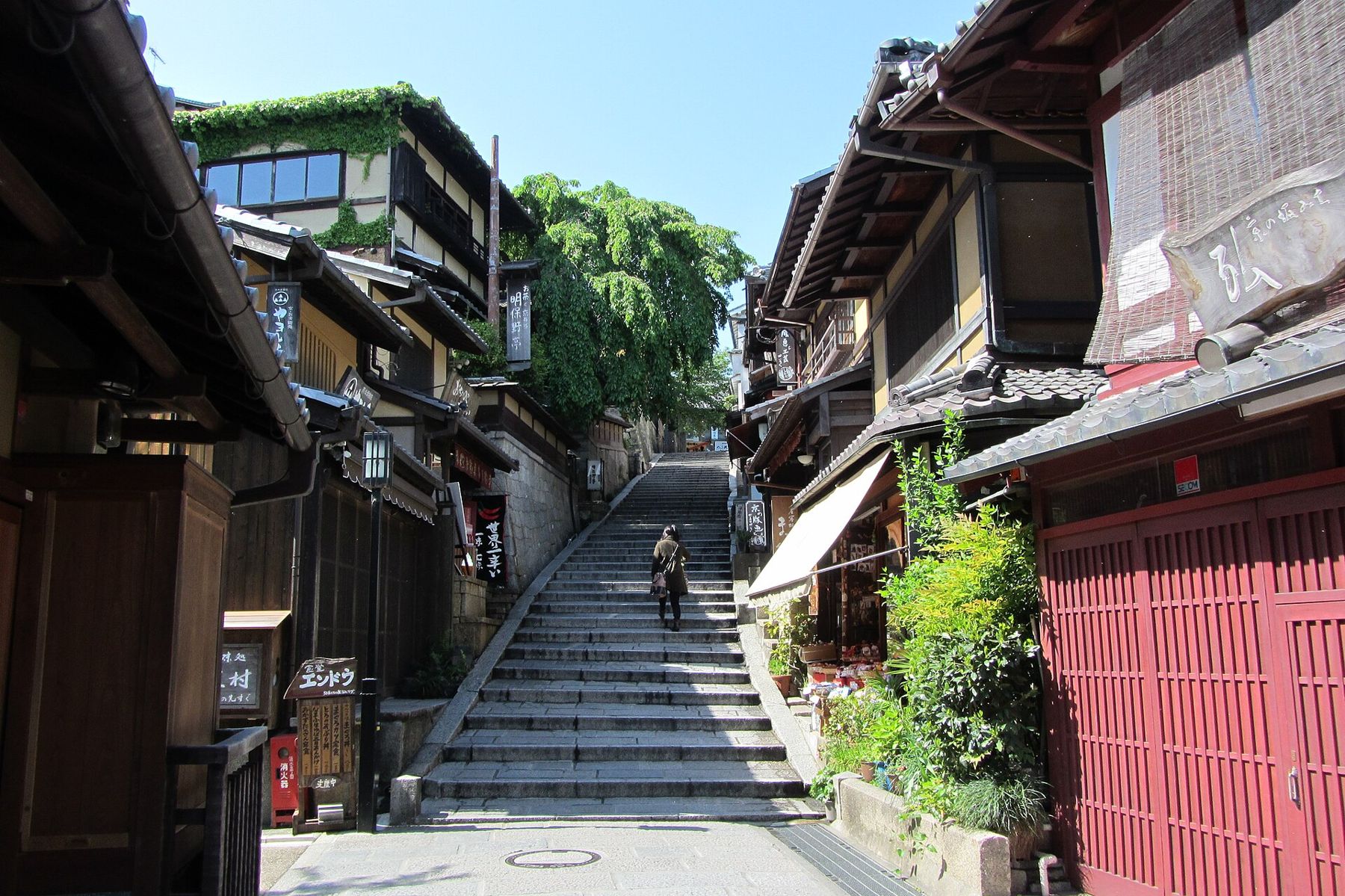
A well-known story says that if you trip on Sannenzaka, you will die within three years. Whatever the origin, the steps are uneven and crowded, so look where you are putting your feet.
The area is a protected historic district, and the rules on building heights, materials and signs explain why the street looks so consistent. Notice the low eaves, the bamboo screens and the small stone gutters running beside the steps. Early in the morning, before the shops open, the lane is close to what earlier visitors saw.
Walk on · At the foot of the steps, head downhill west towards the pagoda, 3 minutes.
Yasaka pagoda, Hōkan-ji
Look up the sloping street at the five-storey pagoda framed between the houses.
The Yasaka pagoda belongs to the temple of Hōkan-ji. A temple has stood on this spot since long before Kyoto became the capital, and tradition links its founding to Prince Shōtoku in the sixth century. The present five-storey pagoda was rebuilt in 1440 on the orders of the shogun Ashikaga Yoshinori after an earlier one burned.
At about 46 metres it is one of the most recognisable landmarks of eastern Kyoto, and the view of it at the top of this sloping street is one of the most photographed in the city. Stand to the side and keep the road clear: cars and taxis still use it.
Notice how each roof of the pagoda is a little smaller than the one below, and how the central spire on top carries rings of bronze. The whole structure is built around a central pillar that helps it ride out earthquakes.
 Change here for the Kyoto lineGion at dusk
Walk on · Back uphill and north into Ninenzaka, the next stepped lane, 3 minutes.
Ninenzaka
Look at the wooden fronts and paper lanterns lining the gently stepped lane.
Ninenzaka, the two-year slope, continues the line of Sannenzaka northwards. It is a little gentler, with shorter flights of steps and stone paving between the wooden houses. Together the two lanes form the core of the Sannenzaka preservation district.
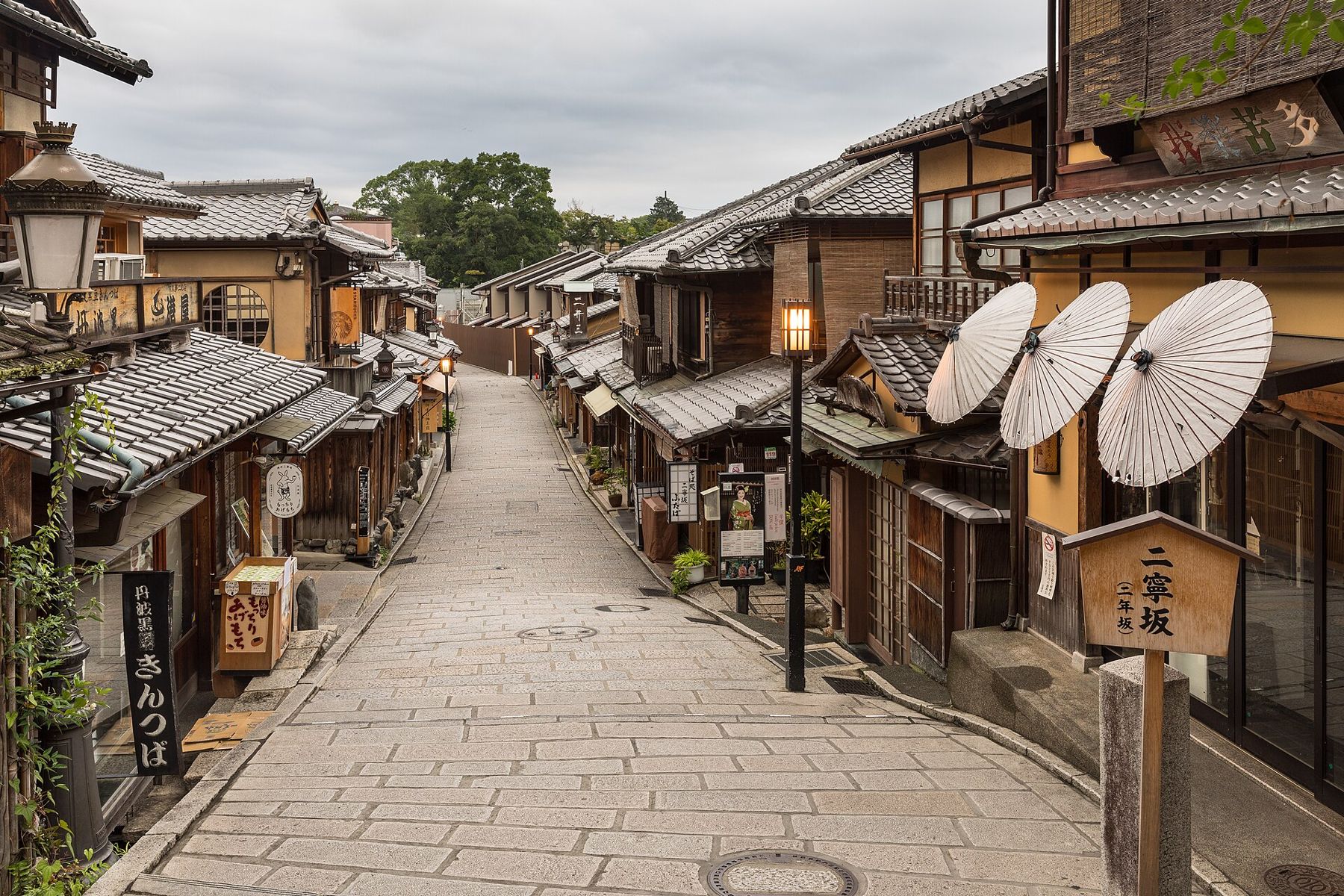
Many buildings here are traditional machiya, townhouses with narrow street fronts and deep plots behind, built close together. Their fronts use wooden lattices that let light and air in while keeping the inside private, and their low second floors are often explained by an old custom that townspeople should not look down on processions of their betters passing in the street.
Notice the small stones and planters at the door of each house, and the doorway curtains that signal whether a place is open. If you can, walk it twice: once in the crowd, once in the quiet of early morning.
Walk on · At the end of Ninenzaka, continue north along the wide paved lane to Kōdai-ji's steps, 5 minutes.
Kōdai-ji
Look up the long stone staircase to the temple gate on the hillside.
Kōdai-ji was founded in 1606 by Nene, the widow of Toyotomi Hideyoshi, the warlord who unified Japan in the late sixteenth century. She became a nun and built the temple in his memory, with support from Tokugawa Ieyasu. The lane at the foot of the steps is known as Nene-no-Michi, Nene's path.
Inside, the temple has Zen gardens of raked gravel, a pond garden and a mausoleum decorated with gold lacquer work so fine that the style is named after the temple. A covered corridor climbs the hillside between the buildings. Entry rules and times change.
Even from the lane, notice how the temple uses the slope: the main buildings sit high above the street, so that you have to climb towards them.
Walk on · Back down the steps; Ishibe-kōji opens off the west side of Nene-no-Michi, 3 minutes.
Ishibe-kōji
Look at the smooth stone paving and the high stone walls on either side.
Ishibe-kōji, the stone-wall lane, is a narrow, winding passage paved with flat stones and lined with walls, wooden gates and old inns. It bends as it goes, so you never see far along it, which is what gives it its quiet, enclosed feeling.
This is a residential lane, not an attraction. People live and work behind these walls. Walk through quietly, keep to the paving, and do not open gates, step into entrances or photograph people at their doors. Large groups and loud voices change the place for everyone who lives here.
Notice the details at ground level: the drainage channels, the clean-swept stones, the small bamboo fences protecting the base of the walls from splashing. In the evening, lanterns over the gates light the lane, but at any hour the best way to see it is slowly and in silence.
Walk on · Back to Nene-no-Michi and north into Maruyama Park, 6 minutes.
Maruyama Park
Look for the great weeping cherry tree in the open centre of the park.
Maruyama Park, opened in 1886, is Kyoto's oldest public park. It was created from temple land at the foot of the eastern hills, and it has ponds, streams, winding paths and many cherry trees. Its centrepiece is a huge weeping cherry, lit up at night during the blossom season, when the park becomes one of the busiest places in the city.
Look for the statue of two men in the park: Sakamoto Ryōma and Nakaoka Shintarō, two activists from the 1860s who worked to end the rule of the shoguns and were assassinated together in Kyoto in 1867.
At other times of year the park is calm, with benches beside the pond. Notice how the park rises gently towards the hills behind, which helps it feel larger than it is.
Walk on · West through the park to the back of Yasaka Shrine, 4 minutes.
Yasaka Shrine
Look up at the rows of paper lanterns hanging around the open dance stage.
Yasaka Shrine, often called Gion-san by locals, is one of Kyoto's most important Shinto shrines. Its kami is linked to protection from disease. In 869, during an epidemic, a ritual procession was organised to calm the gods, and that ceremony grew into the Gion Matsuri, the shrine's great summer festival, still held every July.
The open stage in the centre of the precinct is hung with hundreds of white lanterns, each carrying the name of a local business or donor. When they are lit in the evening, they glow over the whole courtyard.
Notice the main hall behind, whose single great roof covers both the inner sanctuary and the worship hall, a style particular to this shrine. Then walk out through the vermilion west gate at the top of Shijō-dōri. Standing on its steps, you look straight down the avenue into Gion.
Finishing at Yasaka Shrine
The walk ends at the west gate of Yasaka Shrine, on Shijō-dōri. Gion-Shijō station on the Keihan line is about ten minutes' walk west along the avenue, across the Kamo River, and buses stop at the Gion stop below the gate. Public toilets are available in Maruyama Park and at the larger temples. There are vending machines for drinks along the lanes, and water is easy to buy, but carry some in summer.
Crowds, steps and heat
The stone steps on Sannenzaka and Ninenzaka are uneven and become slippery in rain. The lanes are packed from mid-morning to late afternoon, especially in the cherry blossom and autumn leaf seasons, so an early start makes a real difference. Kyoto summers are hot and humid, and there is little shade in the lanes; the temple grounds and Maruyama Park are cooler. Eat and drink standing still rather than while walking, as local manners expect.
What to walk next
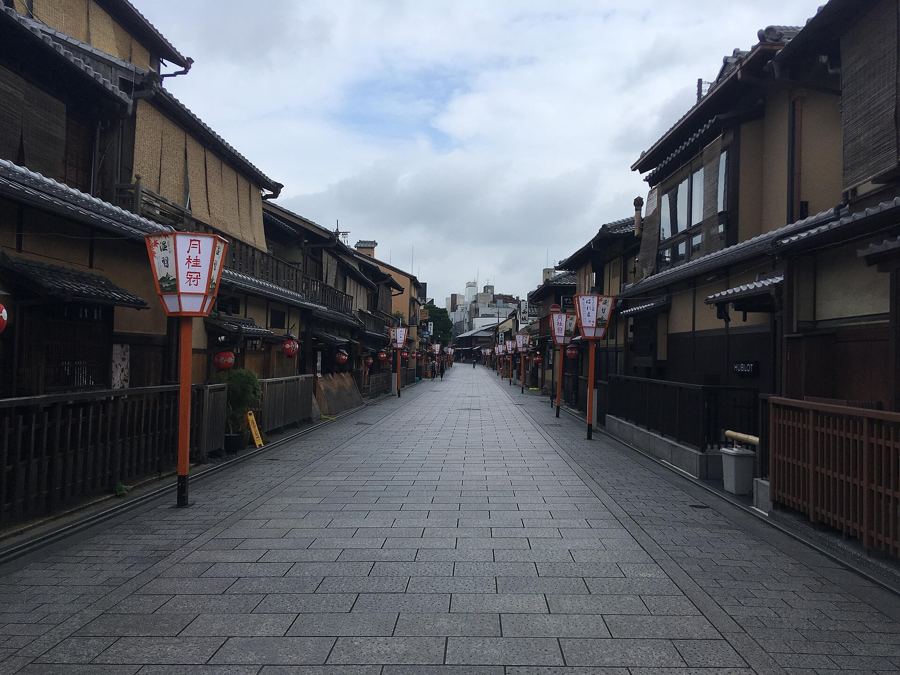
From the shrine gate it is only a few minutes into Gion, and the walk through Gion at dusk makes a natural evening continuation. Another day, take the canal path north on the Philosopher's Path to Nanzen-ji.