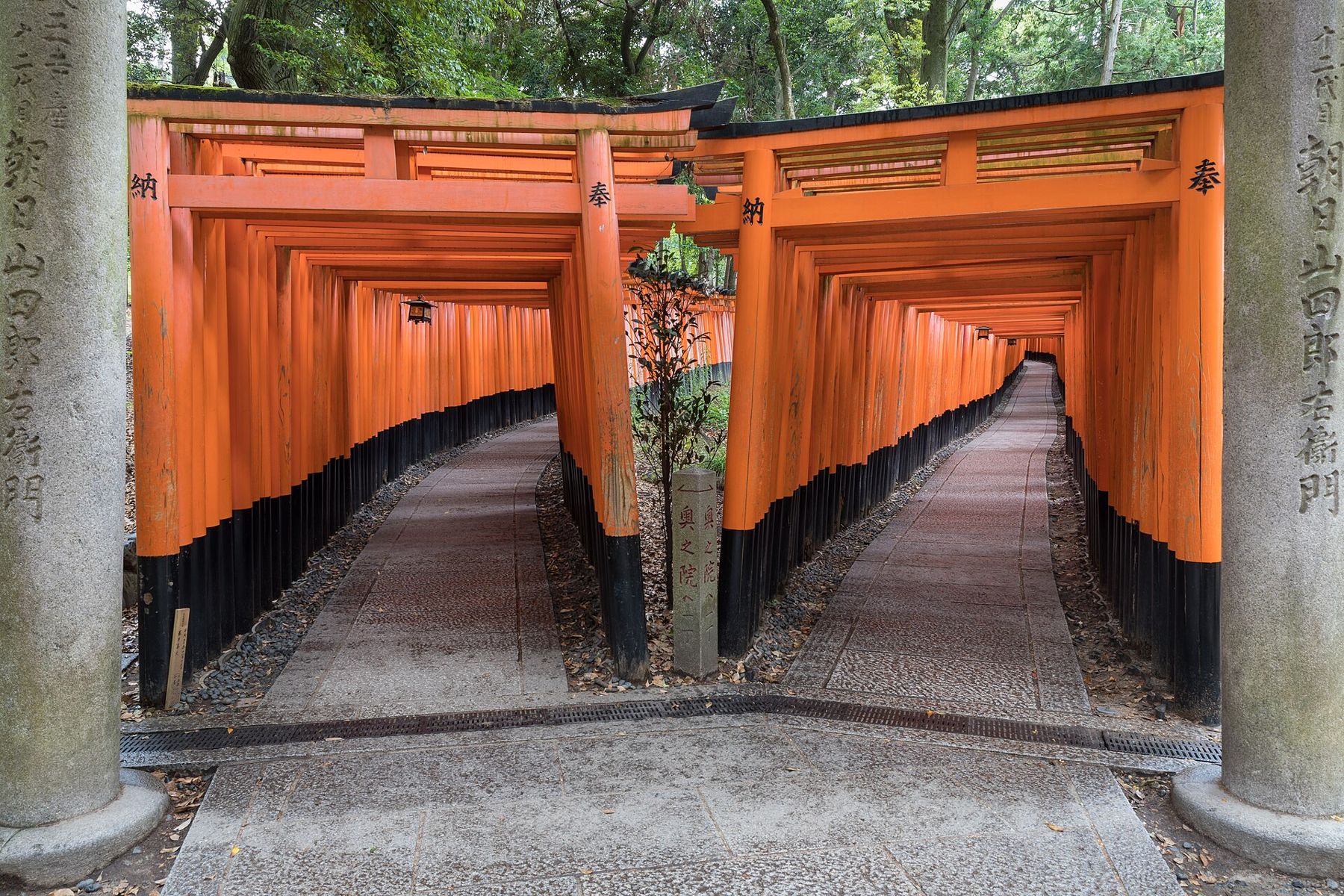
Fushimi Inari Taisha is the head shrine of the many thousands of Inari shrines across Japan, dedicated to the kami of rice, harvests and, by extension, business and prosperity. It covers the whole of Mount Inari, on the south-eastern edge of Kyoto, and its paths are lined with thousands of vermilion torii gates, each one a gift.
This walk climbs from the shrine's great gate and main hall through the famous double tunnel of the Senbon Torii, past the inner shrine and a pond of candles and echoes, up to the Yotsutsuji crossroads, with its view over the city. From there you can go on round the summit loop or come back down. The route as written, up and back, is about 3.6 kilometres and takes a little over two hours with stops, almost all of it on steps.
To reach the start, take the JR Nara line to Inari station, which faces the shrine's entrance across the road, or the Keihan line to Fushimi-Inari station, about five minutes' walk. The lower shrine is crowded from mid-morning; the higher you climb, the fewer people you meet. The paths are steep, so bring water and good shoes.
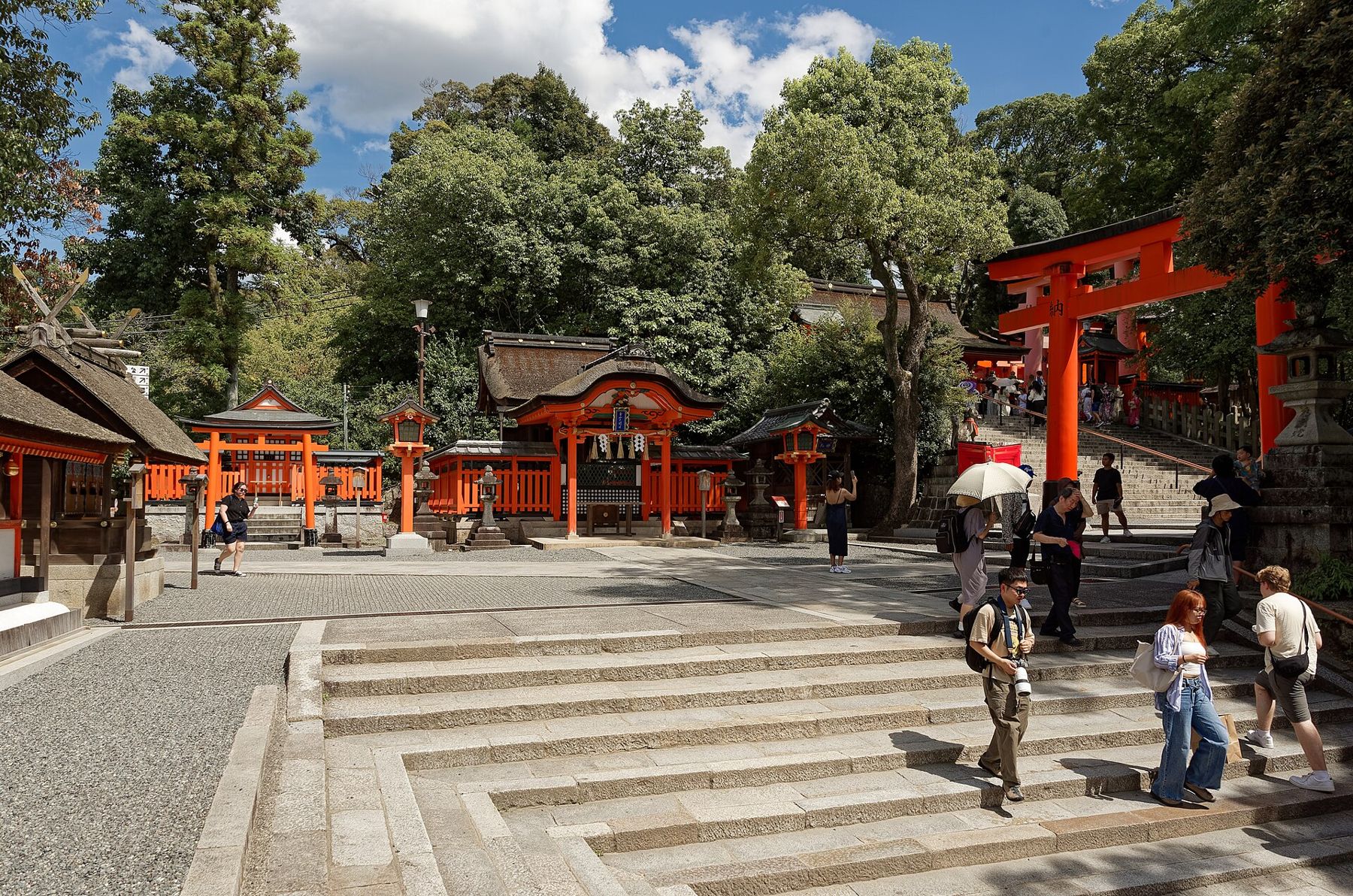
Rōmon gate
Look up at the vermilion two-storey gate, then at the stone foxes guarding it.
The great tower gate, the Rōmon, was donated in 1589 by Toyotomi Hideyoshi, the warlord who unified Japan, by tradition as thanks for his mother's recovery from illness. It is one of the largest gates of its kind at any shrine in Japan.
On either side stand stone foxes. At Inari shrines foxes are the messengers of the kami, not gods themselves. Look closely at what they hold in their mouths: often a key, said to be the key to the rice granary, or a jewel, a scroll or a sheaf of rice. Each fox is slightly different.
By tradition the shrine was founded in 711, centuries before Kyoto became the capital, by the Hata clan, who settled in this area. Notice how the vermilion colour, said to ward off evil and preserve the wood, runs through everything you are about to see.
Walk on · Through the gate and up the steps to the main hall, 2 minutes.
Honden, main hall
Look at the main hall's sweeping roof, curving far out over the front steps.
The main hall, the honden, was rebuilt in 1499 after the original buildings were destroyed in the Ōnin War, the civil war that devastated Kyoto in the late fifteenth century. Its long, gracefully curving roof extends out over the front to shelter worshippers.
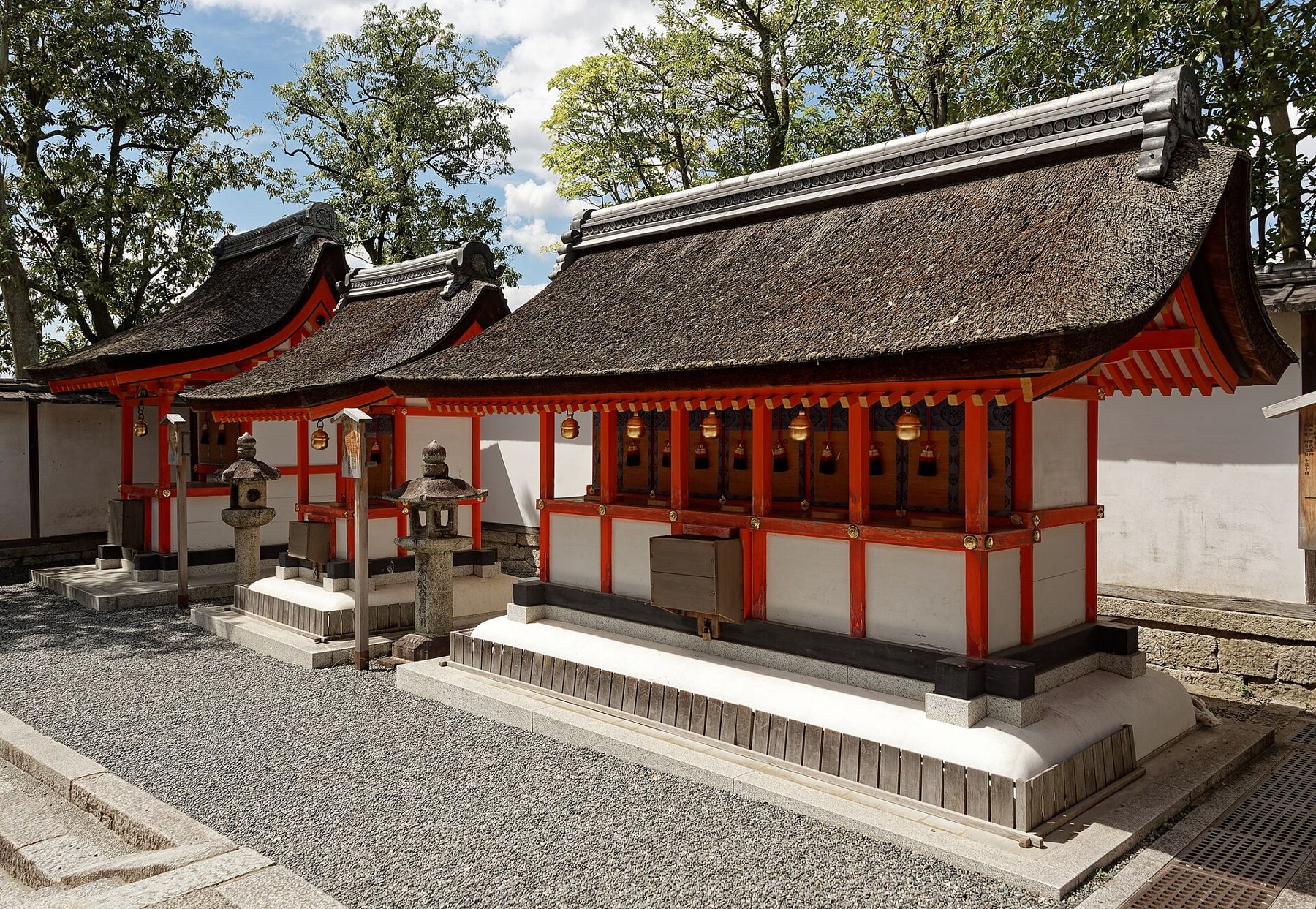
This is where most visitors make their prayers: a bow, a coin in the offering box, two more bows, two claps and a last bow. Around the main hall stand smaller shrines and halls dedicated to other kami.
Notice the wooden prayer plaques hung nearby. At most shrines they are rectangular, but here many are shaped like fox faces, and visitors draw the faces themselves. Some are serious, some comic, and they make an unusual portrait gallery of the people who came before you.
Walk on · Behind the main hall, up the steps signed for the Senbon Torii, 3 minutes.
Senbon Torii
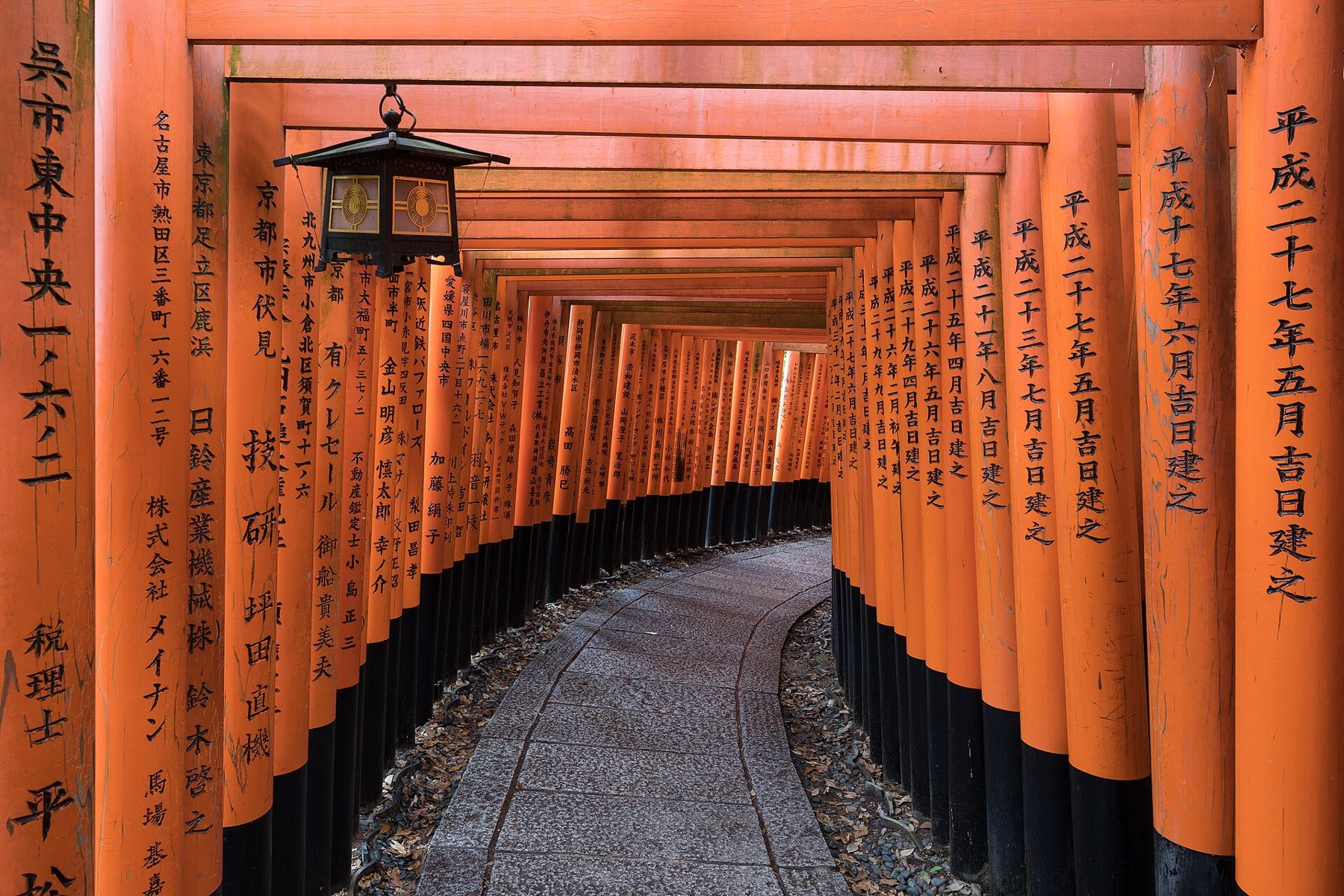
Look at the two parallel tunnels of gates splitting left and right.
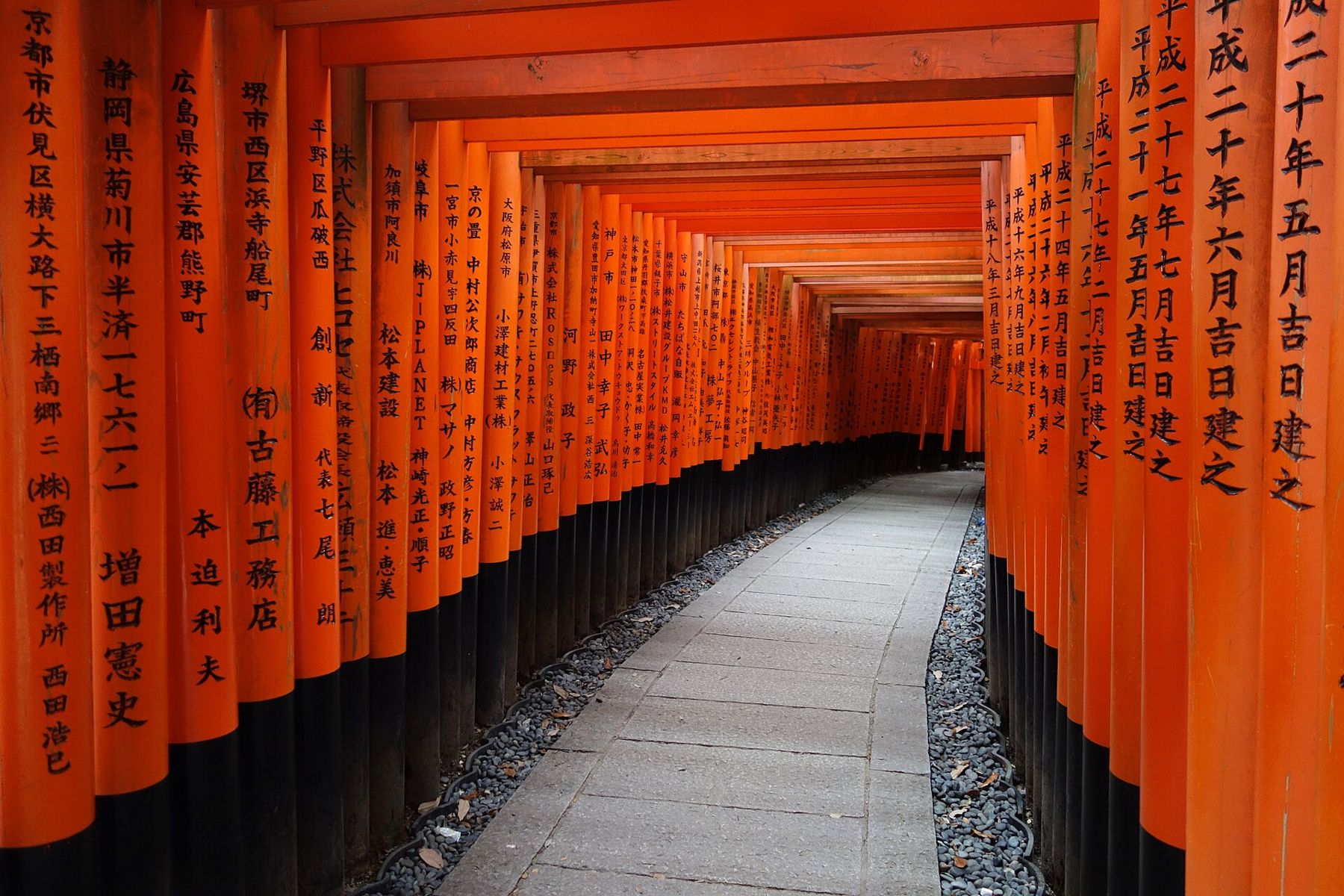
Senbon Torii means a thousand torii, and here the gates are set so close together that they form two parallel tunnels running up the hill. The usual way is to go up through the right-hand tunnel and come down through the left.
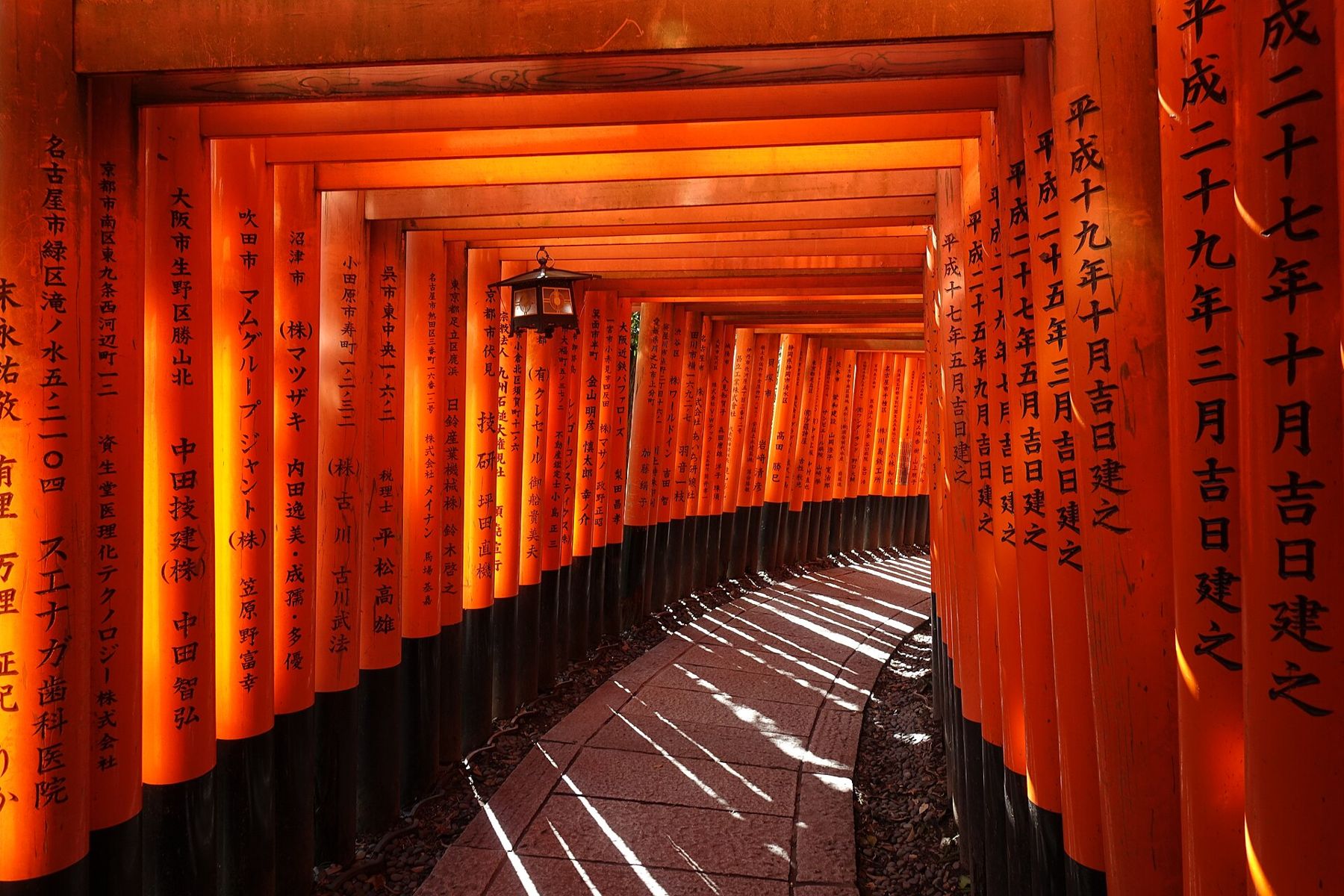
Every gate on the mountain has been donated, by a business, a family or an individual, as thanks or in hope of good fortune. The donor's name and the date are painted in black on each pillar, on the side that faces uphill, so you mostly see them as you come down. Gates are renewed as the wood weathers, which is why some are bright and some faded.
Notice the black bases of the pillars, painted to protect the wood from damp. Stop and step aside when you want a photograph; the tunnels are narrow and the people behind you are climbing too.
 Change here for the Kyoto lineArashiyama: bridge, temple, bamboo and river
Walk on · Up through the right-hand tunnel to the inner shrine's worship hall, 5 minutes.
Okusha Hōhaisho
Look for the pair of stone lanterns with round stone tops, the omokaru stones.
The Okusha Hōhaisho is the inner shrine's worship hall, a place to pray towards the mountain itself. Many visitors turn back here, which is why the crowds thin noticeably above this point.
Behind the hall stand a pair of stone lanterns with round stones on top, the omokaru-ishi, the light-or-heavy stones. Make a wish, then lift the stone. If it feels lighter than you expected, the wish is said to be likely to come true; if heavier, it may take more effort. Lift gently and put it back carefully.
From here the gate tunnels continue uphill in a long, single line. Notice how the path changes character: rougher stone steps, deeper forest, smaller groups of gates and, on either side, the beginnings of the stone altars that cover the upper mountain.
Walk on · Uphill through the gates to the pond and the Kumataka shrine, about 15 minutes.
Kumataka-sha and Shin-ike
Look at the candles glowing inside the shrine hall beside the pond.
The Shin-ike pond lies in a hollow of the mountain, and beside it stands the Kumataka shrine, a hall where candles burn in rows in front of the altars. It is a dim, quiet place compared with the busy gates below.
A local tradition says that if you are looking for someone who is missing, you should clap your hands by the pond; the direction from which the echo returns shows where to look for them.
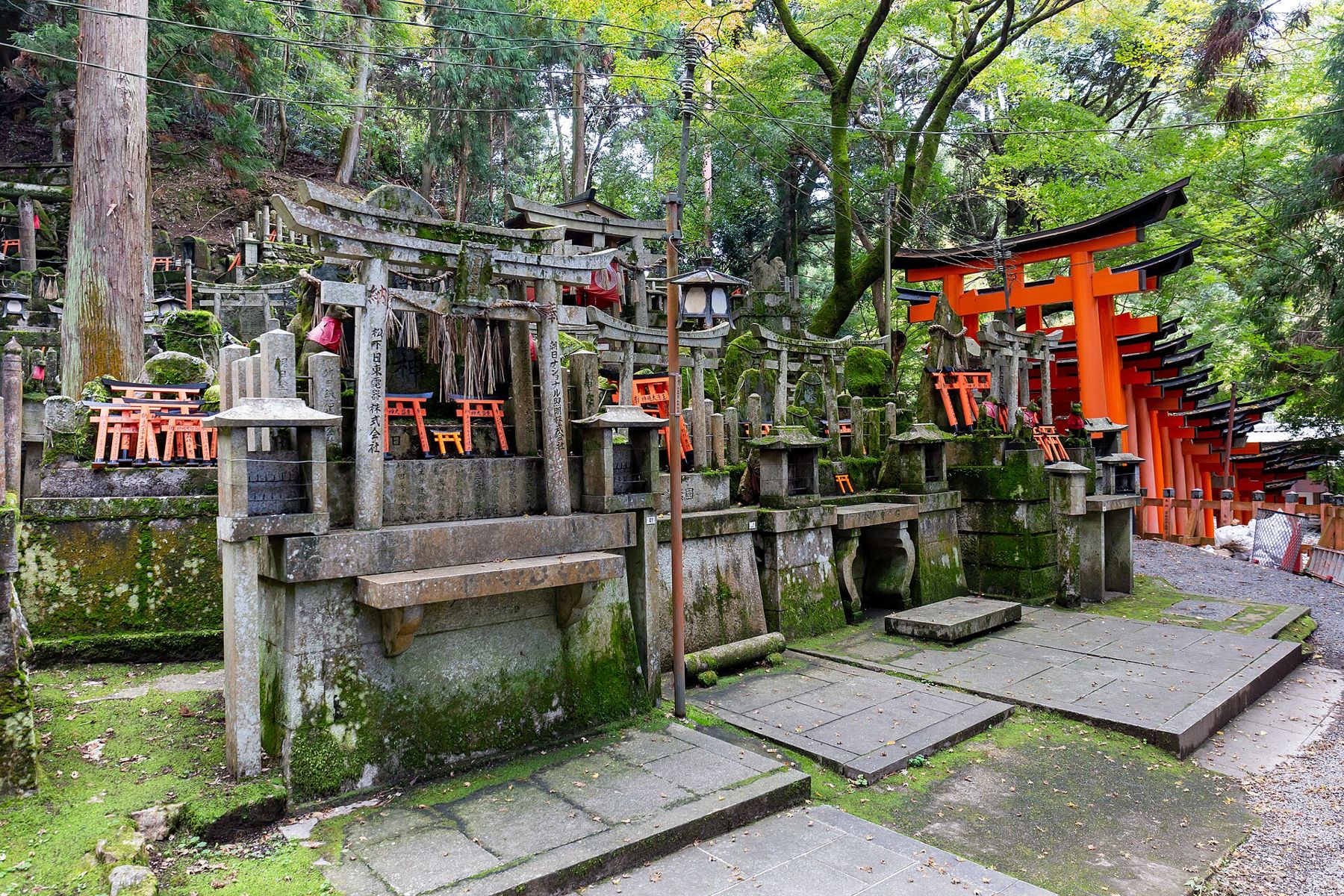
Around the pond and all over the mountain you will see clusters of stone altars, the otsuka, each carved with the name of a kami and set up by a family or group of worshippers, often surrounded by miniature torii. There are thousands of them. Notice that many are tended, with fresh offerings and small gates; this is a living place of worship, not a monument.
Walk on · Up the steps through the gates past the three-way junction to Yotsutsuji, about 15 minutes.
Yotsutsuji
Look west over the rooftops of southern Kyoto to the hills on the far side.
Yotsutsuji, the four-way crossroads, is a small level space on the shoulder of Mount Inari where the paths divide. It is roughly halfway to the summit, and its open side gives the best view on the mountain: west and north over the southern half of Kyoto, with the western hills beyond.
From here, the paths form a loop around the summit, which stands at 233 metres, passing more gates and altars and returning to this same crossroads. The loop adds a good extra half hour or more of steps. Many people find the view from Yotsutsuji the reward they came for and go back down.
Notice how few people there are compared with the Senbon Torii, and how the sounds of the city are replaced by birds and wind. Sit for a while before deciding which way to go.
The way back down
To come down, retrace your steps to the inner shrine and take the left-hand tunnel of the Senbon Torii, the way down, where the painted names on the gates now face you. If you have time and energy, first go round the summit loop from Yotsutsuji; it returns to the same crossroads. Either way you end back at the Rōmon gate, a minute from JR Inari station.
Water, toilets and safety
Bring water: the climb is steep, and the mountain is humid in summer. There are toilets at the main shrine and at several points on the mountain, and drinks are sold at intervals along the path. The steps are uneven and slippery when wet. The paths are lit only in places after dark, and the upper mountain is very dark at night, so climb in daylight and leave enough time to come down. Wild animals, including boar, live on the mountain; do not feed any of them.
What to walk next
Back in the city, the old lanes of Higashiyama, from Kiyomizu-dera down to Yasaka Shrine, are a short train or bus ride north. In the evening, finish the day with Gion at dusk.